


In February 2024, Mastercard flipped a switch that should unsettle every merchant still fighting disputes by hand. Its Decision Intelligence Pro system now scans one trillion data points per transaction in under 50 milliseconds, lifting fraud detection by an average of 20%, and by as much as 300% in some cases, per Mastercard.
That is the card network side of the table. On the merchant side, the average team still reviews disputes manually, assembles evidence in spreadsheets, and misses deadlines that never reopen.
That asymmetry is the whole story. The institutions issuing chargebacks have run AI at transaction scale for years. Most of the businesses absorbing them have not. AI in chargeback management and payment disputes is how you close that gap, and the smart version does it by connecting functions that teams treat as separate.
The timing is not accidental. As Generative AI in finance matures beyond customer-facing chat, dispute resolution is becoming a primary operations target, precisely because it is where measurable revenue leaks out every month. This article breaks down how AI helps merchants prevent chargebacks earlier, automate dispute workflows faster, and recover more revenue without adding more manual work.
Table of Contents
Key Takeaways
- Merchants are dealing with more friendly fraud, higher card-not-present volume, and rising dispute costs, while card networks already use AI at transaction scale.
- Manual workflows fail on three fronts: complex reason codes, tight response windows, and inconsistent evidence quality.
- The real value of AI is not one isolated feature. It links fraud detection, reason code classification, evidence compilation, pre-dispute alerts, and representment.
- When these processes share the same transaction data, teams can prevent more disputes, respond faster, and recover more revenue.
- AI can classify chargebacks by reason code, pull the right data from connected systems, and generate structured evidence packages.
- This makes representment more consistent, especially when evidence must match specific card network rules.
- AI-powered fraud scoring and pre-dispute alert handling help stop some cases before they become formal chargebacks.
- That protects both revenue and the chargeback ratio, which affects processing terms and monitoring risk.
- Off-the-shelf tools may work when payment data is simple, but enterprises often need deeper connections to CRMs, ERPs, shipping systems, support logs, and custom payment infrastructure.
- The best AI setup should reflect each company’s data, vertical, reason code patterns, and chargeback risk thresholds.
Chargebacks Are Getting More Expensive, and More Automated on the Other Side
Three forces are pushing dispute costs up at the same time, and each one rewards the side with better technology.

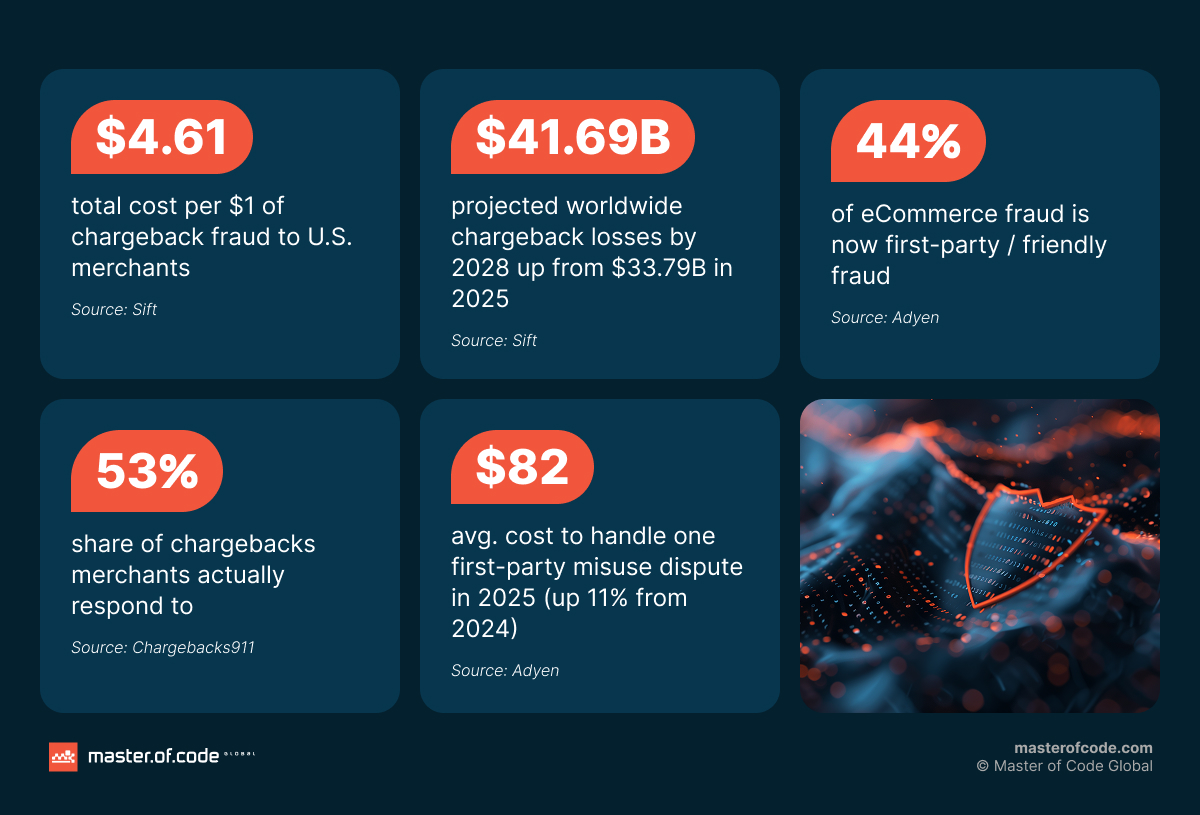
The first is the normalization of friendly fraud. First-party fraud, where a customer makes a legitimate purchase and then disputes it anyway, is now the most commonly reported type of eCommerce fraud at 44% of incidents, according to Adyen’s Fraud’s Identity Crisis study. It has moved from an edge case to a default consumer tactic.
The second is sheer volume. Card-not-present payments now make up 63% of merchant transactions, per Sift’s Digital Trust Index, and dispute volume tracks that growth closely.
The third is rising per-dispute cost. The cost of handling a single first-party misuse dispute climbed to $82 in 2025, up 11% from $74 the year before. Multiply that by your monthly dispute count, and the operating line item gets uncomfortable fast.
Then there is the pressure point underneath all of it: your chargeback ratio. Cross a card network monitoring threshold, and you do not just lose individual disputes. You enter programs that bring fines and restricted processing terms. So this was never only about winning cases one at a time. It is about the ratio that decides whether you keep favorable terms at all.
Why Manual Dispute Management Breaks at Volume
The failure here is operational, not just financial. Three specific things give out when dispute volume climbs.
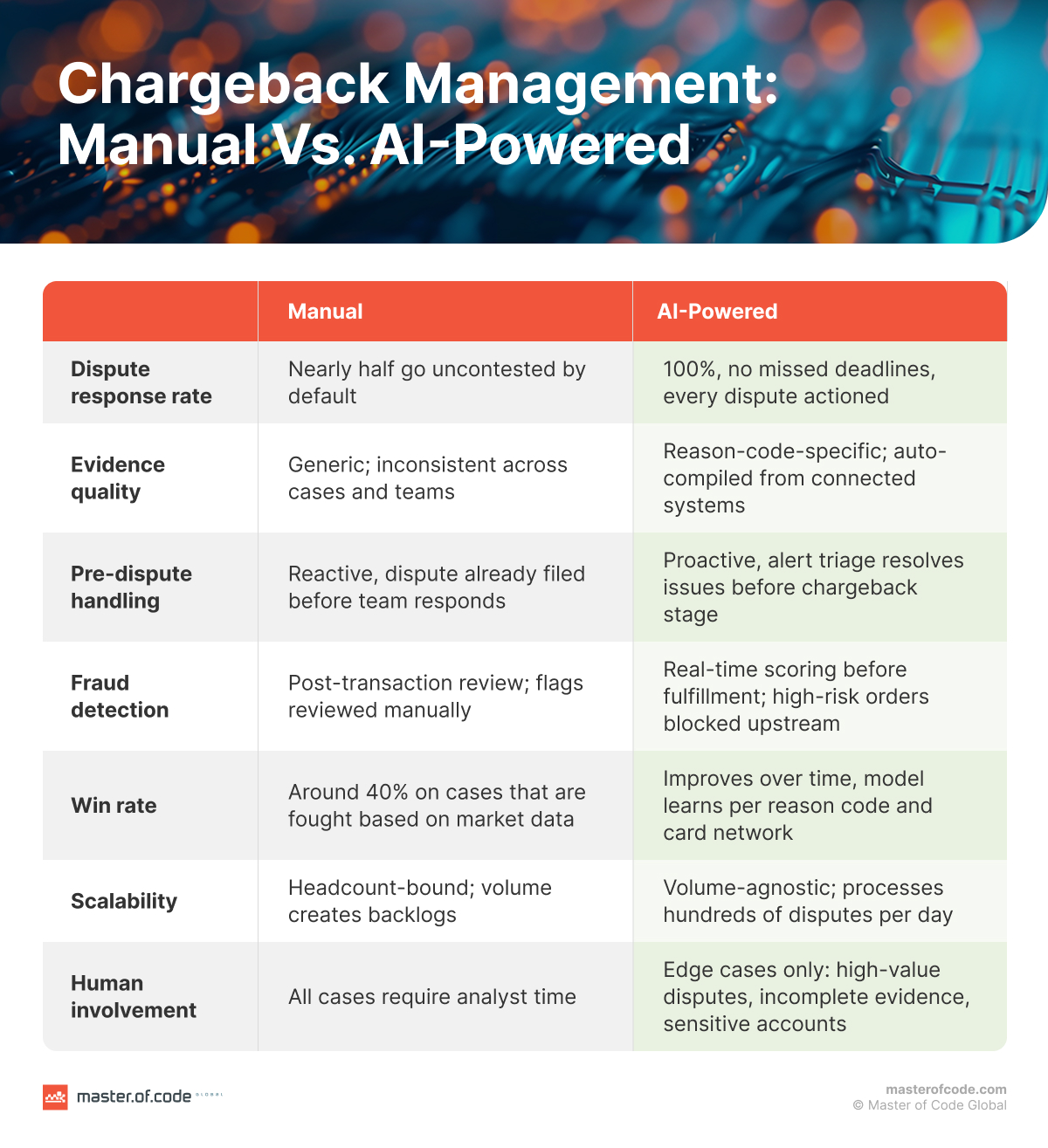
Reason code complexity outpaces any team. Visa and Mastercard each maintain dozens of reason codes, and American Express and Discover layer on their own frameworks. Every code carries different evidence requirements, deadlines, and rules. A human team handling mixed-network volume hits a knowledge ceiling quickly, and the rules keep moving. Visa’s VAMP consolidation, effective April 1, 2025, folded multiple fraud and dispute programs into a single monitoring framework and reshaped thresholds across the industry.
Response windows close while the work piles up. Dispute response windows typically run 30 to 45 days, depending on the card network and reason code. At volume, manual processes generate missed deadlines, and a missed deadline permanently closes the recovery window. The pressure is not theoretical: dispute rates rose 78% year over year in Q3 2024, per Sift’s Digital Trust Index.
Evidence quality drifts case by case. Without structured, data-driven compilation, response packages vary in what they contain and how they frame it. That matters because the merchant rarely gets a second chance to settle things directly. Fully 53% of cardholders dispute a transaction with their bank without ever contacting the retailer first, according to Chargebacks911’s Chargeback Field Report. When your only move is the evidence package, a generic submission that meets the minimum loses to a structured, reason-code-specific one almost every time.
How AI Handles the Full Chargeback Lifecycle
The value of AI in chargeback management and payment disputes does not live in any single function. It lives in the fact that fraud detection, evidence compilation, pre-dispute alert resolution, and representment stop being four separate workflows run by different systems and different teams. In a well-built system, they share the same transaction data and feed each other, which is what turns dispute resolution from a reactive chore into a managed process.
Fraud Detection and Transaction Scoring
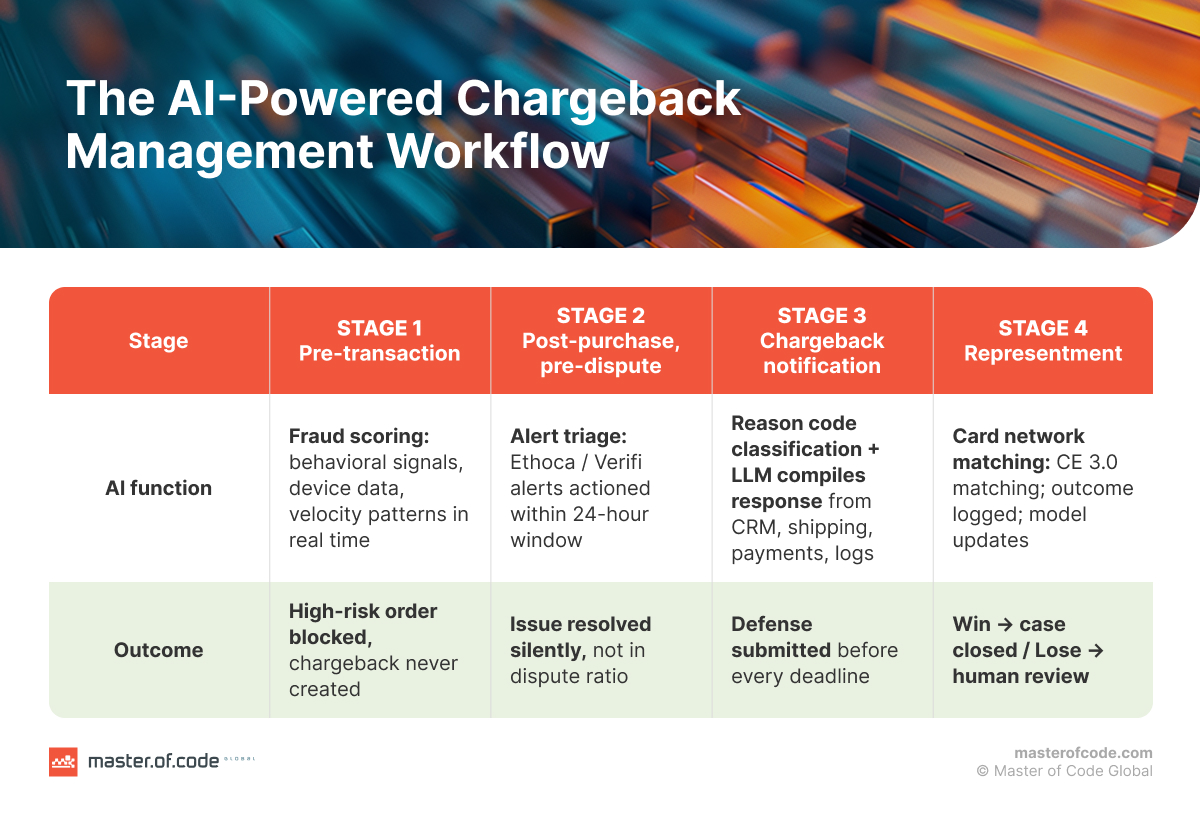
AI scores transactions in real time using behavioral signals, device data, velocity patterns, and historical cardholder activity, all before a dispute is ever filed. The goal at this stage is not only to catch true fraud. It is to remove the upstream conditions that create chargebacks in the first place. Businesses can further improve chargeback fraud prevention by combining AI-driven risk scoring with advanced fraud detection strategies that identify suspicious transactions before they result in payment disputes. A high-risk transaction blocked or flagged before fulfillment never becomes a dispute.
A well-designed AI fraud detection service is built to balance prevention against false declines, a real cost that rigid rules-based systems create by over-blocking good customers. The market has clearly moved this way: 80% of organizations now use AI or machine learning for fraud prevention, and roughly 80% say it has already helped them stop attacks, per Veriff’s Fraud Industry Pulse Survey. For enterprises already exploring Generative AI for fraud detection, the same behavioral signals that feed scoring also inform dispute triage downstream.
Reason Code Classification and Evidence Compilation
When a chargeback notification lands, AI classifies the dispute by reason code and instantly determines the evidence threshold required, with no human reading the notice and looking up the rules. The bigger lift comes from evidence compilation itself. LLM-powered systems generate dispute response packages tailored to the specific reason code, pulling device fingerprints, IP addresses, shipping confirmations, communication logs, and customer history from connected systems.
This is where Generative AI delivers direct, measurable value: structured evidence generation that replaces a manual writing and assembly job. The detection layer pays off here, too. Mastercard’s Decision Intelligence Pro boosts fraud detection on average by 20%, and up to 300% in specific cases, per Mastercard. The same transaction data that powers the detection feeds the evidence compilation that follows. Detection and defense draw from one well, not two.
Pre-Dispute Alerts and Prevention
Pre-dispute alert programs notify you when a cardholder contacts their issuer, before a formal chargeback is ever filed. AI processes these alerts inside the required response window, typically 24 hours, and routes each one: an automatic refund for clear cases, escalation to a person for genuine edge cases, and a rejection with logged rationale for likely friendly fraud.
The outcome is a dispute that never enters the formal chargeback workflow and never touches your dispute ratio. AI is what makes that alert volume actionable. Without it, the window closes before a manual team can act, and the alert becomes just another chargeback.
Representment and Win Rate Optimization
When a dispute reaches the formal chargeback stage, an AI-driven algorithm submits a structured defense before the deadline, with evidence matched to the card network’s specific requirements. Take Visa disputes under reason code 10.4, the code most often tied to first-party fraud. Visa’s Compelling Evidence 3.0 gives merchants a structured path to reverse or block friendly fraud, but only if historical transaction data is accessible and correctly matched. AI makes that matching automatic.
The compounding effect is what moves your win rate. You get a 100% response rate on represented disputes, plus evidence quality that improves over time as the system learns which evidence types correlate with wins per reason code and per network. The payoff shows up in the data: merchants using representment software and services through a platform saw net recovery rates more than 55% higher than those managing the process internally, per Chargebacks911’s Field Report. Building this capability means connecting representment logic to the same data layer that underpins Generative AI for payments.
Human-in-the-Loop: A Design Decision, Not a Hedge
Most chargeback AI pitches treat human oversight as a selling point, the quiet implication being that AI on its own is risky. That framing gets it backward. Human-in-the-loop is an intentional architectural decision with specific trigger logic, not a fallback for when the model gets confused.
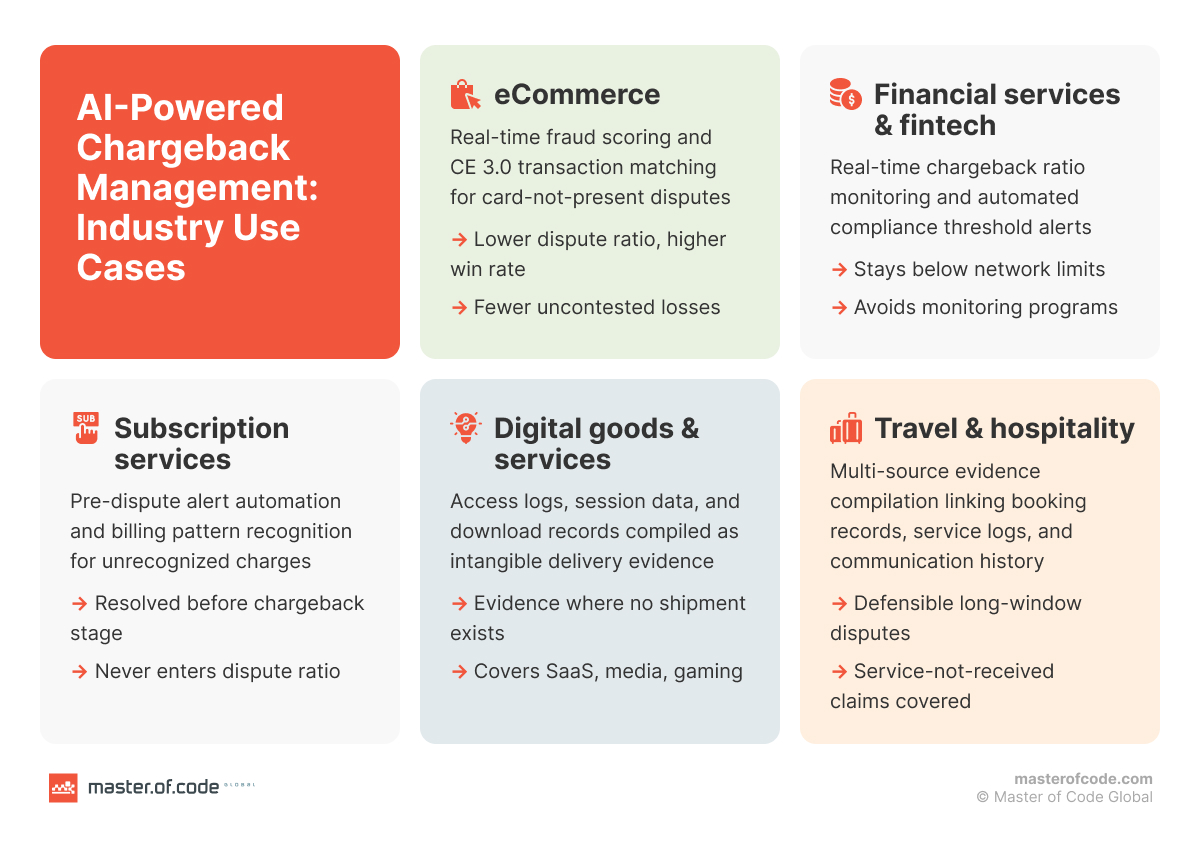
In a well-designed system, human review fires on a defined set of conditions: disputes above a set value threshold, cases where the evidence set is incomplete or contradictory, novel fraud patterns outside the model’s training distribution, and commercially sensitive customer relationships where an automated rejection could do reputational damage. Everything else routes through automation.
The real design question is where to set the escalation thresholds.
- Set them too high, and you get a rubber-stamp review that adds latency without adding judgment.
- Set them too low, and you automate away the very cases that need nuance.
This calibration is iterative. It runs on outcome data, not on upfront guesses, and for enterprises operating across markets, the logic may need to differ by geography, merchant category code, and card network. Designing that escalation logic sits at the core of AI agent development for payments and dispute workflows, a point our team worked through directly while levelling up a payment refund chatbot.
For a major food delivery platform, we enhanced an existing refund chatbot with stronger fraud prevention logic, real-time integrations, and a unified agent workspace. The system helped flag suspicious refund patterns, block repeat offenders, and route complex cases to live agents when automation was not enough. It also connected CRM, loyalty, order management, maps, and other internal tools into one workspace, reducing the need for agents to switch between systems. As a result, the reimagined refund flow helped generate $11M+ in refund cost savings while giving support teams a single interface for handling refund cases.
What Enterprises Should Consider Before Building AI for Chargeback Management
If chargebacks are a material revenue risk for your business, three factors deserve a hard look before you build or buy.
Integration depth determines evidence quality. Off-the-shelf tools work fine when transaction data lives in a standard payment processor. Enterprises with multiple acquirers, custom ERPs, or proprietary CRM data often discover that generic tools cannot reach the evidence set that would actually win the dispute. Custom AI connects to the specific systems holding that data, which is also where dispute resolution and payment reconciliation start to share the same source of truth.
Industry-specific reason code patterns matter. Reason code distributions differ sharply by vertical. Travel merchants face long fulfillment windows and service-not-received claims, while subscription businesses deal mostly with friendly fraud and unrecognized billing. A model tuned for general eCommerce will underperform in a specialized vertical, so custom training data and custom escalation logic earn their keep here.
Chargeback ratio monitoring has to be a real-time feed. Enterprises near a card network threshold need their dispute system to surface ratio data continuously, not at the end of a period. That is a custom integration requirement. For organizations mapping this evaluation, AI in financial services consulting helps analyze the current dispute workflow, identify data limitations and operational risks, and define the best approach for reducing chargeback exposure.
Wrapping Up
AI in chargeback management works for one reason: it connects what manual processes keep apart. Detection feeds evidence. Evidence feeds representment. Prevention quietly shrinks the volume that ever reaches a formal dispute. That compounding effect across the lifecycle is what closes the cost gap that the card networks opened years ago.
The architecture matters as much as the technology. The enterprises running these systems most effectively did not bolt a generic tool onto existing infrastructure. They built around their own data, their own verticals, and their own thresholds.
If you are managing dispute losses at scale, watching your chargeback ratio creep toward a monitoring threshold, or trying to recover revenue without growing headcount to match, the path forward is a system shaped to your data, not a product dropped on top of it. Contact us, and we will help you map where custom AI fits your dispute operation, and start preventing the disputes you have been fighting.
Discover how Master of Code Global can help enhance your customer’s experience and boost sales growth.