



At Master of Code Global, our C-level team has observed firsthand—from industry events like Enterprise Connect to ongoing conversations with enterprise clients—that 2026 is shaping up to be the year of AI agents.
While some organizations are fully deploying agentic artificial intelligence, many are still in early exploration, running pilots or focused PoCs.
To help bring clarity to this emerging space, we analyzed over 10 leading research reports—including observations from PwC, EY, IBM, SailPoint, and others—and compiled the most relevant AI agents statistics. This article distills those findings to offer a grounded snapshot of where the market really stands. We’ve also included early insights from our in-progress Definitive 2025 Report on AI Adoption in Fintech.
If you’re planning the next step for this technology in your organization, this breakdown can help you assess the right timing, priorities, and opportunities. Let’s take a closer look at the numbers.

Table of Contents
Inside the AI Agents Market: Size, Growth & Future Outlook
Let’s start with a quick definition.
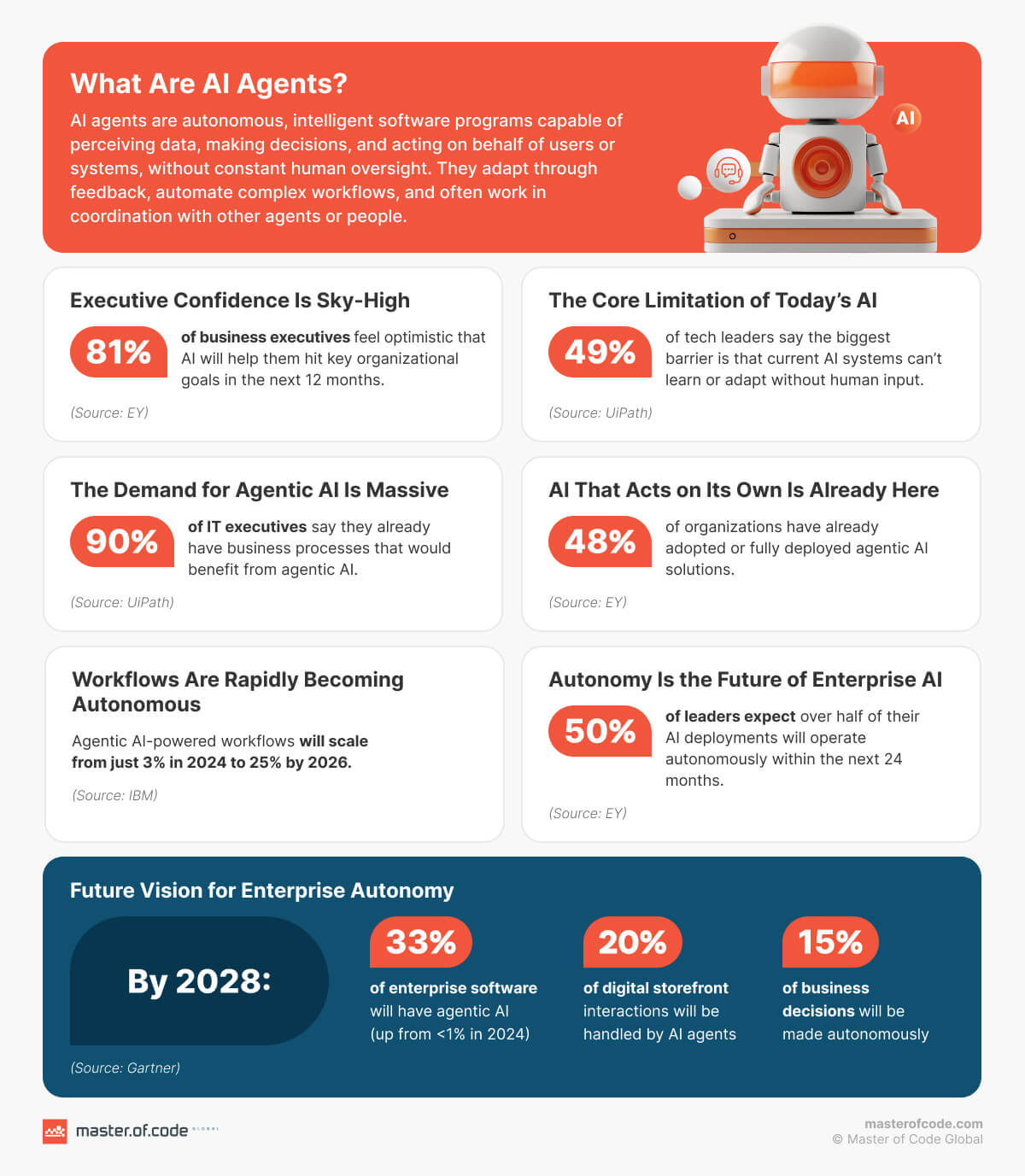
AI agents—also known as agentic or autonomous systems—are intelligent programs capable of making decisions, performing tasks, and adapting to new data with minimal human input. They’re quickly evolving from single-task bots to digital “co-workers” that manage complex workflows, orchestrate multiple tools, and drive real business outcomes.
Our CEO, Dmytro Hrytsenko, visited the World Economic Forum in Davos, and agentic artificial intelligence was the hot topic. Global leaders and innovators all echoed one prediction: 2026 is poised to mark the mainstream arrival of this technology. It’s also a breakout moment for the “Do It For Me” economy, especially in sectors like finance, supply chain, and customer support.
While governments and global organizations are looking for ways to safely regulate AI, and corporations are just starting their transformations, small teams are innovating at neck-breaking speeds—redefining the landscape every few weeks. The world is becoming a playground for AI agents, integrating into every part of life.
Current Market Overview
The latest AI agents statistics confirm the surge in tech interest and deployment, driven by enterprise adoption of LLM-powered automation and real-time task delegation.
| Metric | Value |
|---|---|
| Market Size in 2024 | USD 5.43 billion |
| Forecast for 2025 | USD 7.92 billion |
| Market Growth Rate (2025–2034) | CAGR of 45.82% |
| Dominated Region | North America |
| Fastest Growing Market | Asia Pacific |
Globally, generative technology is expected to contribute $2.6 trillion to $4.4 trillion annually to the world’s GDP by 2030 across multiple industries.
Market Growth & Forecast
The projected expansion of the artificial intelligence agents market is dramatic, with annual growth expected to more than triple in just five years. Here’s how the sector is predicted to evolve:
| 2025 | 2026 | 2027 | 2028 | 2029 | 2030 | 2031 | 2032 | 2033 | 2034 |
|---|---|---|---|---|---|---|---|---|---|
| 7.92 | 11.55 | 16.84 | 24.55 | 35.80 | 52.20 | 76.12 | 111.00 | 161.87 | 236.03 |
Market Size in USD Billions
At this pace, the market is foreseen to double nearly every two years. The steep climb reflects how this tech is scaling from back-office automation to front-line, decision-making roles across industries, pushing agents from experimental tools to essential digital infrastructure.
Regional Breakdown
| North America | Europe | Asia Pacific | Latin America | Middle East & Africa |
|---|---|---|---|---|
| 41% | 27% | 19% | 8% | 4% |
Regional Market Share Distribution
North America captures the largest share of the market, bolstered by high enterprise readiness and major investments from tech giants and VCs. Europe follows, with strong momentum in regulated industries like banking and insurance.
While Asia Pacific holds a smaller share today, its government-backed intelligentization strategies and cloud infrastructure growth suggest it will outpace other regions in implementation speed through 2030.
AI Agent Adoption Statistics 2026: Consumer Interest Meets Enterprise Investment
As this technology matures, the gap between enterprise readiness and client comfort is rapidly closing.
Consumer Adoption Trends
- 44% of U.S. customers would use an AI agent as a personal assistant; interest rises to 70% among Gen Z.
- 39% are already comfortable with such solutions scheduling appointments; 34% choose artificial intelligence to avoid repeating themselves.
- 24% count on the tech to handle shopping tasks; 36% favor automated purchases over human communication.
- 70% rely on agents to manage loyalty points, while 66% would use them for price-drop buys.
- 44% of Americans utilize such tools for job searches; 45% would get help crafting resumes and cover letters.
- 43% are interested in smart apps for meal planning and fitness goal-setting; over 60% of Gen Z are already on board.
- 67% of consumers trust human-like AI; 68% prefer interacting with artificial intelligence that feels more personal. 37% feel confident about such systems generating personalized content tailored to their preferences.
- Trust in AI agents is highest among Millennials (72%), followed by Gen X (68%), Gen Z (64%), and Boomers (60%)
- By 2028, 68% of customer interactions with vendors are expected to be handled by autonomous tools.
- 92% of companies say support and service are now more important than ever due to growing IT complexity.
- 93% believe artificial intelligence will deliver more individualized, proactive, and predictive experiences.
- 89% of clients emphasize combining human connection with machine intelligence efficiency to optimize service.

AI Agents for Enterprises
These tools become a strategic priority for leaders seeking efficiency, agility, and scale. From marketing to operations and customer service, businesses across sectors are adopting enterprise AI agent solutions to automate complex workflows, enhance decision-making, and boost returns.
According to McKinsey, companies that implement such technologies report a revenue increase ranging between 3% and 15%, along with a 10% to 20% boost in sales ROI. Some have also slashed marketing costs up to 37% in cost reductions, significantly optimizing their operational spend.
As per the LangChain State of AI Agents report, based on a survey of over 1,300 professionals:
Acceptance & Deployment Trends
- 51% of respondents share that they already have these systems running in production environments.
- 78% of all organizations surveyed are currently planning to move agents into deployment soon.
More recent LangChain research shows that production adoption continues to rise. In 2026, 57.3% of surveyed professionals reported having AI agents in production, compared with 51% in the previous survey. Another 30.4% were actively developing agents with concrete deployment plans. Large enterprises are moving fastest: 67% of organizations with more than 10,000 employees already operate agents in production. The results suggest that enterprise attention is shifting from whether to deploy agents toward making them reliable and scalable.
Top Use Cases
Respondents cited the following as their primary applications:
- 58% – research tasks and summarizing large volumes of information.
- 53.5% – improving personal productivity, such as workflow automation or digital assistance.
- 45.8% – customer service, including triaging tickets, resolving issues, and accelerating response times.
- 35.5% – code generation.
- 33.8% – data transformation and enrichment tasks.
A recent UiPath 2025 Agentic AI Report, surveying 252 US IT executives, reveals:
- 93% of them express strong interest in this technology, whereas 32% plan to invest in it within the next six months.
- 90% believe agentic automation could enhance current business processes.
- 87% say it’s critical that the tech integrates smoothly with other intelligent tools.
What Drives This Technology Appeal
Most desirable outcomes C-level specialists expect:
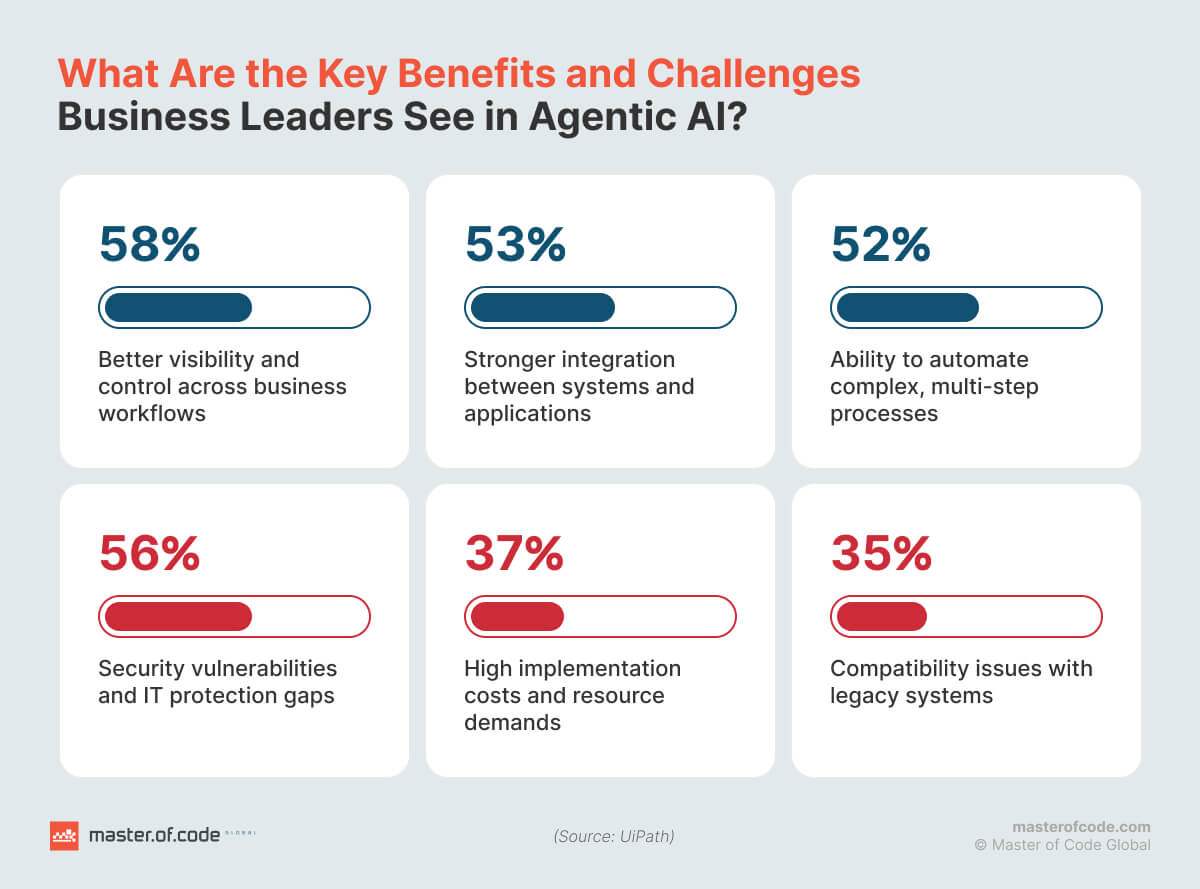
- 58% better visibility into workflows.
- 53% tighter application integration.
- 52% automating complex operations end-to-end.
- 51% improved responsiveness to customer needs.
- 48% enhancing employee reply speed.
- 47% reduction in IT support dependencies.
- 41% minimizing the need for constant human input.
- 39% offloading operational burdens through autonomy.
Core capabilities that matter most:
- 55% increased automation power.
- 53% better problem-solving.
- 53% higher accuracy and fewer errors.
Top Benefits Reported
- 72% operational efficiency and productivity gains.
- 69% elevated precision and error mitigation.
- 65% better decision-making.
- 58% faster innovation and business transformation.
- 52% upgraded customer service and overall CX.
- 52% cost reductions.
- 49% higher employee satisfaction.
A separate IBM CEO study found that 61% of surveyed CEOs were adopting AI agents and preparing to scale them.
Drawn from a survey of 2,500 executives, the IBM report finds:
ROI & Business Performance
- Scaled intelligentization projects now deliver a modest 7% return on investment, reflecting a shift from the initial pilot hype to more sustainable returns.
- AI-enabled workflows have tripled in profit contribution, improving operating profit by 2.4% in 2022, 3.6% in 2023, and 7.7% in 2024.
- Top-performing organizations achieve up to 18% ROI from their efforts, well above typical cost-of-capital thresholds.
Agentic Artificial Intelligence Readiness & Executive Expectations
- 70% of business leaders say this technology is both strategically vital and market-ready.
- 76% are actively pushing for hands-on experimentation.
- 83% expect AI agents to outperform humans in repetitive, rule-based tasks.
- Another 83% believe process re-engineering efforts will be more successful thanks to these solutions.
- 71% anticipate that such systems will self-adapt to changing workflows and business conditions.
- Intelligence-infused processes are on track to grow to 25% in 2026—an 8x increase in just two years.
EY’s Technology Pulse Poll, based on responses from more than 500 US technology leaders, indicates:
- 48% of these specialists report that they are already adopting or fully deploying agentic technology within their organizations.
- 50% expect that more than half of their intelligent deployments will become autonomous over the next 24 months.
- 81% express optimism about AI’s ability to help them meet organizational goals in the coming year.
- 92% plan to expand their funding in the next 12 months—a 10-point jump compared to March 2024.
- 58% believe their companies are ahead of the curve in terms of investment.
- Among those planning to increase budgets, 43% state that over half of their present spending is dedicated to agentic technologies.
- 69% mention staying competitive as a key motivator for its usage. 59% say the technology is being used to enhance customer-facing operations. Another 59% indicate internal strategic use cases as a primary reason for integration.
- Enterprises are focusing almost equally on upskilling current employees (70%) and hiring AI-literate talent (68%) to support rollouts. As a result of artificial intelligence implementation, 84% of tech leaders anticipate expanding their workforce in the next six months.
Based on the key insights from The State of AI Agents in Enterprise by Lyzr:
- 62% of businesses exploring these solutions lack a clear starting point.
- At the same time, 41% still treat them as a side project. And 32% stall after pilot, never reaching production. To bridge this gap and prevent organizations from getting stuck in “pilot purgatory,” Master of Code Global has structured its proprietary AI Pilot Program. Designed to provide a clear starting point, the program runs on a 30-day fixed timeline with a dedicated team of 4 to 5 specialists (including AI Developers and Solution Leads) to validate 1 to 2 core autonomous use cases. This swift compression of timelines allows enterprises to build a working, testable product in just 1 month instead of the traditional 3 months required for a full MVP, cutting initial validation time and costs by a clean 1:3 ratio.
- Over 70% of artificial intelligence rollout initiatives focus on action-based agents, not just conversational assistants.
- Enterprises that deploy such tools are estimating up to 50% efficiency gains in customer service, sales, and HR operations.
- Chat & voice ones handle up to 80% of queries, slash resolution time, and improve CSAT.
- Automated SDRs research leads, personalize outreach, and boost meeting conversions – 4x faster than manual efforts.
AI Agents & CX: What Sets Leaders Apart in 2026
57% of decision-makers say retaining skilled service desk staff remains one of their biggest hurdles. High turnover leads to costly retraining and slower resolution. Smart automation systems are stepping in to fill the gap, not just as a stopgap, but as force multipliers. In customer service alone, artificial intelligence has driven productivity gains between 15% and 30%, with some firms aiming for 80% improvements through advanced automation.
Key business outcomes of agentic technology in customer experience include:
User Engagement
- 80% of consumers feel more valued when autonomous assistants deliver hyper-personalized interactions.
- 65% of B2B companies report stronger client engagement rates since implementing such solutions.
Customer Satisfaction
- 75% of organizations have seen improvements in satisfaction scores post-AI agent deployment.
- Businesses have reported an average 6.7% boost in CSAT in areas where artificial intelligence has been tested or implemented.
Employee Productivity
- 90% of companies observe more efficient workflows with the help of Generative AI.
- Such solutions help developers complete tasks 126% faster.
- 38% of employees say these tools facilitate their creativity.
- 79% of workers report better performance since adopting cognitive tools.
The Zendesk CX Trends 2025 report provides an in-depth view into how digital agents are transforming customer experiences, differentiating leaders from laggards.
General Consumer Perception & AI Usage
- 70% of consumers see a widening performance gap between companies that excel with artificial intelligence and those that don’t.
- Early users (trendsetters) are 128% more likely to report high ROI in client experience than traditionalists.
- Favorability toward intelligence-infused CX has grown to 67%, up 10 percentage points from last year.
- 81% of individuals acknowledge this technology is now a core part of customer service, up 11 points year over year.
Here are five key trends defining the future of artificial intelligence in CX:
- Copilots & Autonomous Service. Trendsetters expect 80% of issues to be resolved autonomously within a few years. 93% say copilots make agents and customers more adaptable, and 75% of managers now favor AI-generated response drafts.
- Employee Effectiveness. Automation-driven companies have improved staff productivity from 75% to 82%. They’re also ~2x more likely to prioritize human-like behavior in smart systems.
- Personal Virtual Assistants. 87% of trendsetters plan to offer digital helpers across the full journey by 2027—nearly double the rate of traditionalists.
- Voice AI. 90% of innovators regard speech-driven tech as the future of call-based service. 67% of users say natural-sounding virtual bots would improve their experience, and 74% say it would greatly enhance phone interactions.
- Personalization & Loyalty. Demand for customized offerings is on the rise. Leaders are 2x more likely to invest in such tactics, and 91% believe machine intelligence can effectively tailor CX.
Where AI Agents Shine: Industry Adoption & Success Stories
As per the report by Lyzr, the technology sector dominates the race with 46% of current deployments, followed by consulting and professional services at 18%, and finance at 12%. Usage is still modest in healthcare and life sciences (4%), education (3%), manufacturing and engineering (3%), and real estate and construction (3%). An additional 11% falls under various other sectors.
When it comes to business functions, as highlighted by PwC, use of intelligent agents is most prevalent in
- customer service and support (57%),
- sales and marketing (54%),
- and IT or cybersecurity (53%).
They’re also being integrated into
- HR (40%),
- finance and accounting (34%),
- product and service development (32%),
- supply chain (23%),
- corporate strategy (23%),
- manufacturing (21%),
- procurement (20%),
- legal and compliance (18%),
- and tax (15%).
Looking ahead, future deployments are planned across nearly all business areas. Cybersecurity and support desk teams top the list (38% each), followed by software development (36%), customer service (34%), IT (30%), HR (28%), compliance (26%), product management (25%), marketing (24%), and sales (22%).
Let’s take a closer look at how different industries are applying this technology and what outcomes they’re already seeing in the real world.
Retail & eCommerce
- Over 40% of retailers have integrated artificial intelligence into their operations.
- Focus areas are improving the customer journey (59%), boosting performance (49%), and achieving better cost efficiency and ROI (44%).
- Amazon. Raised sales by 35% with personalized recommendations and boosted loyalty by 20%.
- Walmart. Lowered inventory costs by 15%.
- Inventory Intelligence Engine. Reduced inventory spoilage by 34%, improved forecast accuracy by 29%, and saved 35+ hours weekly through automation and smarter SKU-level planning.
- Zipify Agent Assist. Increased efficiency in support operations, continuous knowledge base growth, and enhanced employee engagement & performance.

Finance & Banking
- More than half of financial services leaders report using intelligent technologies in their organizations.
- Common areas of deployment: operations (48%), risk and compliance (45%), marketing (34%), and sales (27%).
- The top benefits: improved operational efficiency (43%), competitive advantage (42%), enhanced customer experience (27%), more accurate predictive models (27%), etc.
- JPMorgan Chase. Saved 360,000 hours of manual work annually through automation.
- Coupa. Reached 276% return on investment.
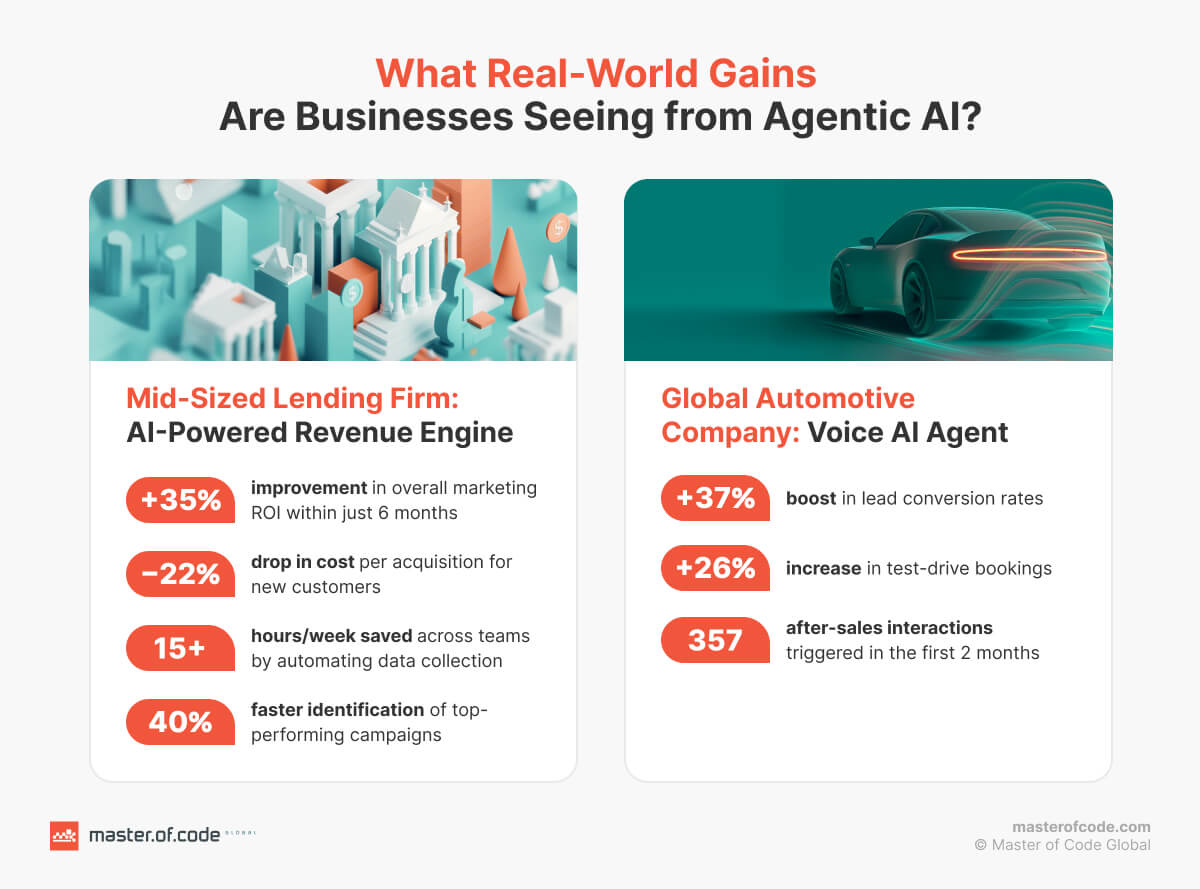
- Agentic AI-Powered Revenue Engine. 35% increase in ROMI within six months; 22% reduction in the cost per acquisition; 15+ hours freed up weekly across teams; and 40% faster recognition and capitalization on high-performing initiatives.
Healthcare
- More than 70% of organizations have already embraced or are actively exploring intelligentization.
- In the short term, top use cases include charge capture and reconciliation (39%), patient data structuring and analysis (37%), and workflow automation (36%).
- Looking ahead, long-term priorities shift toward predictive analytics and risk scoring (44%), clinical decision support (41%), and AI-powered diagnostics and treatment guidance (37%).
- Mayo Clinic. Cut diagnostic turnaround times by 30% and reduced unnecessary procedures by 15%.
- Insilico Medicine. Earned 35% ROI in nine months and achieved 79% trial accuracy in clinical development.
- AI Pharmacy for Canadian Insurance Giant. 43% decrease in customer support inquiries; 1M+ medication records secured and processed with zero data breaches; and 320% expansion of the drug database.
Energy & Manufacturing
- In the energy sector, intelligentization investment is forecasted to triple, growing from $40 billion in 2023 to over $140 billion by decade’s end.
- Siemens AG. Achieved a 20% reduction in maintenance costs and improved production uptime by 15% through AI agents for manufacturing.
- British Petroleum. Cut exploration costs by 20% and enhanced drilling success rates by 15%.
- Agentic AI-Driven Data Analysis. Empowered non-technical employees with instant data access and accelerated decision-making by eliminating SQL barriers and providing real-time insights.
Supply Chain
- Intelligence-infused demand forecasts cut lead times by 22% and reduce expedited shipments by 27%. They have also boosted supplier-level accuracy by 35–42%, improving production efficiency and lowering costs. Compared to traditional methods, agentic AI in supply chain also resulted in 14.2% fewer stockouts and an 8.7% drop in excess inventory.
- DHL. Lowered operational costs by 15% and improved delivery speeds by 20%.
- Uber Freight. Cut empty miles by 10–15%, moved $20B in freight, and reduced support wait times from 5 minutes to 30 seconds.
Automotive
- Currently, 75% of companies are piloting at least one artificial intelligence use case. AI agents for automotive are already delivering impact, cutting development timelines for auto parts by 10–20%.
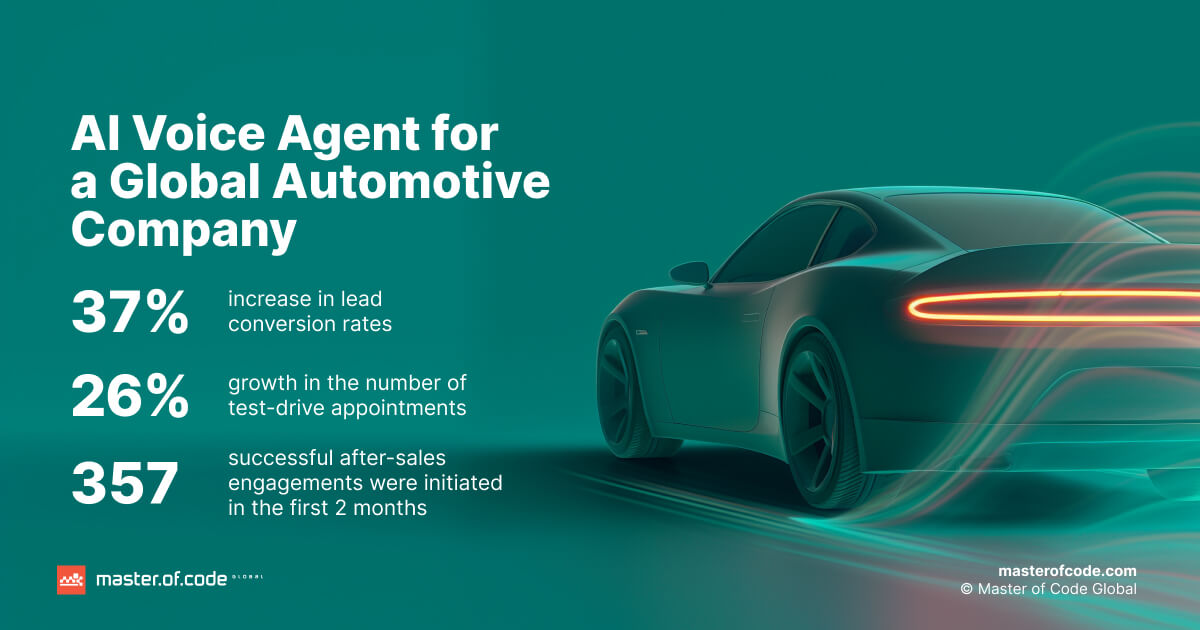
- AI Voice Agent. 37% increase in lead conversion rates, 26% growth in the number of test-drive appointments, and 357 successful after-sales engagements were initiated in the first 2 months.
- AI-Powered Predictive Maintenance. 67% reduction in unplanned downtime across all facilities; 45% decrease in overall costs; 92% accuracy rate in predicting failures 30 days before they would occur; and 23% increase in overall equipment effectiveness.
Insurance
- In 2026, agentic AI in insurance usage among businesses rose to 48%.
- Reported benefits include greater staff efficiency (61%), enhanced customer service (48%), cost reductions (56%), and increased business growth (48%).
- AI Assistant for Global Insurance Leader. Lowered risk of non-compliance, streamlined claims processing, reduced client churn, and data-driven insights for risk assessment.
Telecom
- Nearly half (49%) of organizations are already embracing artificial intelligence, and 84% have plans to introduce GenAI-powered customer service offerings.
- The primary motivators behind this integration include greater efficiency and productivity (41%), cost reduction (20%), and gaining a competitive edge (18%).
- AT&T. Cut operational expenses by 15%.
- BT Group. Automates up to 60,000 interactions each week, with success rates nearing 50% across several key client journeys.
Customer Service
- 39% of organizations are “highly committed” to evolving their support systems using chatbots, employee assistants (copilots), or fully autonomous systems.
- Bank of America. “Erica” handles 1 million+ daily queries, cuts service costs by 10%, and boosts cross-sell rates by 5%.
- GenAI Agent for Customer Onboarding. Increased conversion rates, lowered acquisition costs, and streamlined user onboarding. Master of Code Global’s website-integrated GenAI assistant used intelligent routing to deliver instant, personalized guidance—driving +22% conversions, –17% CAC, and +20% onboarding completion.
Marketing
- Over half of specialists (51%) are already using or testing artificial intelligence.
- The top applications include data analysis (45%), market research (40%), copywriting (27%), image generation (22%), and customer service (13%).
- Coca-Cola. Cut content creation time in half and increased marketing ROI by 20%.
Sales
- Teams leveraging machine intelligence saw significantly better outcomes—83% reported revenue growth over the past year, compared to just 66% of those without its integration.
- They also anticipate that technology will reshape their roles by automating reporting (51%), streamlining content creation (48%), and analyzing market performance (47%).
- Salesforce. Drove a 15% increase in deals and shortened sales cycles by 25%.
HR
- Currently, 45%+ of global leaders are using AI agents for HR, with another 39% planning to adopt them soon. A strong majority—65%—report that this tech has greatly enhanced efficiency and productivity in managing HR-related tasks.
- Unilever. Saved $1 million+ per year in recruiting and reduced time-to-hire by 75%.
What’s Holding AI Agents Back? Key Risks and Limitations
Despite their transformative potential, these solutions come with a complex set of technical, operational, and governance challenges that enterprises must proactively manage.
Based on SailPoint’s AI agent adoption and security survey:
- 82% of companies have AI agents in use, with 53% confirming access to sensitive data, and 58% saying this happens daily.
- 80% have experienced applications acting outside intended boundaries.
- Specific incidents include unauthorized access (39%), restricted information handling (33%), and even phishing-related movements (16%).
- Privileged data access (60%), unintended actions (58%), and data sharing (57%) are top concerns.
- 92% believe governance is essential—but only 44% have policies in place.
- Visibility into algorithm activity varies drastically across departments, with only 52% able to fully track the system’s behavior.
LangChain’s State of AI Agents report identifies the key blockers preventing companies from scaling agentic AI.
- The biggest obstacle is unreliable performance (41%), followed by cost (18.4%), safety concerns (18.4%), and latency (15.1%).
- To control the intelligent solutions, companies rely on tracing tools (55.4%), guardrails (44.3%), offline evaluations (39.8%), and real-time A/B testing (32.5%).
According to the UiPath 2025 Agentic AI Report, enterprise leaders remain enthusiastic about the technology but cautious about implementation risks.
- Security vulnerabilities (56%) and high costs (37%) top the list of concerns.
- System integration (35%) and governance risks (34%) also present major obstacles.
- Many also worry about hallucinations (32%) and giving agents too much autonomy (28%).
The Road Ahead: What’s Next for Agentic Intelligence
So, where’s all this headed? Let’s take a look at what the next few years might actually look like for this technology based on the latest AI agents statistics:
- By 2028, nearly one-third (33%) of enterprise software applications will have built-in agentic capabilities—an enormous leap from under 1% in 2024.
- Cognitive tools are expected to handle 20% of interactions at digital storefronts by 2028, shifting away from human-focused interfaces.
- At least 15% of routine workplace decisions will be made independently by agentic systems by 2028, a major shift from zero autonomous decision-making in 2024.
- 46% of executives plan to introduce AI-driven assistants for human employees within the next 6–12 months.
- 38% expect to adopt copilots within 1–2 years, while 6% already use them in live support environments.
- A majority—54% of executives—expect to begin deploying fully autonomous artificial intelligence CX assistants within two years.
- Specifically, 35% foresee implementation in 1–2 years, 26% in 3–4 years, 19% within 6–12 months, 16% in 5+ years, and 4% remain uncertain.
- By 2027, AI agents are expected to automate 15% to 50% of routine business tasks, freeing teams to focus on higher-value work.
The shift toward agentic artificial intelligence is already underway, but we’re still in the early innings. Most companies are figuring it out as they go—testing, learning, adjusting. What’s clear is that the pace is picking up, and now’s a smart time to start thinking seriously about where autonomous solutions fit into your roadmap.
Not sure where to begin? We’ve got you. Get in touch for a no-strings-attached consult and start capitalizing on our AI agent development services.
Ready to build your own Conversational AI solution? Let’s chat!