


Field service and HVAC operations are under pressure from every direction: aging technician workforces, rising customer expectations for same-day resolution, and margins that shrink every time a truck rolls to the wrong job. Companies that have moved AI into production (for intelligent dispatch, predictive maintenance, and real-time technician enablement) are pulling ahead. They’re reducing repeat visits, cutting scheduling overhead, and turning reactive service models into proactive revenue engines.
But the partner you choose determines whether your AI investment compounds or stalls. The right development company understands what makes this industry different: unpredictable demand spikes during peak seasons, complex technician skill-matching across geographies, fragmented legacy systems from decades of bolt-on software, and field conditions where connectivity is unreliable and every minute of downtime costs money. They also know that ROI in field service management is measured in first-time fix rates, SLA compliance, and whether your dispatchers can finally stop firefighting.
This guide compares the top HVAC AI companies and field service AI companies building custom automation for this space, evaluated on integration depth, domain expertise, and ability to move real operational KPIs.
Table of Contents
Key Takeaways
- The best AI companies for field service automation integrate AI into dispatching, inventory, CRM, and IoT ecosystems without disrupting live operations or requiring a full platform overhaul.
- Field service AI companies with genuine operational understanding (seasonal demand patterns, SLA windows, mixed-workforce logistics) deliver measurably faster time to value than generalist AI firms.
- Production readiness is the dividing line. Look for partners with structured proof-of-concept processes, security certifications like ISO 27001, and a documented track record of moving past pilot stage into scaled deployment.
- Predictive maintenance and AI workflow automation drive the highest measurable ROI when applying AI in HVAC industry and across field service operations, but only when connected to clean data pipelines and your existing ERP or field service management platform.
- Total cost of ownership matters more than hourly rates. Factor in integration complexity, scaling overhead, ongoing support, and time to value when choosing a long-term AI partner.
- Start with one high-impact workflow (intelligent dispatch, predictive maintenance, or automated customer scheduling) prove adoption and ROI, then scale across the organization.
How We Created the List of AI Development Companies for Field Service & HVAC
To keep this guide practical and easy to scan, we focused on the criteria that matter most when choosing an AI partner for field service and HVAC: domain expertise, team size, geographic presence, pricing model, minimum project budget, and depth of the service offering.
We assessed each company’s delivery approach across the field service AI value chain — scheduling optimization, dispatch, predictive maintenance, technician enablement, customer communication, and IoT integration. We also evaluated how teams move solutions from pilot to production and how they support growth beyond a single business unit or geography.
The companies were selected based on market visibility, documented delivery experience, and clear positioning around AI implementation for field service and HVAC operations. The list includes custom AI development firms, field-service-native SaaS platforms, and specialized point-solution providers, a mix that reflects the range of HVAC AI companies and service-focused vendors currently competing for enterprise attention.
We paid close attention to operational maturity — MLOps practices, security certifications, and the ability to handle field service data and compliance requirements. Vendors that modernize data pipelines, reduce system silos, and implement governance tend to scale faster and deliver cleaner outcomes in field service environments, improving total cost of ownership over time.
Top 10 AI Development Companies for HVAC & Field Service Automation in 2026
Below is a list of companies, in order of the details field service leaders typically compare first: domain depth, AI capabilities, delivery model, and support maturity.
1. Master of Code Global
Founded: 2004 Headquarters: Redwood City, CA, USA
Team size: 200+
Hourly rate: $50–99/hr
Minimum project budget: $30,000+
Services: AI consulting, AI chatbot development, Conversational AI, CRM integration, Generative AI, AI agents, voice solutions, custom software development
Master of Code Global is a long-term AI implementation partner with over 20 years of delivery experience, focused on production-ready solutions that drive measurable business outcomes. The team has completed 1,000+ projects across industries, including automotive, healthcare, finance, and eCommerce, reaching more than one billion users globally. Documented results include a 15× revenue uplift, 3× higher conversions, and 80% improvement in customer satisfaction, a track record that translates directly to the operational demands of HVAC and field service.
For field service and HVAC companies, the value proposition centers on AI agent development services that automate workflows technicians and dispatchers deal with daily. For example: intelligent scheduling, dispatch optimization, real-time customer communication (appointment booking, troubleshooting, status updates), and integration with predictive maintenance pipelines. Their AI consulting services help organizations identify which use case will generate the fastest ROI before a single line of code is written, and their AI predictive analytics services connect equipment sensor data to actionable forecasts that reduce unplanned downtime. This approach draws on the same methodology behind their work in AI predictive maintenance in manufacturing, adapted for the unique equipment lifecycles and service patterns of HVAC operations.
What makes this particularly relevant for field service management is the company’s LOFT framework — an open-source LLM-Orchestrator that accelerates AI delivery with 43% less setup effort, up to 20% budget savings when scaling, and 3× faster ongoing support. For HVAC companies dealing with legacy CRM, ERP, and IoT platforms, that speed of integration is the difference between a six-month pilot and a solution in production before the next peak season.
Their strategic AI Proof of Concept process, offered at a fixed price, reduces potential development waste by 50–70% and provides a clear, confident path forward. This is especially valuable in an industry where workflow automation projects often stall because stakeholders can’t visualize what production looks like. The company is ranked among the Top AI Consulting Companies globally by Clutch (4.7-star rating).
2. ServicePower
Founded: 1996
Headquarters: McLean, VA, USA (also Stockport, UK)
Team size: 150+
Hourly rate: Enterprise pricing (not publicly listed)
Minimum project budget: Custom / not publicly listed
Services: AI-powered schedule optimization, automated dispatch, contractor management, workforce management, warranty claims, mobile field service, consumer self-service
ServicePower is a field-service-native platform company that has spent nearly three decades focused on a single problem: getting the right technician to the right job at the right time, at the lowest cost. The platform is trusted by enterprise organizations including GE Appliances, LG, Siemens, Electrolux, AIG, and Allstate, and is recognized as a Gartner Visionary in field service management six times running.
The core differentiator is ServicePower’s ability to manage blended workforces — employed and contracted technicians — within a single AI-powered scheduling and dispatching engine. The platform continuously re-optimizes schedules throughout the day based on technician skills, geography, parts availability, traffic conditions, and cost constraints. For HVAC operations that rely on a mix of in-house crews and third-party contractors to handle seasonal demand spikes, this is a direct operational advantage. Documented outcomes include a 40% increase in first-time fix rates and 12× annualized ROI for customers.
Worth noting: ServicePower is a product company with enterprise-tier pricing — it is not available for custom AI development engagements. Organizations looking for bespoke AI solutions built around their unique workflows and legacy systems will need a custom development partner. The platform’s strength is its depth within field service scheduling and dispatch; broader AI use cases like conversational customer service, predictive analytics, or custom agent development fall outside its scope.
3. Pragmatic Coders
Founded: 2014
Headquarters: Kraków, Poland
Team size: 100+
Clutch rating: 4.9 / 5.0 (18 reviews)
Hourly rate: $70–150/hr
Minimum project budget: $25,000+
Services: Custom software development, AI integration, UX/UI design, product management, staff augmentation, DevOps
Pragmatic Coders is a product-focused software development company with strong roots in FinTech and HealthTech, and growing AI automation capabilities. Since 2014, the team has delivered 150+ digital products for clients ranging from venture-backed startups to established enterprises, including Atom Bank (the UK’s first fully digital bank) and Kitopi (a FoodTech unicorn). The company positions itself as a product partner rather than a vendor — embedding product managers and UX specialists alongside engineers to ensure every build ties back to measurable business outcomes.
For HVAC and field service organizations, Pragmatic Coders brings relevant capability in AI-powered automation, cloud-native architecture, and complex system integration. Their experience building data-driven platforms in regulated industries (HIPAA-compliant healthcare systems, secure financial applications) translates to the compliance and data-handling demands of field service environments. The team’s AI work spans computer vision and process automation — both applicable to equipment inspection and workflow optimization.
Worth noting: Pragmatic Coders is a generalist product development company. While their AI and automation capabilities are solid, HVAC and field service are not primary verticals. Organizations seeking a partner with deep pre-built domain expertise in dispatching, predictive maintenance, or technician enablement should weigh this against the company’s strong delivery fundamentals and adaptability across industries.
4. FieldAware
Founded: 2009
Headquarters: Plano, TX, USA
Team size: 51–200
Hourly rate: Custom / not publicly listed
Minimum project budget: Custom / not publicly listed
Services: Field service management, scheduling and dispatch, work order management, mobile workforce tools, invoicing, CRM integration (Salesforce, NetSuite)
FieldAware is a cloud-based field service management platform designed from the ground up as a mobile-first solution. The company helps service organizations streamline scheduling, dispatching, invoicing, and work order management through a single platform that provides real-time visibility between the field and back office. FieldAware was acquired by GPS Insight in 2021, extending its capabilities into fleet tracking, asset management, and in-cab smart cameras for organizations managing both service technicians and vehicle fleets.
The platform integrates with Salesforce and NetSuite, which makes it a natural fit for HVAC and field service companies already running their sales and operations through those CRMs. FieldAware has been named a Market Leader in field service management by FeaturedCustomers and was commended by Frost & Sullivan for its mobile FSM product portfolio. The platform’s mobile app gives technicians real-time access to work orders, customer history, parts information, and scheduling — reducing the back-and-forth that slows down service delivery.
Worth noting: FieldAware is a SaaS product company, not a custom AI development partner. Its AI capabilities are embedded in the platform’s scheduling and dispatch workflows rather than offered as customizable, standalone solutions. The platform is designed for organizations seeking packaged field service management capabilities rather than bespoke AI development. Following its acquisition by GPS Insight, its scope now includes both field service and fleet management.
5. Brocoders

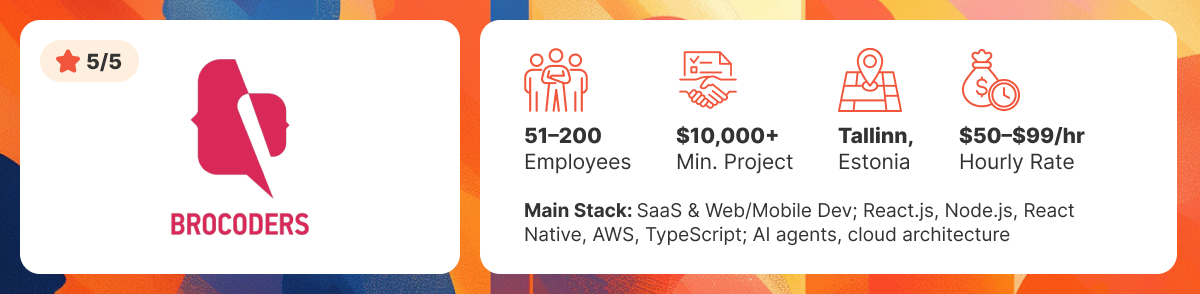
Founded: 2014
Headquarters: Tallinn, Estonia (development teams in Ukraine)
Team size: 70+
Clutch rating: 4.9 / 5.0 (35 reviews)
Hourly rate: $25–49/hr
Minimum project budget: $10,000+
Services: Custom software development, AI development, MVP development, team augmentation, cloud architecture (AWS), mobile app development
Brocoders is a custom software development company that operates as an on-demand technical team for SaaS products and midsize businesses. Since 2014, the company has built 80+ digital products across Agritech, FinTech, FoodTech, PropTech, and EdTech — industries that share field service’s reliance on real-time logistics, workflow coordination, and multi-user platforms. Their tech stack centers on Node.js, React, and AWS cloud, and the team has experience building AI-driven features including automated accounting solutions that eliminate up to 80% of manual workload.
For field service and HVAC companies, Brocoders brings relevant experience in building fleet management software (Gokada), property management platforms (C.I.A. Services, AreaButler), and operational tools that coordinate multiple user types — dispatchers, field workers, and end customers — within a single system. Their cost-effective hourly rates and lean engagement model make them accessible for mid-market operators looking to build custom tools without enterprise-level budgets.
Worth noting: Brocoders is a generalist software development firm. HVAC and field service are not core verticals, and the company does not have pre-built domain expertise in scheduling optimization, predictive maintenance, or IoT-driven equipment monitoring. The 70-person team is best suited for mid-market engagements. Organizations with complex, enterprise-scale AI requirements may need a partner with deeper bench depth and dedicated domain specialization.
6. Zinier
Founded: 2015
Headquarters: San Mateo, CA, USA (offices in Mexico City, Bengaluru, Singapore, Lisbon, London, Madrid)
Team size: 130+
Funding: $120M+ (Accel, ICONIQ Capital, Founders Fund, Tiger Global, Qualcomm Ventures, NGP Capital)
Hourly rate: Enterprise pricing (not publicly listed)
Minimum project budget: Custom / not publicly listed
Services: AI-powered field service automation, low-code/no-code workflow design, scheduling and dispatch optimization, mobile technician enablement, asset management, integration marketplace
Zinier is an AI-first field service automation platform built to help organizations move from reactive service management to proactive, intelligent operations. The platform combines AI-driven scheduling, real-time dispatching, guided mobile workflows for technicians, and an integration marketplace that connects to over 1,000 applications including CRM, ERP, and EAM systems. Its low-code/no-code Studio-Z builder allows operations teams to customize workflows through a visual interface without extensive development resources.
The company serves telecom, utilities, energy, EV infrastructure, and manufacturing — industries that share HVAC’s dependence on asset-intensive field operations, complex scheduling, and multi-site service delivery. Zinier’s ISAC (Intelligent Service Automation and Control) engine runs continuously in the background, observing operational patterns and delivering AI recommendations that coordinators and technicians can accept or adjust in real time.
Worth noting: Zinier is a platform company, not a custom AI development partner. Its strength lies in configurable, pre-built field service automation — organizations needing fully bespoke AI solutions will need a development partner that builds from scratch.
7. Epiphany Dynamics
Headquarters: USA
Team size: Not publicly disclosed
Hourly rate: Not publicly listed
Minimum project budget: Not publicly listed
Services: AI-powered workflow automation, after-hours call management, customer communication automation for HVAC and field service contractors
Epiphany Dynamics is a specialized designer of AI and workflow programs built specifically for the HVAC and field service industry. The company addresses one of the most persistent pain points in residential and commercial HVAC operations: the 35–45% of customer calls that come outside of business hours. According to the company’s own data, 78% of callers who reach a voicemail will contact a competitor within two minutes — making after-hours responsiveness a direct revenue driver.
Worth noting: Epiphany Dynamics is a smaller, niche-focused company, with public information centered on its core use case. The company does not appear to offer broader AI capabilities such as predictive maintenance, dispatch optimization, or custom model development. Organizations looking for a comprehensive AI transformation partner across multiple operational areas will likely need to pair Epiphany Dynamics with a broader development firm, or choose a partner that covers the full spectrum.
8. Tavant
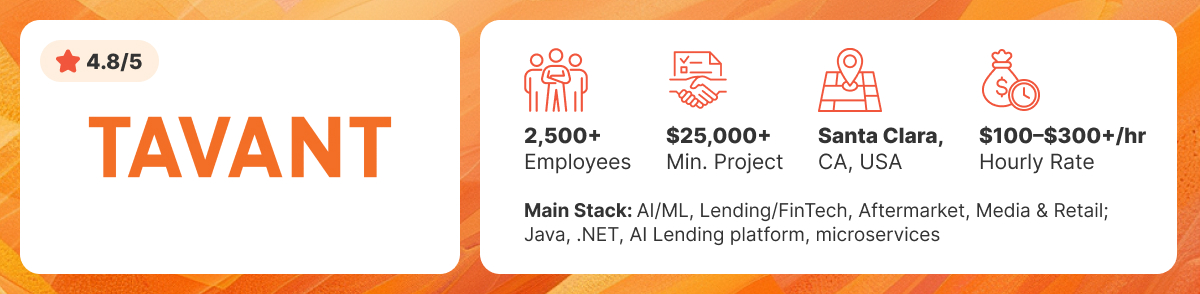
Founded: 2000
Headquarters: Santa Clara, CA, USA
Team size: 2,500+
Hourly rate: Custom / not publicly listed
Minimum project budget: Custom / enterprise engagements
Services: AI-powered warranty management, service lifecycle management, field service analytics, predictive maintenance, parts management, customer service, quality analytics, Salesforce integration, GenAI-accelerated software development
For HVAC and field service organizations, Tavant’s relevance centers on its AI-driven field service management capabilities: real-time technician performance analytics, work order optimization, knowledge-base integration for faster troubleshooting, and service intelligence that connects warranty, IoT, and engineering data to reduce machine downtime. The company’s Salesforce integration expertise is particularly valuable for organizations already running their service operations on that platform. Tavant also brings Agentic AI capabilities for back-office automation and GenAI-accelerated development for custom solutions.
Worth noting: Tavant is primarily focused on manufacturing, automotive, and heavy equipment verticals. While the service lifecycle management framework translates well to HVAC and field service, the company’s core case studies and product positioning lean toward OEM warranty ecosystems rather than the residential and commercial HVAC contracting market. Organizations seeking a partner with direct HVAC industry experience should evaluate fit carefully. Tavant’s enterprise pricing and engagement model are also oriented toward larger organizations rather than mid-market HVAC operators.
9. MindTitan
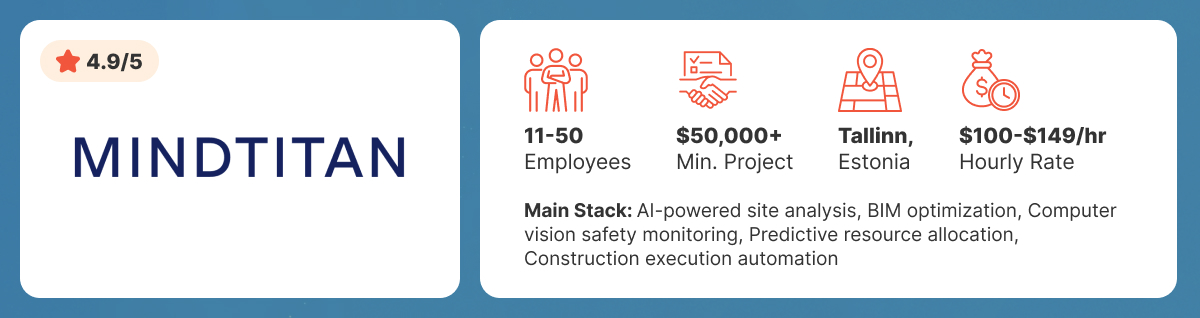
Founded: 2016
Headquarters: Tallinn, Estonia (also Portland, OR, USA)
Team size: 31+
Clutch rating: 5.0 / 5.0 (15 reviews)
Hourly rate: $50–99/hr
Minimum project budget: $50,000+
Services: AI/ML consulting and development, NLP, computer vision, data engineering, MLOps, predictive analytics
MindTitan is a specialized AI consultancy that bridges the gap between breakthrough research and practical business applications. The company delivers end-to-end AI solutions — from strategy and use case identification through development, deployment, and ongoing MLOps — with a team of senior ML engineers, data scientists, and product managers. MindTitan was recognized by Gartner as a Cool Vendor in AI and Automation in CSP Operations, and holds a perfect 5.0 Clutch rating across 15 reviews, with clients describing the team as feeling “like an in-house AI team” rather than external consultants.
For HVAC and field service organizations, MindTitan’s relevance lies in its ability to build custom predictive models (equipment failure forecasting, demand prediction), NLP-powered customer interaction tools, and computer vision solutions that could be applied to remote equipment inspection or quality assessment. Their European data privacy expertise is also an asset for organizations handling sensitive operational and customer data.
Worth noting: MindTitan is a small, specialized team of roughly 31 people, which limits capacity for multiple large concurrent projects. The company does not have pre-built field service or HVAC domain expertise — its strength is applying rigorous AI methodology to new verticals.
10. BrainBox AI
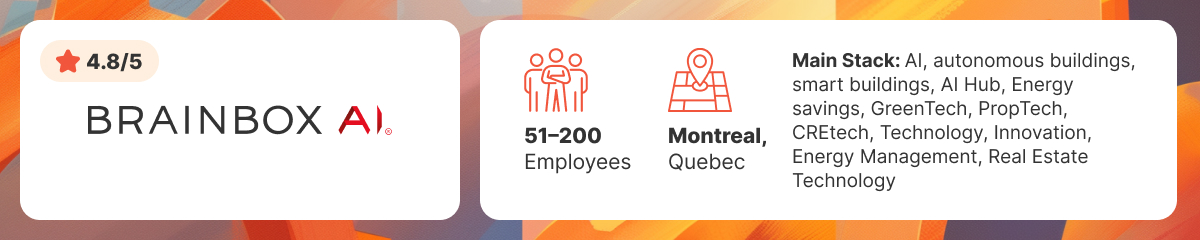
Founded: 2017
Headquarters: Montréal, QC, Canada (acquired by Trane Technologies in January 2025)
Team size: 190+
Funding: Acquired by Trane Technologies (NYSE: TT)
Hourly rate: N/A (product company)
Minimum project budget: N/A (SaaS/product)
Services: Autonomous AI-powered HVAC optimization, building energy management, predictive HVAC controls, generative AI virtual building assistant (ARIA), cloud-based building management system
Since its 2019 commercial launch, BrainBox AI has transformed over 100 million square feet of building space across five continents, serving retail chains (Dollar Tree, SAIL Outdoors), corporate offices, hotels, airports, and academic institutions. The company was named one of TIME’s Best Inventions in both 2020 and 2024, and was selected by CB Insights as a Top 100 AI Startup. In 2024, BrainBox AI launched ARIA — the world’s first generative AI-powered virtual building assistant, built on Amazon Bedrock — which gives facility managers a 24/7 conversational interface for building operations, from energy optimization to maintenance prioritization.
In January 2025, BrainBox AI was acquired by Trane Technologies, a global climate innovation company with nearly 40,000 employees. The acquisition followed a two-year collaboration and positions BrainBox AI’s technology within Trane’s broader HVAC and building management ecosystem. A BrainBox AI Lab has since been launched to advance autonomous control systems, predictive models, and physics-informed neural networks for the built environment.
Worth noting: BrainBox AI is a product company focused specifically on building-level HVAC energy optimization. It is not a custom AI development partner and cannot be hired for bespoke software builds. Its scope centers on autonomous HVAC controls and energy management — broader field service automation needs such as scheduling, dispatching, technician enablement, customer communication, and predictive maintenance for distributed equipment fleets fall outside its offering. The Trane Technologies acquisition also means BrainBox AI’s roadmap is now shaped by a larger corporate strategy.
How to Make the Right Choice
Choosing among the top AI development companies for field service and HVAC is less about comparing feature lists and more about finding a partner whose delivery model, domain understanding, and integration capabilities match the reality of your operations.
Start by pressure-testing partner fit across five dimensions:
Field service integration depth. Can they connect AI to your FSM platform, CRM, IoT sensors, and dispatch tools with clean, scalable interfaces? Deep integration is where most AI projects either accelerate or stall. A partner that has navigated legacy system complexity before will save you months of rework.
Data quality and operational readiness. Do they assess your data foundations before layering AI on top? Organizations with fragmented data across channels need a partner who can first modernize pipelines and reduce silos, then build intelligence on a reliable foundation.
Delivery model and track record. Do they run structured phases that reduce rework and keep stakeholders aligned? Look for clear milestones, defined KPIs, and a documented history of moving AI from proof of concept into full production. A strategic POC process that validates ideas before committing to a full build can reduce development waste significantly.
Value proof and ROI commitment. Do they define success criteria upfront and tie measurement to real field metrics, first-time fix rate improvement, truck roll reduction, SLA compliance, customer satisfaction? The best partners commit to outcomes tied to your P&L, not vanity metrics about model accuracy.
Total cost of ownership and execution realism. Can they deliver a production-ready workflow that demonstrates adoption, not just feasibility? Factor in integration complexity, scaling costs, long-term support, and time to value. A partner with a proven framework for accelerating delivery, reducing setup effort, streamlining scaling, and speeding ongoing support — will protect your investment over the lifecycle of the project.
Conclusion
Don’t start with the vendor, start with the problem. Map the HVAC automation or field service use case that would have the most immediate impact on your operational efficiency, technician productivity, or customer experience. Then evaluate which partner can get that first win into production fastest, with the lowest risk and the clearest path to scale.
The HVAC and field service companies winning with AI aren’t the ones who chose the flashiest technology. They’re the ones who chose a partner who understood field operations well enough to deliver outcomes that mattered, and who had the integration depth, delivery discipline, and long-term commitment to keep those outcomes compounding.
Discover how Master of Code Global can help enhance your customer’s experience and boost sales growth.