



For the past several years, the dominant paradigm for interacting with Large Language Models (LLMs) has been single-turn prompting. A human inputs a query, and the model outputs a response in a single forward pass. While impressive, this “zero-shot” approach forces the model to act as an oracle – generating an answer without the ability to pause, verify, or correct its course.
The agentic approach shifts this dynamic. By wrapping LLMs in code architectures that enable reasoning loops, tool access, and state management, we transition from passive chatbots to autonomous agents. This shift lets engineering teams take advantage of the cognitive strengths of LLMs while systematically engineering around their liabilities.
Table of Contents
1. Beyond the Chatbox: Shifting from Oracle AI to Collaborative AI
A core limitation of zero-shot prompting is autoregressive lock-in. Because an LLM generates text token by token, an early commitment to a suboptimal direction tends to compound: the bad prefix remains in context and continues to influence what follows, and the model cannot delete what it has already written. It can self-correct mid-output (“actually, on reflection…”), but the correction adds to the response rather than replacing it.
An agentic architecture structures what enters the context window. By giving the model dedicated regions for intermediate reasoning, tool outputs, and revised drafts, the application scaffolding turns the context window into a working scratchpad rather than a single output buffer.

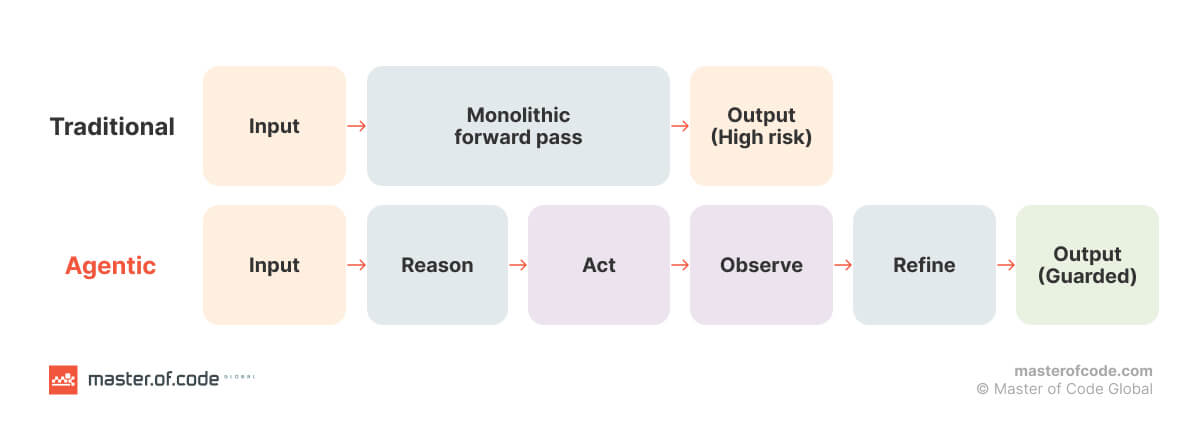
This transition moves the industry away from “AI as a smart oracle” and toward AI as an active, collaborative system. The software can draft, test hypotheses against external systems, identify its own structural mistakes, and incrementally build toward a reliable output.
2. Architecture & Topology of Agentic Systems
2.1 Domain Specialization & Blast Radius Control
Building a production system around a single, all-encompassing system prompt is an anti-pattern. Dumping 2,000 lines of disparate rules – covering accounting, legal compliance, and customer tone guidelines – into one prompt results in instruction dilution. The model begins to prioritize conflicting rules arbitrarily.
That said, the opposite extreme has real costs too: many small agents add latency, coordination overhead, and handoff failures. A well-tooled monolithic agent often outperforms a poorly designed multi-agent topology. The right granularity is an engineering judgment, not a default.
When decomposition does pay off, the business domain is partitioned into role-specific agents:
- The Specialization Edge: A single agent is assigned a focused system prompt and a constrained tool registry. A Legal Analyst Agent only knows contract logic; a Financial Controller Agent only knows ledger reconciliation. This focus drives down semantic confusion.
- Blast Radius Isolation: If an LLM hallucinates or enters an unstable state, the failure should be structurally contained. In a multi-agent topology, if the Logistics Agent miscalculates a shipping window, its output is passed to a downstream Reviewer Agent or Critic Node. The error is caught at the boundary, preventing a single system failure from reaching the end-user.
2.2 Dynamic Teams vs. Deterministic Workflows (Agility vs. Governance)
When designing multi-agent software using modern frameworks like LangGraph, CrewAI, or AutoGen, a critical architectural division must be enforced based on the predictability of the task:

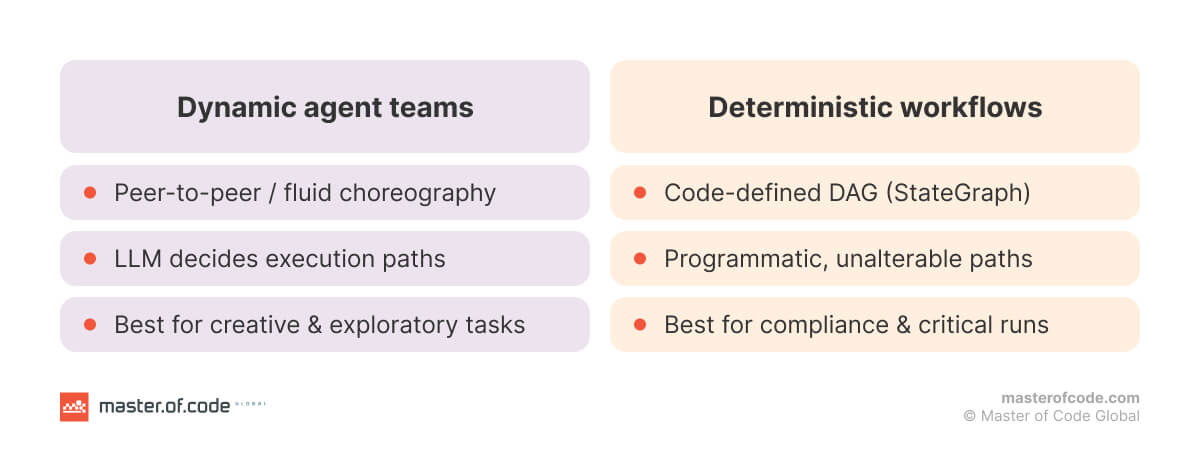
Dynamic Agent Teams (Agility)
Agents communicate via open peer-to-peer choreography or fluid supervisor routing. The LLM dynamically determines which agent should talk next or when a task is finished. This model is effective for exploratory, high-variability operations like market research, creative drafting loops, or cross-functional brainstorming.
Deterministic Workflows (Governance)
For mission-critical corporate operations – such as processing a payment, verifying security permissions, or changing production database state – allowing an LLM to dynamically route the execution path is a significant liability.
Instead, developers build a structured state graph where the execution edges, conditions, and loops are explicitly defined in code. The graph is permitted to contain cycles (a true DAG cannot represent retry loops or iterative refinement); what matters is that control flow is code-defined, not model-decided. The LLM agents exist inside the nodes as isolated processing units, but they possess zero authority to alter the overall process architecture. If a compliance verification step fails, the system code deterministically routes to a rejection handler, bypassing any downstream transactional modules.
The Hybrid Reality
Production systems merge both models. A rigid, deterministic corporate pipeline enforces standard operating procedures, but inside an isolated node of that workflow, it can safely spin up a dynamic agent team to resolve an unstructured sub-problem before feeding the clean result back into the deterministic track.
2.3 Evaluation & Validation (Testing the Non-Deterministic)
Because LLMs are non-deterministic, traditional software testing paradigms fall short. A production-ready agent system requires a dual-layered evaluation matrix:

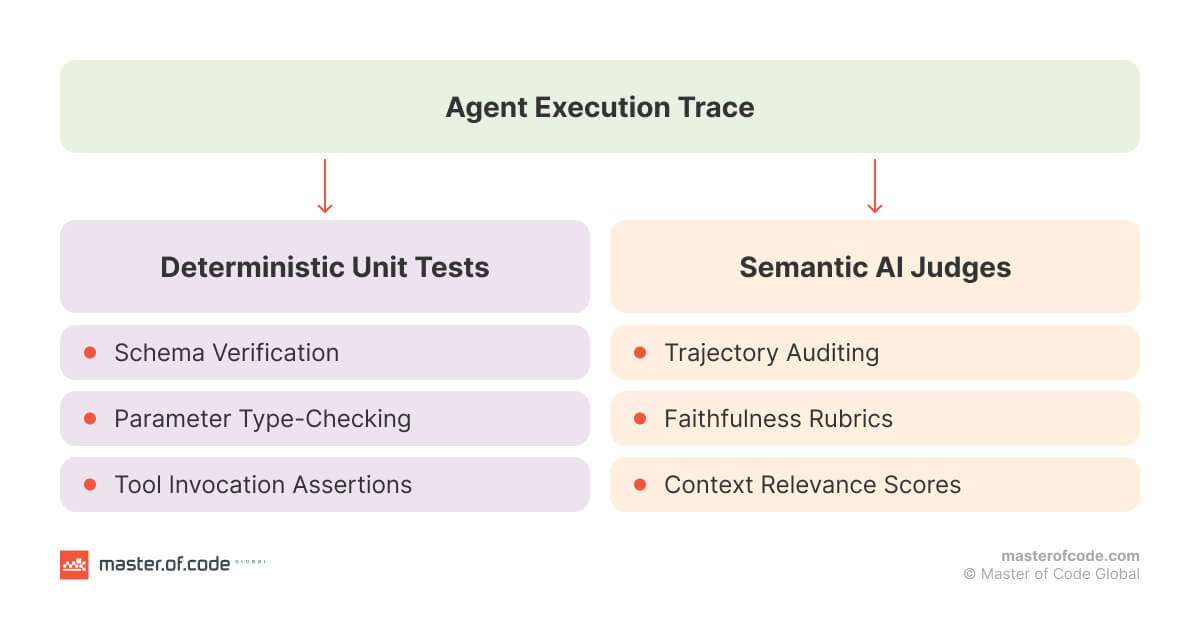
- Deterministic Unit Tests (The Structural Box): Written using standard, binary code assertions. These verify whether the agent outputs structurally sound data formats (e.g., matching a strict Pydantic model), extracts arguments with exact type-matching, and invokes the precise tool required given a specific programmatic input mock.
- Semantic Evaluation (LLM-as-a-Judge): To evaluate multi-step reasoning, tone, and logical trajectories, frontier-tier models are deployed as automated auditors. The judge model reads the historical execution trace and grades the runtime agent against corporate rubrics, tracking metrics like Faithfulness (checking RAG retrievals against generation to detect fabrication) and Task Completion.
A caveat that engineering teams routinely underweight: LLM-as-judge has well-documented failure modes – positional bias (preferring the first or last answer shown), length bias (favoring longer responses), self-preference (judges rate outputs from their own model family higher), and shared blind spots between judge and generator. Production evaluation pipelines should pair judge models with periodic human review on a sampled stream, calibrate judges against a labeled gold set, and treat large judge-score swings as a signal to investigate rather than ship.
3. The Micro-Logic of Agentic Patterns
Under the hood, managing an agent requires rigorous state manipulation and token conservation techniques:
Context Isolation and Compression
As an agent interacts with tools or other agents, conversation logs grow quickly – linearly in single-agent loops, and faster in nested or recursive topologies where each sub-agent’s history can be re-included in the parent context. If Agent A dumps its entire raw conversation history into Agent B during a handoff, the system quickly hits a context window bottleneck, inflating costs and degrading model attention.
Modern architectures implement Context Isolation. When an agent hands off a task, an intermediary routine compresses the session. The raw history is removed from the active frame and replaced with a structured handoff object – typically a JSON record with fields for completed steps, verified constraints, open variables, and resume point – rather than a free-form prose summary. Structured handoffs keep the active context compact and reduce the risk that the receiving agent reinterprets the summary creatively.
Managing the Iteration Loop
Left unchecked, autonomous agents given complex or ambiguous goals can enter runaway execution loops – repeatedly calling the same failing tool or continuously rewriting the same sentence under a flawed critique. Production scaffolding must explicitly enforce circuit-breakers:
- Hard Iteration Caps: Restricting an agent to a maximum of N sequential loop turns per session.
- Token and Financial Ceilings: Automatically killing an execution stream if token expenditure crosses a designated dollar threshold.
- Format Parsers & Intermediary Fixers: Intercepting malformed text or partial JSON strings mid-flight, feeding the structural validation error directly back to the generation frame for a single-turn fix before it is committed to downstream application logic.
4. Interoperability Protocols & Context Economics
4.1 Function Calling & Protocol Standardization
Agents interact with reality by translating natural language intentions into structured execution calls. Through the Model Context Protocol (MCP) – an open standard donated by Anthropic to the Linux Foundation’s Agentic AI Foundation in December 2025 – the industry has moved away from writing brittle, bespoke integration code for every tool and database.

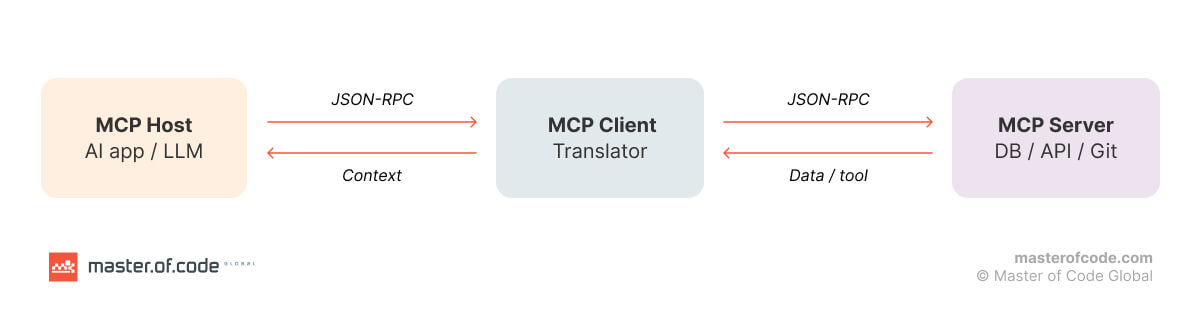
MCP standardizes how an LLM application (the host) discovers and communicates with external databases, enterprise files, and web APIs via a JSON-RPC 2.0 transport layer.
Similarly, Google’s Agent-to-Agent (A2A) protocol (also now under Linux Foundation governance) standardizes how an agent running within Enterprise Architecture A can call, negotiate, and transact with an independent agent in Enterprise Architecture B over the open web, establishing a framework for automated machine-to-machine workflows.
4.2 Balanced Complexity Control
While tools give agents power, overloading an agent’s initialization prompt with hundreds of tool schemas leads to severe performance degradation. This is known as Context Overload.
To maintain efficiency, enterprise software implements Dynamic Tool Activation. Instead of exposing the entire corporate API suite to the model at all times, the system uses a lightweight routing layer. The agent is initially provided only a minimal set of core routing options. As the agent selects an operational branch, the system swaps out the tool registry, injecting only the tool definitions required for that immediate sub-task.
5. Security, Guardrails, and Human-in-the-Loop (HITL)
5.1 The Principle of Least Privilege (PoLP) for AI
In a production system, a model only ever predicts characters; human code is what executes those characters against infrastructure. Therefore, a model’s prompt instructions can never be trusted as a true security boundary.
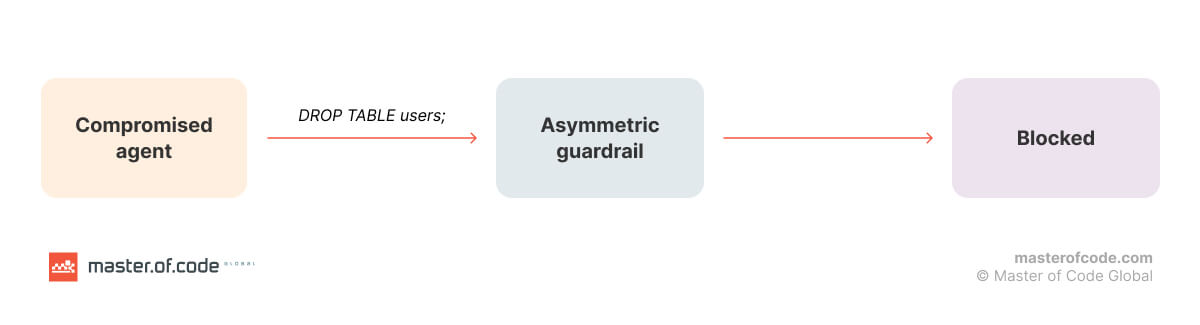
Enterprise engineering requires a zero-trust stance using the Principle of Least Privilege:
- Granular Restraints: If an agent is designed to look up a customer invoice, its underlying database connection must be a read-only replica scoped to that specific schema. It must possess no capability to execute a drop or write command.
- Ephemeral Sandboxing: Any agent that runs code execution scripts must be confined to short-lived, isolated sandbox environments. Practical options include purpose-built code-execution sandboxes (E2B, Modal), Firecracker microVMs, gVisor-isolated containers, or hardened Docker pods with seccomp profiles. Serverless platforms like AWS Lambda can work for narrow, well-scoped cases but were not designed as untrusted-code sandboxes.
- Indirect Prompt Injection Defense: Perhaps the most underrated agentic security risk: instructions hidden inside tool outputs (a fetched webpage, an inbound email, a document the agent ingests) can hijack the agent’s reasoning. Defenses include treating all tool outputs as untrusted data, parsing them through structured extractors rather than feeding raw text back into the model, segregating “instruction” context from “data” context, and reviewing outbound tool calls against the original user intent before they execute.
5.2 Side-Car Security Agents & Asynchronous HITL
Production deployment demands that security tooling match the complexity of business logic. This is achieved via side-car guardrail agents – independent micro-agents that sit outside the main execution stream. Their job is to parse outgoing tool payloads generated by the business agents, checking them against regex, security, and data exfiltration patterns before the API call is authorized to cross the enterprise firewall.
For critical or high-risk operations (e.g., initiating corporate wire payments or approving a legally binding vendor agreement), Asynchronous Human-in-the-Loop (HITL) checkpoints are required:

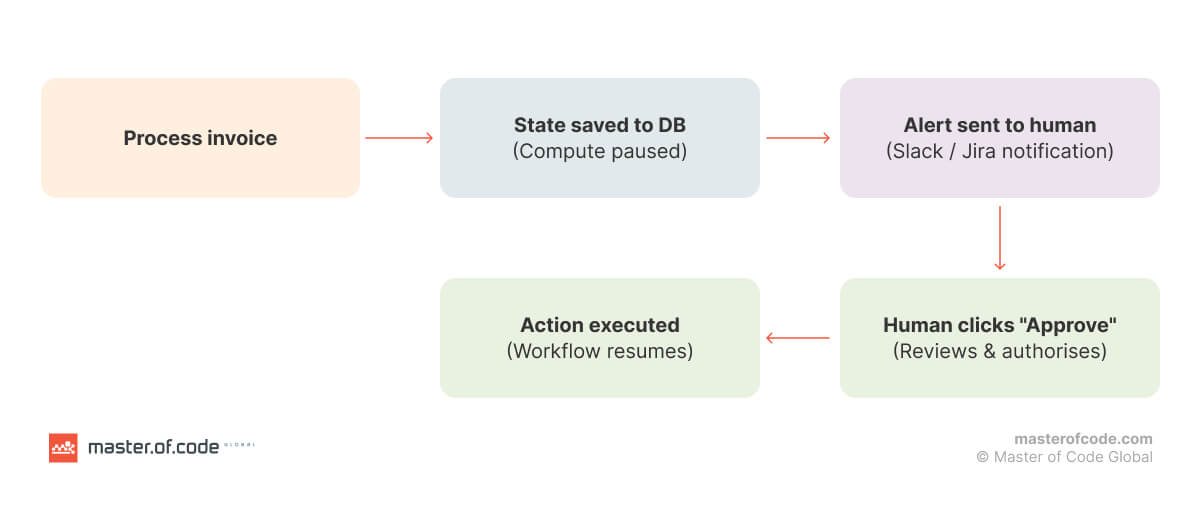
The system writes the execution state to a persistent data layer, frees the idle compute resources, and sends an alert (such as a Jira ticket or a Slack notification) to a human operator. The agentic system hibernates until the human verifies the reasoning path, reviews the generated artifact on a UI, and clicks an explicit authorization control to resume the workflow.
The honest tradeoff: asynchronous HITL trades latency for safety, and at high volume it can fail in predictable ways. Pending-approval queues become bottlenecks; under alert fatigue, human reviewers begin rubber-stamping. Effective HITL designs include batching low-risk approvals, escalating only outliers, and instrumenting approval latency and approval rates as first-class metrics – a 99% approval rate often means reviewers have stopped reading.
6. Personal All-Purpose Bots vs. Enterprise-Scale Assistants
A common point of confusion when planning corporate AI investments is equating developer-facing tools like Claude Code or ChatGPT with enterprise-scale customer or operational assistants. They have fundamentally different token economics:
| Metric | Personal All-Purpose Bots | Enterprise-Scale Specialized Assistants |
|---|---|---|
| User Profile | Individual professional/developer | High-volume consumer base or employee tier |
| Goal Scope | Broad, fluid, unconstrained | Predictable, specialized domain |
| Transaction Cost | Variable – pennies per chat turn up to $5–$10+ for long coding agent runs | Low (fractions of a cent to a few cents per run) |
| Model Class | Monolithic, expensive frontier-class models | Tiered routing of optimized models |
When a developer uses an advanced coding agent on a substantial task, a transaction cost of several dollars to build a software component is a reasonable tradeoff against human labor hours. A typical short ChatGPT turn, by contrast, costs a small fraction of a cent. However, if an enterprise deploys a high-throughput customer support system handling hundreds of thousands of concurrent daily sessions, using a frontier model for every basic query creates a financially unsustainable cost curve.
To scale cost-effectively, production systems employ Model Routing (often combined with Cascading):

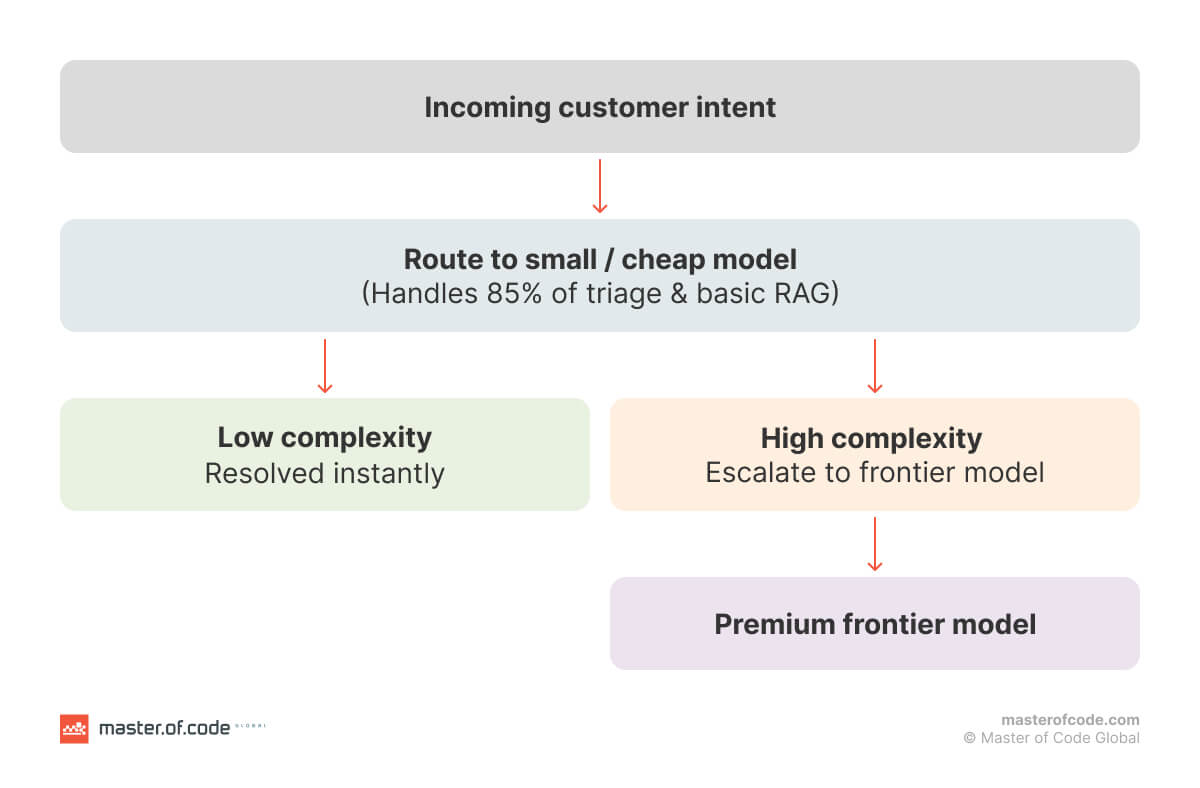
Routing uses a classifier to pick the right model up front; cascading runs the cheap model first and escalates only when its confidence is low. Both patterns reduce average transaction costs by allocating expensive frontier processing only when the problem state demands advanced semantic synthesis.
7. Agentic UX & The Shared Autonomy Canvas
An empty chat input box is an inefficient interface for complex enterprise work. It forces users to type lengthy textual prompts to correct minor elements of a generated output.
Modern agent software uses a Hybrid UX Paradigm built on the concept of Shared Autonomy:

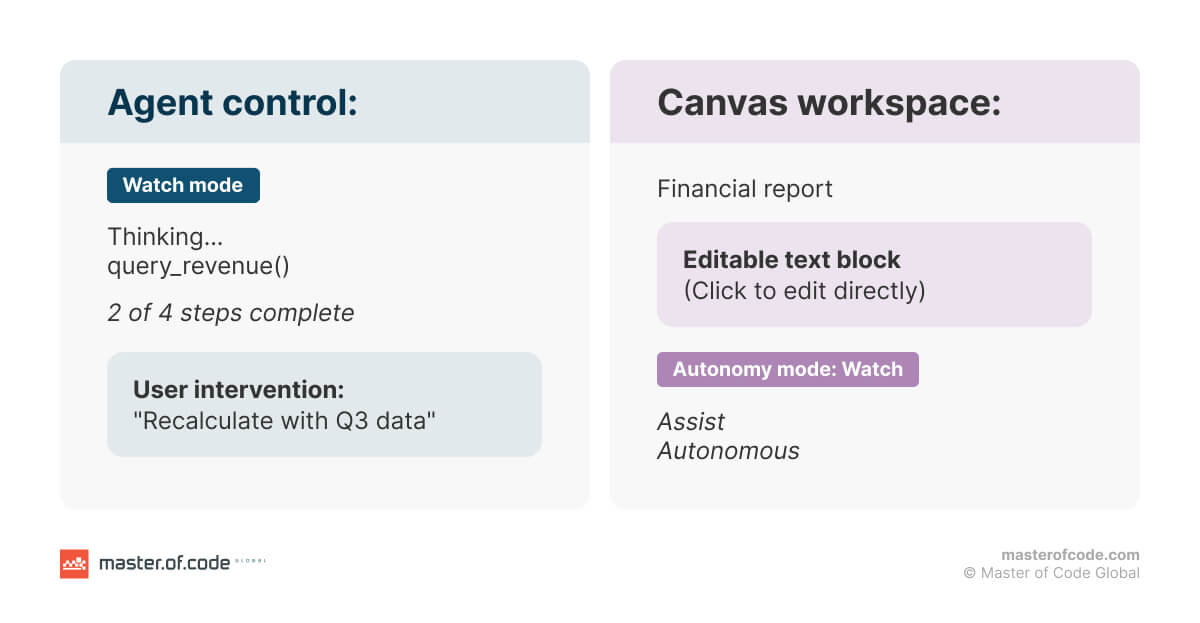
- The Canvas Layout: The screen is divided into an operational sidebar and a presentation workspace (the canvas). The agent operates in the sidebar, displaying its live execution trace, thoughts, and called tools, while it builds interactive components, documents, or data visualizations directly inside the main canvas.
- Traditional Interface Elements: Instead of forcing the user to type text commands for common operations, the canvas retains native interactive elements like sliders, drop-down menus, and direct text-editing blocks. The user can fix a typo or click a button to change a chart style without engaging the LLM.
- Variable Autonomy Modes: The application provides simple configuration states to control the agent’s degree of independence:
- Watch Mode: The human tracks a live visual graph of the agent’s processing path.
- Assist Mode: The agent executes sub-tasks and stops to wait for explicit manual confirmation before modifying the canvas.
- Autonomous Mode: Headless background processing that runs out of sight, updating an activity log and surfacing only if a security or compliance exception occurs.
8. Conclusion: Grounding Innovation in Business Value
Agentic architectures have moved from experimental open-source novelties into production-grade enterprise software patterns. They provide a mechanism to scale corporate intelligence, but their success depends on rejecting architectural hype in favor of disciplined engineering.
Building a system that delivers genuine operational return on investment requires moving past the allure of unconstrained autonomy. Real reliability comes from enforcing programmatic graphs, establishing zero-trust security perimeters around every tool (with particular attention to indirect prompt injection), optimizing model selection for token economics, instrumenting evaluation pipelines that account for the known weaknesses of LLM judges, and anchoring the software within hybrid user interfaces designed for meaningful human oversight. Upgrading to agentic systems is not about chasing the newest model release; it is about building resilient software that uses language-model computation to solve real-world problems safely and predictably.
If you’re evaluating where agentic systems can deliver measurable impact in your operations, get in touch with our team for a consultation and practical guidance tailored to your use case.