


No article will tell you exactly what your AI MVP cost will be. But…
The real number depends on your data, your systems, your integrations, and a dozen variables that only become clear once someone looks at your specific situation. But that doesn’t mean the research isn’t worth doing.
Understanding the cost tiers, what drives them up, and what most estimates quietly leave out puts you in a much stronger position before any vendor conversation begins. That’s what this article is for. And if at any point you want a proper assessment of what your specific project would actually cost, our team can work through it with you directly. Let’s start with the basics.
The cost ranges in this article are based on real project profiles and are intended as a general reference point. Every AI project is different, and actual costs depend on your specific requirements. For an accurate estimate, a proper assessment by an experienced team is always the right starting point. If you’d like one, we’re happy to help.
Table of Contents
Key Takeaways
- PoC, Pilot, and MVP are not interchangeable. Misidentifying your stage leads to quotes that don’t reflect what you actually need to build. Budgets below $30K–$40K typically cover an AI PoC or Discovery, not a production-ready AI MVP.
- AI MVP development cost runs from $20K–$45K for a narrow API-based build up to $350K+ for regulated or highly complex projects. Where you land within a tier depends on data readiness, integrations, accuracy requirements, and compliance obligations.
- Data preparation and integrations eat the most. These two cost drivers are the most consistently underestimated. Data work alone can account for 20–30% of total spend before a single AI feature is built.
- The visible build cost is only part of the picture. Post-launch monitoring, model maintenance, compliance documentation, and scope creep specific to AI routinely add 15–20% of the original build cost per year. Plan for them upfront or pay for them reactively.
- A realistic budget starts with scope, not features. Define what success looks like before development begins, separate the build cost from total cost of ownership, and reserve an iteration budget for the first 60–90 days post-launch.
MVP, PoC, or Pilot: Getting the Label Right Before You Plan Anything
Before talking about numbers, it’s worth getting clear on what you’re actually building. A lot of cost confusion in AI projects starts here.
PoC, Pilot, and MVP are not interchangeable. Vendors often use them loosely, and that leads to estimates that don’t match what you’ll actually need to spend.
Here’s how they differ:
- Purpose: Validate a technical assumption. Can this model work with our data? Is the approach even feasible?
- Scope: Narrow. One use case, controlled inputs, no real users.
- Output: Evidence that something is possible, not a usable product.
- Purpose: Test a working solution in a real but limited environment. Does it hold up with actual users and real data?
- Scope: Controlled deployment. One team, one process, one location.
- Output: Validated behavior and early adoption signals.
- Purpose: Launch the simplest version of a product that delivers real, measurable value to real users.
- Scope: Production-ready. Integrated, secure, monitored, and built to scale.
- Output: A live product, not an experiment.
The distinction matters for budgeting because each stage requires a different level of engineering. A PoC doesn’t need production infrastructure, compliance controls, or monitoring. An MVP does.
This is also where AI MVP cost estimates get misleading. If the scope isn’t clearly defined upfront, you can end up paying PoC prices for a build that actually needs MVP-level engineering. Hitting that gap mid-project is expensive.
As a general rule, in many enterprise-focused projects, budgets below $30K–40K often cover a prototype or PoC rather than a production-ready MVP. If a vendor quotes less than that for a full MVP, dig into what’s actually included before signing.
One practical check: ask what the deliverable looks like at the end. If it’s a demo, it’s a PoC. If real users can interact with it and you can measure it against defined KPIs, it’s an MVP.
AI MVP Cost by Complexity: Four Tiers Based on Real Projects

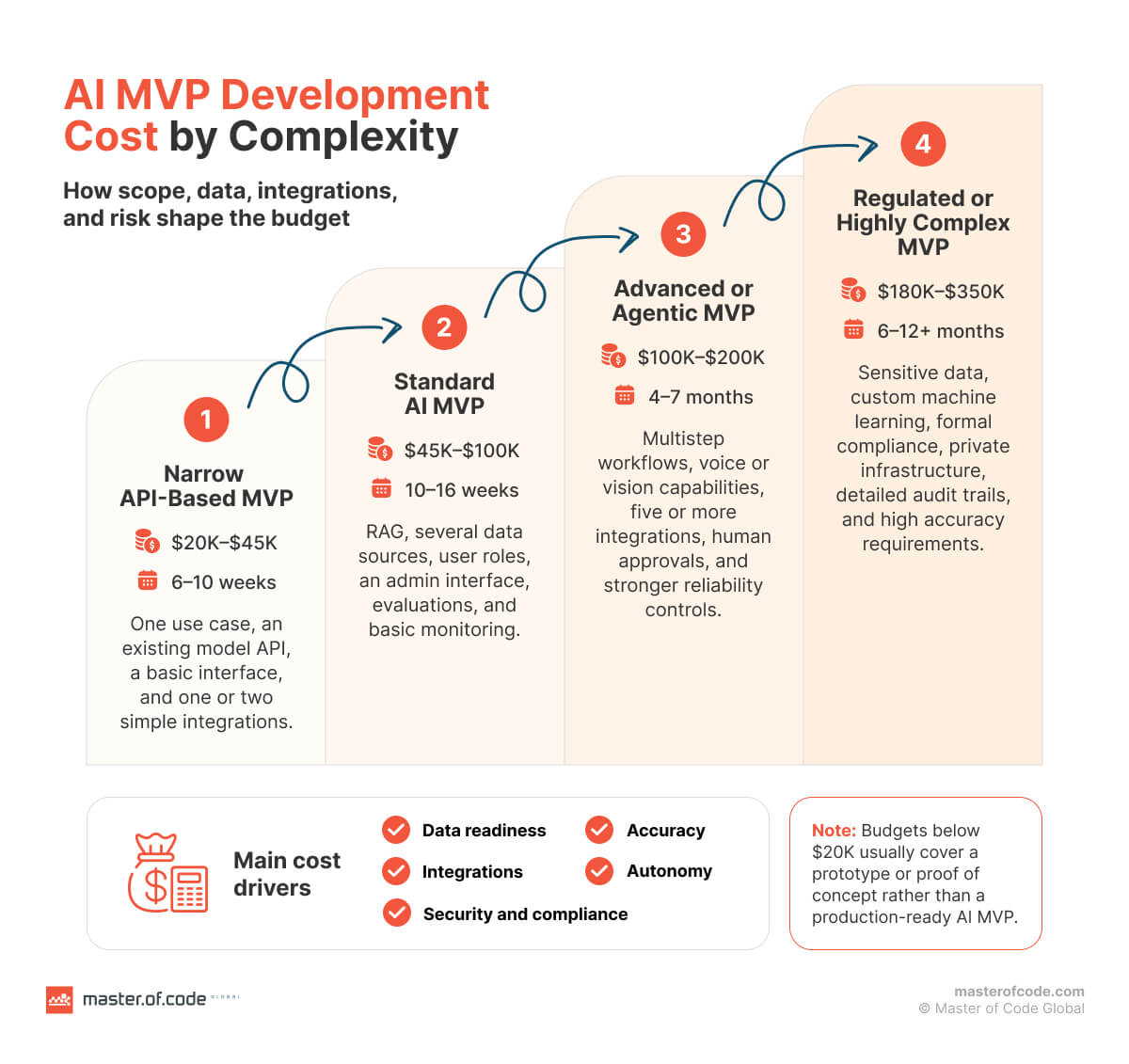
There’s no single price for an AI MVP. What you’ll pay depends on how much the system needs to do, what data it works with, and how many things it connects to. Below are four tiers based on real project profiles.
Tier 1: Narrow API-Based MVP
$20K–$45K | 6–10 weeks
The simplest and fastest path to a working AI product. This tier covers:
- One clearly defined use case;
- An existing model API (OpenAI, Anthropic, Google, etc.);
- A basic interface for end users;
- One or two simple integrations;
- Basic logging and error handling.
This works when the problem is focused, the data is reasonably clean, and you don’t need custom model training. Common examples: a document Q&A tool, a single-purpose internal assistant, an AI-powered content generation feature added to an existing product, or a simple lead qualification bot.
The technology stack here is lean by design. You’re connecting to a model API, building a thin interface on top, and integrating with one or two existing tools. The engineering effort goes into prompt design, basic retrieval, and making the output reliable enough for real users.
What typically pushes a project out of this tier: multiple user roles, more than two integrations, data that needs significant preparation, or accuracy requirements that demand evaluation infrastructure. If any of those apply, you’re looking at Tier 2.
Tier 2: Standard AI MVP
$45K–$100K | 10–16 weeks
This is the most common tier for B2B AI products, and where most enterprise-facing MVPs actually land. It typically involves:
- RAG (Retrieval-Augmented Generation) architecture;
- Multiple data sources connected and prepared;
- User roles and permissions;
- An admin interface for managing the system;
- Evaluation dataset and testing setup;
- Basic monitoring and performance tracking;
- Two to four backend integrations.
The jump in development cost from Tier 1 comes from a few specific things. RAG adds meaningful engineering work: chunking, embedding, indexing, and retrieval tuning all take time to get right. Multiple data sources mean data preparation becomes a project in itself. And once you have user roles and an admin layer, QA requirements increase significantly.
Most enterprise knowledge assistants, internal AI copilots, AI-powered customer support tools, and document analysis products fall here. If you’ve seen demos of these types of tools and thought “that’s roughly what we need,” this is the budget range to plan around.
What pushes you to Tier 3: if the system needs to do something rather than just respond, if it connects to five or more systems, or if it needs voice or vision capabilities.
Tier 3: Advanced or Agentic MVP
$100K–$200K | 4–7 months
Once the system needs to take actions rather than just generate responses, complexity and cost increase significantly. This tier covers:
- Multistep automated workflows;
- Tool use and external action-taking (writing to systems, triggering processes);
- Voice or vision capabilities;
- Five or more system integrations;
- Human-in-the-loop approval checkpoints;
- Stronger fallback controls and error recovery;
- More extensive evaluation and reliability testing.
The AI MVP development cost here reflects the engineering reality of agentic systems. Each action the agent can take needs to be validated, tested for edge cases, and wrapped in appropriate controls. Integrations multiply the failure surface. Human approval workflows require UI, logic, and audit design on top of the core AI functionality.
If this is the direction you’re heading, starting with an agentic AI POC first is worth the investment. It de-risks the workflow assumptions before you commit to a full build, and typically surfaces integration complexity that isn’t visible upfront.
Tier 4: Regulated or Highly Complex MVP
$180K–$350K+ | 6–12+ months
The most demanding category. Projects here are defined not just by feature complexity, but by the controls, documentation, and infrastructure required to operate safely. This tier typically involves:
- Sensitive data handling (health records, financial data, personal information);
- Custom model training or fine-tuning;
- Formal compliance requirements: HIPAA, GDPR, SOC 2, PCI DSS, or sector-specific standards;
- Private infrastructure deployment rather than shared cloud;
- Detailed audit trails and explainability requirements;
- High accuracy thresholds with documented evaluation methodology;
- Security architecture review and penetration testing.
Timelines at this tier are longer because compliance work adds phases that can’t be compressed. Legal review, security audits, and documentation requirements run in parallel with engineering and often block deployment until complete. This isn’t overhead that can be cut to reduce cost; it’s the product.
Industries that typically land here: healthcare, financial services, insurance, legal, and any product handling personal data at scale.

What Actually Drives AI MVP Development Cost
Two projects can look identical in a brief and come in at very different prices. The tiers above give you a starting range, but where you land within them comes down to six specific factors.
Data Readiness
This is the most underestimated cost driver in AI projects. The model itself isn’t the expensive part. Getting the data into a state the model can actually use is.
If your data is scattered across systems, inconsistently formatted, poorly labelled, or simply incomplete, that work needs to happen before any meaningful AI engineering can begin. Common tasks that add time and cost:
- Cleaning and deduplicating existing records;
- Structuring unstructured documents (PDFs, emails, legacy files);
- Building evaluation datasets to measure model accuracy;
- Setting up ongoing data pipelines for production.
Projects where data is clean, well-governed, and accessible from day one move faster and cost less. In many projects, data preparation can consume a substantial share of the budget before AI features are developed.
Integrations
Every system your MVP needs to connect to adds engineering time. One clean REST API integration is manageable. Five integrations with legacy systems, inconsistent data formats, and limited documentation is a different project entirely.
The complexity multiplies further when integrations are bidirectional, meaning the AI system doesn’t just read data but writes back to CRMs, ERPs, or ticketing systems. Each write operation needs validation logic, error handling, and testing that doesn’t exist for read-only connections.
Accuracy Requirements
Not all AI products need to be right 99% of the time. An internal brainstorming tool can tolerate occasional errors. A system making financial recommendations or triaging medical queries cannot.
Higher accuracy requirements mean more investment in:
- Evaluation dataset creation and maintenance;
- Prompt engineering and RAG tuning;
- Human review workflows for edge cases;
- Ongoing monitoring in production.
The higher the accuracy bar, the more engineering cycles go into hitting and maintaining it.
Autonomy and Agentic Behavior
A system that responds is simpler than a system that acts. The moment your MVP needs to take actions, trigger processes, or make decisions without human confirmation, the development cost increases. Every autonomous action requires fallback logic, approval workflows, and more thorough testing to ensure the system behaves correctly when things don’t go as expected.
Security and Compliance
Security architecture isn’t a feature you add at the end. For any MVP handling sensitive data or operating in a regulated environment, it shapes decisions made from the start: where data is stored, how it’s encrypted, who can access what, and how the system is deployed.
Compliance requirements add a distinct workload on top: documentation, audit trail design, legal review, and in some cases formal certification processes. These are non-compressible. They take the time regardless of how much engineering resources are available.
Technology Stack
The choice of models, frameworks, hosting environment, and orchestration layer all affect cost, both upfront and ongoing. A solution built on managed cloud APIs has different economics from one deployed on private infrastructure. A proprietary fine-tuned model has different maintenance implications from a standard API integration.
The right technology stack depends on your accuracy requirements, data sensitivity, expected scale, and budget for ongoing operations, not just what’s newest or most impressive at demo time.
Where the Budget Goes
Knowing the total range is useful. Knowing how that budget is actually distributed helps you plan more accurately and spot estimates that are missing something. Below is a sample breakdown for a $60K standard AI MVP. The percentages reflect real allocation patterns.
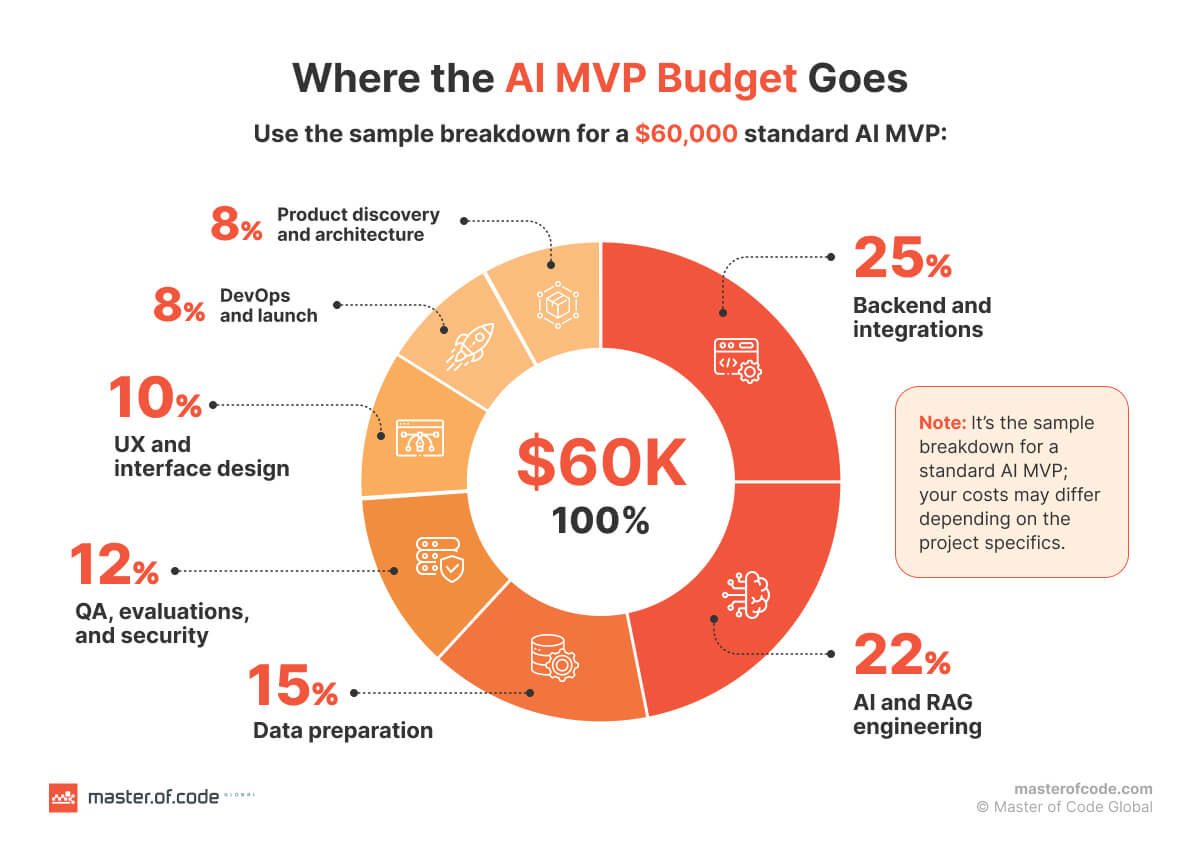
- Product discovery and architecture – 8% (~$4,800). Scoping the problem, mapping data sources, defining the technical approach, and producing the architecture before engineering begins. Skipping this phase doesn’t save money; it creates expensive rework later.
- UX and interface design – 10% (~$6,000). Wireframes, user flows, and interface design. Scales with the number of user roles and the complexity of the admin layer.
- Data preparation – 15% (~$9,000). Cleaning, structuring, chunking, and indexing data for RAG. This figure assumes reasonably accessible data. If your data is fragmented or poorly structured, this line item grows first.
- AI and RAG engineering – 22% (~$13,200). The core model integration, retrieval architecture, prompt design, and evaluation setup. This is where most of the AI-specific work happens.
- Backend and integrations – 25% (~$15,000). API development, system integrations, authentication, and data pipelines. Often one of the largest line items in standard MVPs, and the one most likely to expand if integration complexity is underestimated upfront.
- QA, evaluations, and security – 12% (~$7,200). Functional testing, model evaluation against defined benchmarks, and security review. In regulated projects, this line item moves up significantly.
- DevOps and launch – 8% (~$4,800). Infrastructure setup, deployment pipelines, environment configuration, and go-live preparation.
Two line items vary most between projects. Data preparation can double or triple if the source data needs significant work. Backend and integrations scales directly with the number of systems connected and how well-documented those systems are.
This breakdown is a reference point for a Tier 2 project. Agentic or regulated MVPs redistribute weight toward AI engineering, security, and compliance work, often significantly.
The Hidden Costs Most AI MVP Estimates Leave Out
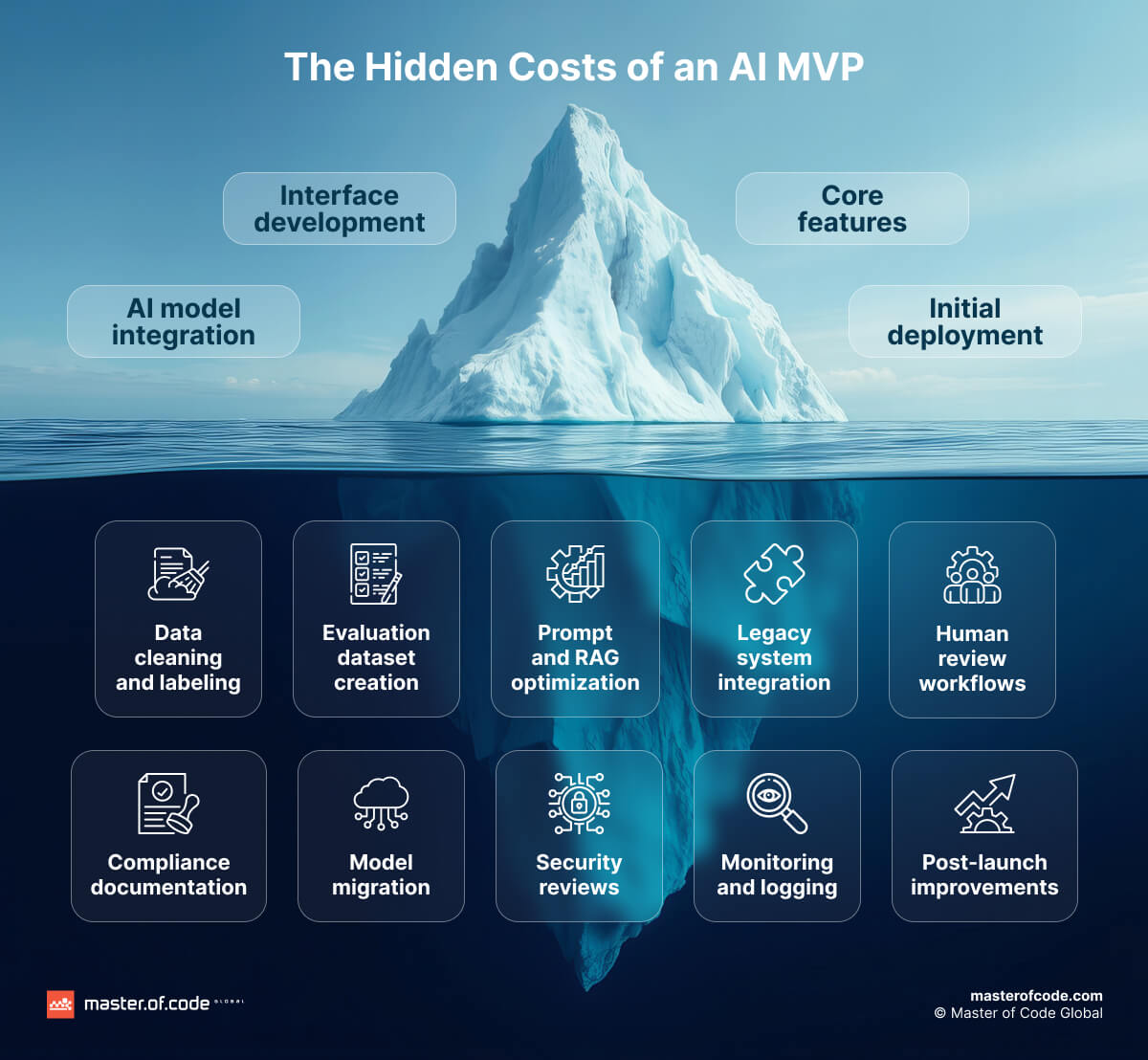
Most AI MVP estimates cover what’s visible: model integration, interface development, core features, initial deployment. What they don’t cover is everything below the surface, and that’s typically where projects go over budget.
These aren’t edge cases. They’re predictable costs that show up on almost every project, just rarely in the initial quote.
Post-Launch Monitoring and Model Maintenance
Launching an AI MVP isn’t the finish line. Once real users interact with the system, new problems appear that didn’t exist in testing. Output quality can change as usage patterns, data, and business requirements evolve. Prompts that worked well in controlled conditions start producing inconsistent results at scale. Retrieval quality degrades as the underlying data changes.
Post-launch costs that are routinely underestimated:
- Ongoing monitoring and alerting setup;
- Prompt and RAG optimization after real usage data comes in;
- Model migration when a better or cheaper model becomes available;
- Performance tuning as data volumes grow;
- Bug fixes from edge cases that only appear in production.
Many teams budget roughly 10–20% of the original build cost annually for maintenance and improvement. For a $60K MVP, that’s $9K-$12K annually just to keep the system performing well.
Data Preparation Gaps
The discovery phase surfaces most data issues, but not all of them. Some problems only appear when the system runs against the full dataset in production. Common late-stage surprises:
- Source documents with inconsistent formatting that breaks retrieval;
- Data that was clean in the sample but messy at full volume;
- Missing historical data that limits model accuracy;
- Integration sources that change format without notice.
Each of these requires engineering time to resolve, and they rarely arrive one at a time.
Compliance Documentation
For regulated projects, compliance isn’t a one-time gate. It’s an ongoing workload. After launch, you typically need:
- Audit trail maintenance and reporting;
- Regular security reviews;
- Documentation updates as the system changes;
- Legal review for new use cases or data sources.
This work doesn’t require large teams, but it requires consistent attention and adds real cost over time. Projects that don’t plan for it post-launch end up spending more reactively than they would have with a structured approach from the start.
Scope Creep Specific to AI
Traditional scope creep is about adding features. In AI projects, it more often looks like accuracy work: the system works but not well enough, so engineering cycles go into improving outputs rather than building new functionality.
Common sources:
- Accuracy thresholds that weren’t formally defined upfront;
- Edge cases discovered after real user testing begins;
- Stakeholder feedback that shifts the success criteria mid-build;
- Integration behavior that differs from documentation.
This is one of the strongest arguments for defining clear scope and validation criteria before development starts. When success is ambiguous, the development cost keeps growing until someone decides it’s good enough.
Infrastructure at Scale
Prototypes are cheap to run. Production systems are not. API costs, cloud infrastructure, and storage all scale with usage. A system handling 100 test queries a day has very different running costs from one handling 10,000 real queries.
For an honest view of total cost of ownership, the AI ROI calculation needs to include operating costs alongside build costs, not just the initial investment. And if you’re thinking about what comes after the MVP, from AI pilot to production article covers what the transition to full-scale deployment actually demands.
How to Build a Realistic AI MVP Budget
Getting the cost range right is one thing. Building a budget that actually holds through delivery is another. Most AI project projections fail not because the initial estimates were wrong, but because certain costs were never planned for at all.
Here’s how to approach it more accurately.
1. Start with scope, not features
The single biggest source of budget overruns in AI projects is undefined scope. Before any vendor gives you a number, you need to be clear on:
- What problem the MVP is solving, specifically;
- What success looks like, with measurable criteria;
- What data exists, where it lives, and what condition it’s in;
- Which systems the MVP needs to connect to;
- Who the users are and what they need to do with it.
Scope defined at this level of specificity produces estimates that hold. Vague briefs produce low quotes that grow throughout delivery.
2. Separate build cost from total cost
The development cost is what you pay to build the MVP. The total cost includes everything that comes after. A realistic budget accounts for both from the start.
A practical breakdown to plan around:
- Build cost – the initial AI MVP cost to reach launch;
- Iteration – 10-15% of build cost reserved for the first 60-90 days post-launch, when real usage surfaces issues that testing didn’t catch;
- Ongoing maintenance – 15-20% of build cost annually for monitoring, updates, and model maintenance;
- Infrastructure and platform costs – API usage, cloud hosting, storage, and any platform licensing fees that scale with usage.
If you’re building something that needs to work across multiple environments or devices, cross-platform requirements add engineering time and should be scoped explicitly, not assumed.
3. Set validation criteria before you start
Define what “working” means before the work begins. This sounds obvious, but most projects skip it. Without clear validation benchmarks, accuracy improvements become open-ended and scope creep follows.
Concrete examples of useful validation criteria:
- The system correctly answers X% of test queries from the evaluation dataset;
- Average response time stays under X seconds at expected load;
- Human review is triggered in fewer than X% of interactions.
4. Factor in the approach
Whether you’re evaluating no-code tools, low-code platforms, or fully custom development, the build approach directly affects both upfront cost and long-term flexibility. Custom-built cross-platform systems carry higher initial development costs but give you control over the architecture, data handling, and how the system evolves. That trade-off is worth understanding before the budget is set, not after.
How Master of Code Global Approaches AI MVP Development
Most companies come to us with an idea already formed. Before we scope anything, we slow that down.
The first thing we do is assess the idea and use case. That means looking at data readiness, existing infrastructure, team capability, and whether the use case actually justifies an MVP or whether a Pilot makes more sense first. We map it against real business impact, not just technical feasibility. If the numbers don’t stack up, we say so.
This consulting layer is what separates a realistic AI MVP cost estimate from one that falls apart mid-project. By the time we agree on scope, the main risks are already on the table.
When we do build, the development cost and timeline benefit directly from how we work. As a custom AI development company, Master of Code Global uses AI throughout our own delivery process, from requirements synthesis to code generation, automated testing, and QA. Our proprietary LOFT framework reduces initial setup effort by 43% and delivers up to 20% savings at scale. Test coverage reaches 90%+ compared to the 70% industry average. That efficiency doesn’t disappear into our margin; it compresses your timeline and improves the quality of the product.
We’re also platform-agnostic by design. We recommend the technology stack that fits your data environment, security requirements, and long-term needs, not what’s easiest for us to deliver. The same team stays with the project from kickoff to launch, which means no context loss, no repeated decisions, and no handover friction at a critical stage.
If a Pilot makes sense before a full MVP build, we’ll say that too and structure the engagement accordingly. The goal is a path that actually gets to production, not just a signed contract.
Wrapping Up
Most AI MVP budgets don’t fail because the technology is expensive. They fail because the scope was never properly defined, the label was wrong from the start, or no one planned for what happens after launch.
Getting an accurate number starts earlier than most people expect. It starts with being clear on whether you’re building a PoC, a Pilot, or a real MVP. It continues with honest data readiness, integration complexity, and a budget that accounts for the full lifecycle, not just the build. The hidden costs in this article aren’t edge cases. They’re the norm on projects that skipped the planning work upfront.
If you’re trying to get a realistic picture of what your project will actually cost and what it will take to get it to production, that’s the conversation to have before any development begins. Reach out to the Master of Code Global team and we’ll help you scope it honestly.
Discover how Master of Code Global can help enhance your customer’s experience and boost sales growth.