


The energy sector has plenty of ambitious AI projects: smart grid optimization, remote automatic meter reading infrastructure, predictive asset management. But some of the most operationally relevant use cases are smaller in scope and harder to notice from the outside.
Meter reading collection is one of them. For utilities still relying on manual submission processes, it is a recurring billing bottleneck: customers miss submission windows, estimates get issued, disputes follow. It is also a problem that artificial intelligence can address directly, without replacing the meter itself.
This article came out of delivery work. We built and deployed AI for meter reading collection as part of a long-term partnership with an energy company, and what that process revealed is worth sharing: how the technology works, what it takes to deploy responsibly, and what readiness actually looks like before you build.

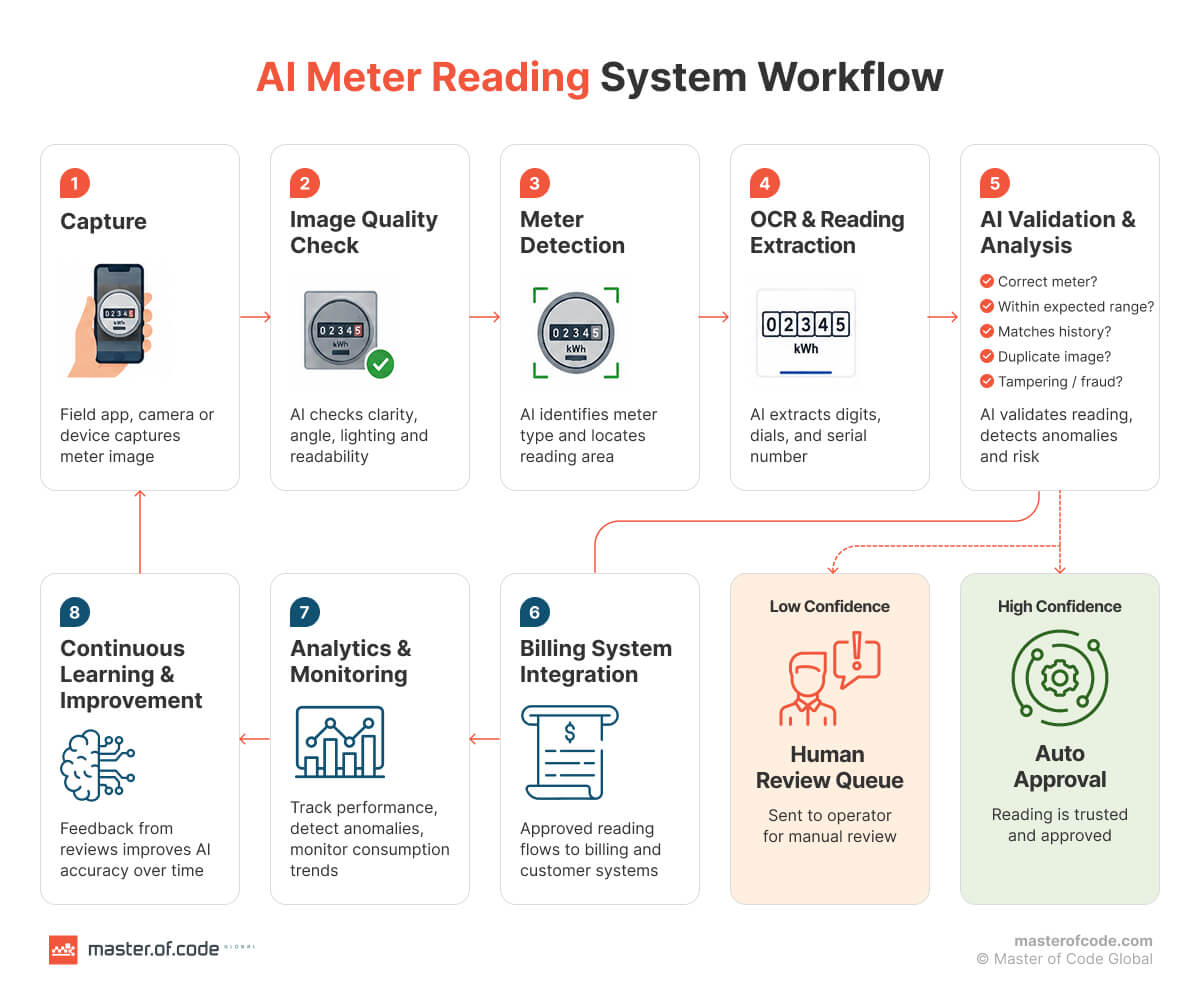
Table of Contents
Key Takeaways
- The AI for meter reading collection use case is live in production across multiple markets. Companies like Neoenergia and Enel Energia are running conversational meter reading at scale, with satisfaction scores above 90%.
- The workflow combines Conversational AI for proactive outreach with OCR-based image capture for photo submissions. Peer-reviewed research shows digit recognition accuracy at 95–99%, with cross-validation between typed input and photo further reducing transcription errors.
- Conversational AI covers the customer segments that automatic meter reading technology has not yet reached, making the two approaches complementary rather than competing.
- Readiness depends on three practical factors: consumption history for anomaly detection baselines, ERP API access for automated write-back, and a messaging channel with real customer reach in your market.
- Successful deployments are built as programs, not projects. Outcomes improve faster when supported by a team with expertise in Generative AI development services across similar programs and the operational context to act on post-launch analytics.
Is It Really Working in Practice?
We can answer that from experience. One of the deployments we’re familiar with is our ongoing partnership with a global LPG distributor serving millions of residential and commercial customers across 21+ countries.
The company had already built internal AI capabilities and was looking to scale them across customer-facing operations. We joined as a dedicated AI implementation team, working alongside their internal stakeholders rather than as an external vendor delivering a handoff. In practice, that looks like:
- A cross-functional team of project managers, AI engineers, developers, and conversation designers embedded into the program
- Joint ownership of delivery, performance monitoring, and iteration
- Ongoing identification of where AI can go next across the organization
One of the use cases we support is proactive Conversational AI for meter reading collection. The challenges are consistent across the energy sector:
- Operational cost pressure: manual collection through call centers is expensive and difficult to scale.
- Customer engagement friction: missed submission windows create billing errors, delays, and blocked invoices.
- No reliable self-service channel: without automation, high-volume data collection falls back on field teams or inbound support.
The solution is live now. The distributor is seeing a 93% customer satisfaction score and 98.68% of conversations resolved without any portal redirection. We continue working with them to improve the solution further. Furthermore, the partnership is expanding into internal operations, applying the same logic to back-office workflows.
Of course, our client is not the only example. Other energy companies have reached similar conclusions:
- Neoenergia, part of the Iberdrola group, built a Conversational AI channel on WhatsApp for its Brazilian distribution customers that includes a self-reading service, letting customers submit meter data directly through the app. The system logged over one million interactions in its first month at a 90%+ effectiveness rate.
- Enel Energia runs “Elena,” a virtual assistant available 24/7 on WhatsApp, Telegram, and Messenger. Among other tasks, it handles meter reading submissions directly through chat.
Between our own delivery work and what companies like Neoenergia and Enel Energia are already running in production, the answer is clear: AI can be effectively used for meter reading collection across different markets, company sizes, and automated meter reading utilities programs. For a broader view of where AI is creating measurable impact in energy, see our overview of AI in the energy sector.
With that said, let’s get into the less glamorous but equally important part: how it actually works.
How Does AI in Meter Reading Collection Actually Work?
The technology combines two main input methods. Conversational AI handles proactive outreach and the customer submission flow. Computer vision and optical character recognition (OCR) handle image-based capture when customers photograph their meter directly. Many customer self-reading workflows combine both: the conversational layer handles submission, while OCR provides a cross-check on the value entered.
In the conversational model, the system initiates contact at the scheduled reading window through a messaging channel: WhatsApp, SMS, or a branded utility app. The workflow is fully automated:
- A proactive message reaches the customer at the scheduled reading window.
- The customer submits their reading through the chat.
- The submitted value is validated against the consumption history, expected seasonal range, and average daily usage.
- Confirmed readings are written to the billing or ERP system automatically via API.
- Values outside acceptable thresholds are flagged for human review, not rejected outright.
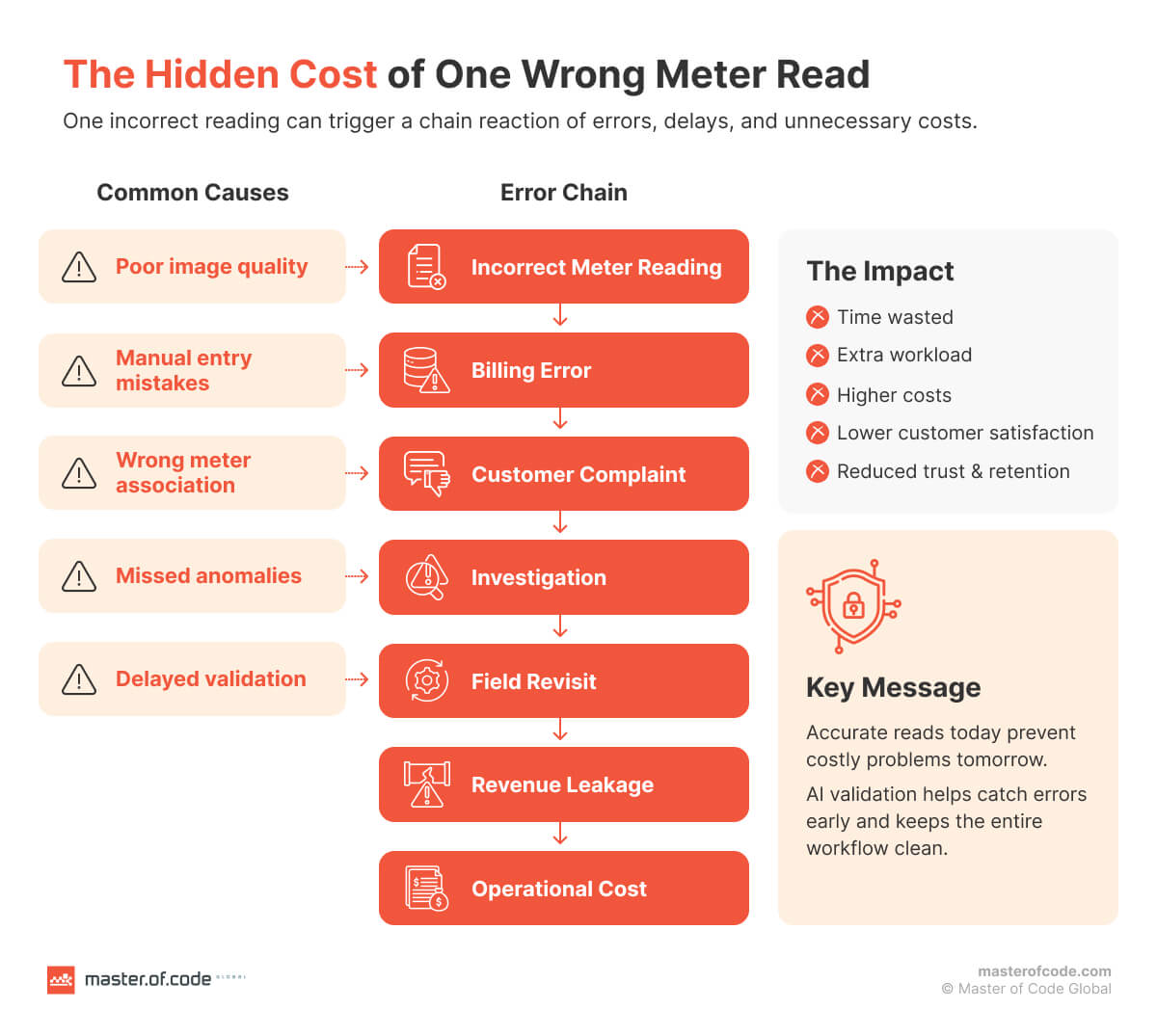
The third step is where precision is truly shaped. AI meter reading accuracy depends on anomaly detection logic that runs at the point of submission rather than downstream in the billing process. A reading that spikes well above the customer’s recent average, shows an unexplained drop, or appears as an implausibly round number, is a candidate for review. This follows a similar logic to how AI fraud detection works in financial services: the same instinct to run pattern analysis at the point of submission, before an error compounds downstream.
OCR meter reading powered by AI works differently. Instead of typing a value, the customer photographs their meter display. A computer vision model, typically a convolutional neural network trained on meter images, performs digit segmentation and recognition. Peer-reviewed computer vision research on meter digit recognition consistently shows accuracy rates of 95 to 99% for well-trained models on clear images.
The main variables affecting performance are image quality, meter type, and lighting conditions. Analog dials require different recognition logic than digital LCD displays, and both are affected by weathering, dirt, or poor camera angles. The practical countermeasure is cross-validation: when both a typed reading and a photo are submitted, the system compares both before accepting the submission, which eliminates most transcription errors before they reach the billing system.
Where Conversational AI fits against hardware-based automatic meter reading systems comes down to infrastructure and timeline. AMI deployments, where smart devices transmit readings automatically without any customer involvement, enable real-time data collection and remove human error from the process entirely. But per-meter hardware installation makes large legacy portfolios a capital-intensive migration that takes years to complete.
According to the IEA’s tracking of global smart meter deployment, roughly one billion smart meters were installed worldwide as of 2022. It’s a significant number, but one that still leaves a substantial share of global utility customers on traditional meters with no near-term hardware upgrade scheduled. For those customer segments, Conversational AI achieves meaningful automation without waiting for infrastructure.
The consumption data collected through either approach feeds the same downstream analytics pipeline. AI predictive analytics services can apply reading history to demand forecasting models and early anomaly detection that extend well beyond billing. This connects meter data to the broader question of grid reliability and load management.
Post-deployment monitoring determines whether performance holds or drifts. Completion rate, fallback trigger rate, and validation rejection rate each signal different operational issues. A high fallback rate typically points to a conversation design problem. A sustained spike in validation rejections often indicates upstream data quality issues that precede the AI system. These are not self-correcting. The implementations that improve over time are those with someone actively reading the analytics and acting on what they find.
Will It Work for Me?
The short answer: it depends on a few specific conditions, and most are easier to meet than organizations expect.
Volume is the primary driver. AI for meter reading collection generates the most value when manual collection is a significant operational line item. That typically means a large customer base where field visits or inbound support consume real budget each billing cycle. For smaller portfolios, the calculation depends on reading frequency and how many submissions go missing each cycle.
Channel availability matters almost as much as technology. Conversational collection works best when there is already a messaging channel with meaningful customer reach: WhatsApp, SMS, or a utility app. In markets where WhatsApp penetration is high, completion rates in well-designed campaigns tend to follow. Where the channel is fragmented or customer contact data is incomplete, the system reaches fewer customers, which affects both collection rates and the business case.
A few readiness factors worth checking before committing to a build:
- Consumption history: anomaly detection requires historical data to establish baselines. New accounts or records with gaps in history need a fallback validation approach.
- ERP and billing integration: automated write-back requires API access to the back-end system. Legacy billing platforms without this will need a middleware layer.
- Automatic meter reading devices already deployed across parts of the portfolio can coexist with conversational collection, serving different customer segments rather than competing with them.
If any of these gaps exist, they are addressable, but each one affects scoping and timeline. That is typically where the AI consulting starts: not with the technology, but with what the data and system landscape actually support.
Master of Code Global has built and deployed conversational meter reading as part of long-term programs for AI implementation in business across the energy sector. That work spans both greenfield deployments and integrations into existing customer service architectures. If this is an area you are actively exploring, our custom AI development team can scope what is realistic for your infrastructure before anything is built.