


People Express changed the airline market by proving that cheaper fares could fill planes fast. American Airlines faced a direct pricing threat, but it did not respond by cutting costs only. It built a system that could decide which seats should stay expensive, which ones could be discounted, and when each fare class should open or close.
That shift became one of the clearest early examples of system-driven pricing. Smith, Leimkuhler, and Darrow estimated that American Airlines’ yield management work generated $1.4 billion in quantifiable benefit over three years, with more than $500 million in expected annual revenue contribution going forward. The lesson was simple: when inventory, timing, and customer willingness to pay change constantly, static pricing leaves money on the table.
AI price optimization is that same shift applied to modern business. Instead of adjusting a limited number of airline seats, companies can optimize thousands of products, services, locations, customer segments, and channels at machine speed. The impact compounds because pricing is one of the most powerful commercial levers. McKinsey found that a 1% improvement in price can create a 6% effect on profitability for a typical S&P 500 company.


For retailers, insurers, airlines, marketplaces, subscription platforms, and B2B companies, pricing is no longer a quarterly spreadsheet task. It is a continuous decision system. The companies that build it well can protect margins without blindly raising prices, and convert more demand without discounting everything.
This article explains how AI price optimization works, where it creates business value, and what companies should consider before turning pricing into a continuous decision system.
Table of Contents
Key Takeaways
- Manual pricing cannot keep up with large catalogs, multiple channels, fast demand shifts, and constant competitor movement.
- AI price optimization helps companies balance revenue, margin, conversion, inventory, and customer demand in one decision system.
- Dynamic pricing changes prices, but optimization decides what the business should actually achieve with those price changes.
- Strong AI pricing systems depend on clean data, demand forecasting, business rules, and clear approval logic.
- Retail, airlines, insurance, travel, and hospitality already use AI to improve markdowns, fares, rates, and offer decisions.
- The main value is better margin control, faster response to market changes, fewer unnecessary discounts, and more confident pricing decisions.
- Custom AI becomes important when pricing depends on complex data, workflows, channels, customer segments, or commercial constraints.
Why Getting Pricing Right at Scale Is Harder Than It Looks
Most companies know pricing matters. Fewer have the data structure, governance, and operating rhythm to manage it well. What looks like a small price decision on one product becomes a major leakage point when repeated across thousands of SKUs, locations, partners, contracts, or customer groups.
The first failure is scale. A pricing team can manually review a few product lines, but it cannot continuously evaluate every price, every channel, and every demand signal. As catalogs grow, teams start relying on broad rules, outdated assumptions, and average margins. That works until demand shifts or inventory starts moving unevenly.
The second failure is a delayed reaction. By the time a team notices competitor pricing changes, the margin or conversion damage may already be done. Some businesses respond too aggressively and start unnecessary discounting. Others react too slowly and lose demand before they understand what happened.
The third failure is volatility. Demand can shift because of seasonality, weather, local events, promotions, supply delays, inflation, stockouts, or changing customer expectations. Without reliable forecasts, teams often underprice high-intent moments and overprice weak ones. Both outcomes hurt revenue, just in different ways.
The fourth failure is channel inconsistency. A product can have one price on the website, another in a marketplace, a different promotion in email, and a separate discount in sales conversations. That inconsistency quietly erodes profit margin and customer trust. It also makes performance analysis harder because teams cannot tell which price actually moved the result.
This is why pricing becomes a systems problem. The issue is not that people do not understand prices. The issue is that market conditions now move faster than manual decision cycles.
What AI Price Optimization Is and How It Differs from Dynamic Pricing
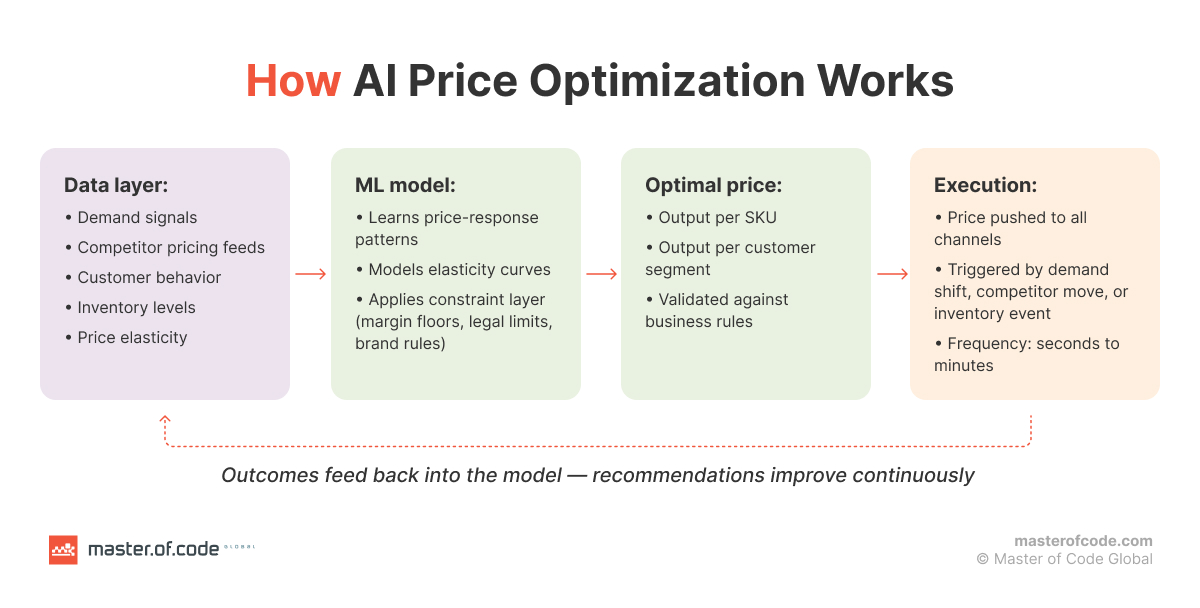
This approach uses machine learning models to recommend or set prices that maximize a defined business objective. That objective can be revenue, margin, conversion, sell-through, retention, market share, or a combination of several targets. The model also works within rules: minimum margin, brand position, legal constraints, contract terms, inventory limits, and customer fairness policies.
The important part is that optimization is the strategy layer. It decides what the business should try to achieve with pricing, given the data and constraints available. A company may want to clear seasonal products faster, protect premium positioning, reduce churn, increase attach rates, or improve contribution margin across a category.
AI dynamic pricing is more of an execution tactic. It changes prices as conditions shift. That can be useful, but it is not automatically smart. A company can change prices frequently and still make poor decisions if the model is optimizing the wrong goal.
Price automation is different again. It removes manual work from pricing updates, approval flows, or channel synchronization. Automation can make teams faster, but speed alone does not create better decisions. Bad logic executed faster only spreads the problem faster.
This distinction matters for leaders choosing between custom systems and price optimization software. A tool can help with standard repricing workflows, but complex workflows often demand models that understand business’s margins, customer segments, operational constraints, and commercial priorities. That is where custom decision logic becomes important.
How the Pricing System Works: Data Inputs, Models, and Pricing Logic
A strong pricing system does not begin with a model. It begins with the data needed to explain why customers buy, why they do not buy, and what each sale actually contributes to the business.
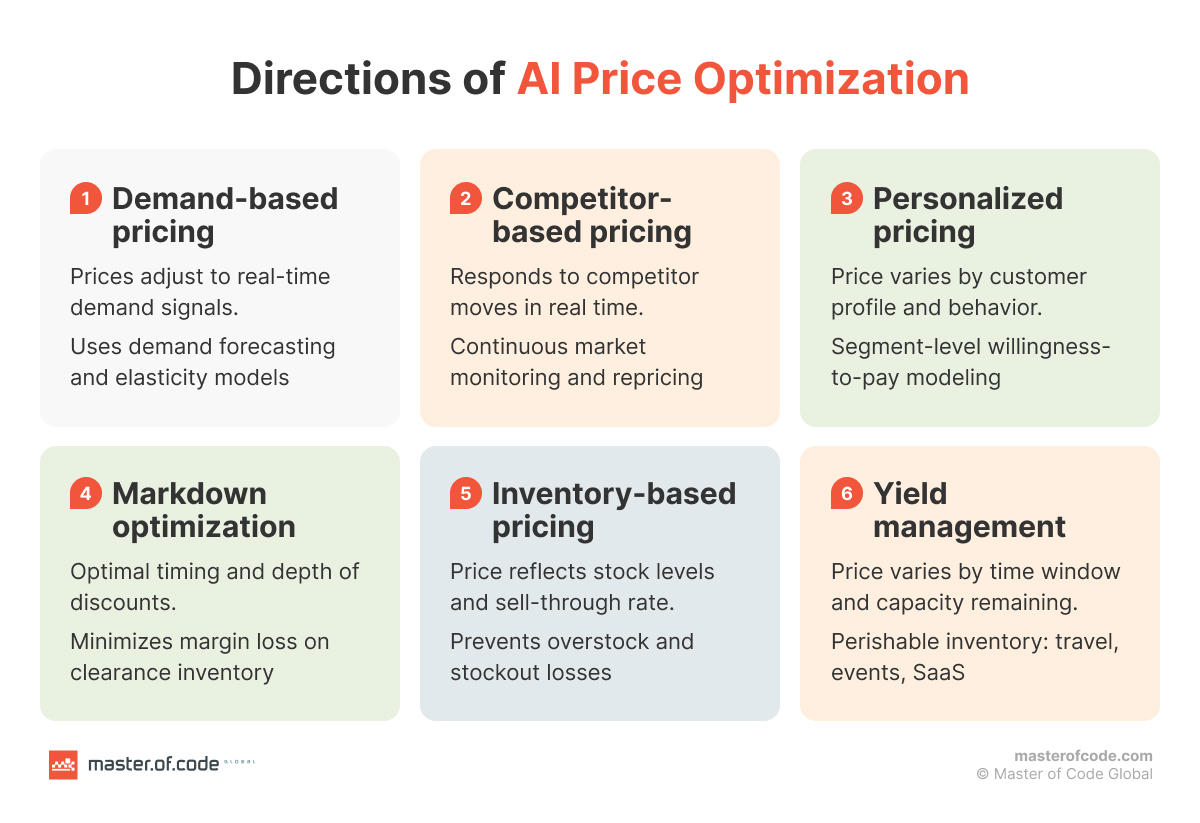
1. Data Collection: Building the Pricing Picture
The model needs internal and external signals.
- Internal data usually includes historical sales, discounts, product costs, margins, stock levels, promotions, returns, customer segments, and channel performance.
- External data may include market demand, competitor pricing, seasonality, weather, events, and macroeconomic indicators collected using residential proxies meaning IP addresses assigned to real residential devices, to access location-specific web information more reliably.
For commerce companies, this layer often connects pricing with AI inventory management. A discount that looks attractive in isolation may be wrong if inventory is already moving fast. A higher price may be safe when stock is limited, but risky when the product is perishable or seasonal.
The goal is to make every price recommendation context-aware. A model should not only see that sales slowed down. It should understand whether sales slowed because of price, availability, traffic quality, competitor action, or changing customer behavior.
2. Model Training: Learning What Moves Demand
Once the data is usable, machine learning models look for patterns. They estimate how demand changes when price changes, which products are substitutable, which segments are more sensitive, and when promotions create incremental demand versus margin waste.
This is where AI predictive analytics services become valuable. Demand forecasting helps teams predict future sales under different price scenarios instead of only reporting what happened last week. The model can test likely outcomes before a new price reaches customers.
Models may also account for cannibalization. Lowering the price of one product can move demand away from another product with a better margin. In B2B, a discount on one deal can influence renewal expectations later. In travel or hospitality, selling too many low-rate units too early can block higher-value demand closer to the service date.
3. Pricing Decision: Balancing Objectives and Constraints
The pricing engine then compares possible prices against the business goal. It can recommend the price that maximizes revenue, margin, conversion, or sell-through. It can also flag cases where the best mathematical answer conflicts with business rules.
For example, a retailer may prevent the model from raising prices above a brand threshold. An insurer may need regulatory approval before changing rates. A marketplace may limit price gaps between sellers. A subscription business may protect existing customers from abrupt renewal increases.
This layer is where explainability matters. Teams need to know why a recommendation changed. Was it demand, stock, seasonality, cost, or competitive movement? Without that clarity, pricing teams either distrust the model or approve recommendations blindly. Neither is acceptable.
4. Execution and Feedback: Closing the Loop
After approval, prices move into commerce systems, ERP, CRM, marketplaces, apps, or sales tools. This is where real-time pricing infrastructure can matter, especially when prices must update across many channels without inconsistencies.
The loop does not stop after execution. The system tracks conversion, revenue, margin, churn, sell-through, and customer response. It learns which recommendations worked and which ones need adjustment. Over time, that feedback improves both the model and the business rules.
The best systems also separate routine decisions from exceptions. Low-risk changes can be automated. High-risk changes can go to human review. That creates speed without removing accountability.
Pricing Intelligence in Practice: Use Cases Across Industries
The clearest examples come from industries where prices, inventory, and demand change quickly. These cases show how machine learning improves pricing decisions without reducing the topic to simple discounting.
Retail: Walmart and Smarter Markdowns
Walmart has been careful to separate its pricing work from surge pricing concerns. In March 2026, the company had secured U.S. patents for machine learning systems related to pricing, including one for markdowns and another for demand prediction and recommendation. Walmart told the Financial Times that the patents were unrelated to surge pricing and that one system was designed for human-led decisions.
The important business point is markdown quality. Seasonal and perishable products lose value when discount timing is wrong. Discount too early, and the retailer gives away margin. Discount too late, and inventory expires, sits unsold, or requires deeper clearance later.
For large retailers, better markdown timing can reduce margin erosion and improve inventory flow. It also creates a more disciplined alternative to broad promotional habits that train customers to wait for discounts.
Airlines: Hawaiian Airlines and AI-based Fare Optimization
Airlines have always been natural pricing laboratories because seats are perishable inventory. Once the plane departs, unsold seats produce no revenue. Hawaiian Airlines implemented AI to support demand forecasting and optimal fare decisions in a volatile travel market.
PhocusWire later reported that Hawaiian saw a 7% revenue increase in leisure markets and a 9% yield increase after moving to dynamic pricing. The same article noted that analysts had less manual work, which matters because pricing teams need time for strategy, not endless fare maintenance.
The airline example also shows why ancillary products need separate logic. Seat selection, bags, and other add-ons do not behave exactly like base fares. They need pricing models that understand timing, intent, and willingness to pay differently.
Insurance: Lemonade and Risk-Based Pricing Signals
Insurance pricing is different from retail because the “product cost” is future risk. Lemonade’s filings describe its Customer Cortex as the place where customer data is transmitted, continuously analyzed, and used across several AI applications. Its 2025 annual report also describes a car insurance pricing model that uses direct vehicle telemetry in certain markets to distinguish autonomous and human-driven miles.
That matters because the pricing decision is tied to risk accuracy. Better signals can help insurers price policies closer to the actual expected loss. Lemonade reported that it passed $1 billion in in-force premium in 2025, and that AI-powered automation helped drive loss adjustment expense ratios of about 4%.
The lesson is not that every insurer should copy Lemonade’s model. It is that pricing can become more precise when quoting, underwriting, servicing, and claims data feed a common intelligence layer.
Travel: Delta and the Governance Challenge
Delta Air Lines became one of the most discussed pricing examples in 2025. PYMNTS reported that Delta was testing an AI pricing system on 3% of flights, with plans to expand it to 20% by the end of the year. The discussion quickly turned into a public debate about personalized pricing, privacy, and fairness.
Delta later stated that its AI-powered pricing functionality was designed to enhance existing fare pricing using aggregated data. The company also said there was no fare product used, tested, or planned that targets customers with individualized prices based on personal data.
This case is useful because it shows both the opportunity and the reputational risk. AI can help teams analyze millions of fare and route signals faster. But companies need clear governance, transparent messaging, and defensible data policies before scaling sensitive pricing models.
Hospitality: Marriott and Group Rate Optimization
Marriott’s Group Pricing Optimizer is an older but still useful example of optimization logic in hospitality. An INFORMS paper described it as a decision-support system for pricing group hotel rooms. The system used demand segmentation, price elasticity modeling, and optimization techniques to recommend group rates.
The use case is complex because group bookings involve negotiation, room blocks, event space, long booking windows, and uncertain pickup. A flat rate may look easier, but it can underprice high-value demand or overprice groups the hotel should win.
Marriott’s example shows why AI based recommendation system logic can be useful beyond product suggestions. In pricing, recommendations guide human teams toward better decisions while preserving control over final approvals.
What Businesses Actually Gain: Margin, Speed, and Pricing Confidence
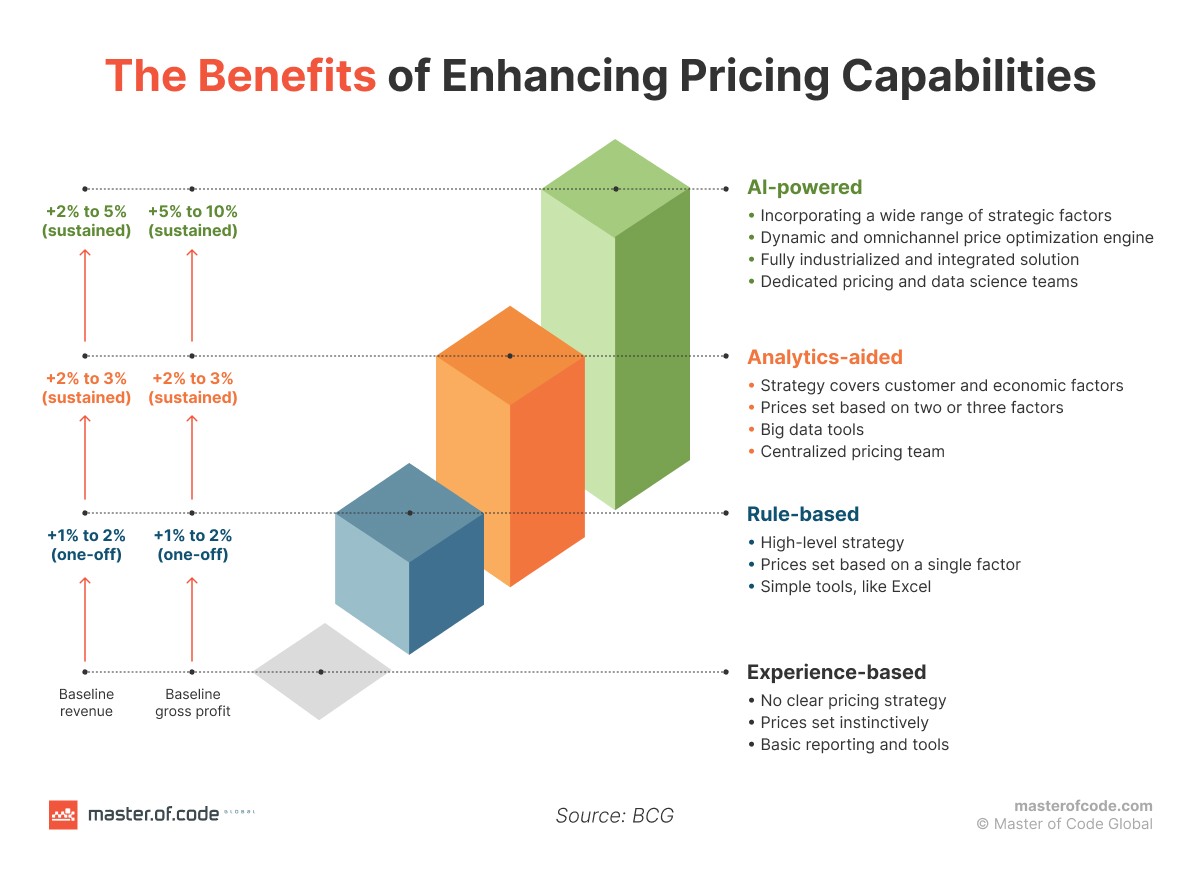
The first gain is margin protection. Better pricing does not always mean higher prices. Often, it means fewer unnecessary discounts, smarter markdowns, and better alignment between price and demand. Walmart’s markdown example shows how retailers can improve discount quality without presenting the work as customer-facing surge pricing.
The second gain is faster market response. When costs, demand, or competitors move, teams need to see the signal quickly and act with confidence. Real-time pricing capabilities help only when the underlying model understands what should change and why.
The third gain is better conversion quality. A business can improve conversion by discounting heavily, but that is not always profitable. More advanced models help identify where lower prices create incremental demand, and where customers would have converted anyway.
The fourth gain is consistency across channels. Data-driven pricing helps teams apply one commercial logic across websites, apps, marketplaces, sales teams, and partner channels. That consistency reduces confusion and makes performance reporting cleaner.
The fifth gain is better human focus. Pricing managers should not spend most of their time updating spreadsheets or checking routine exceptions. AI can surface recommendations, risks, and anomalies, while people focus on strategy, rules, and commercial judgment.
Wrapping Up
Pricing used to be a periodic decision. Now it is a continuous system. Demand shifts too quickly, catalogs are too large, and customers compare options too easily for businesses to rely only on manual reviews.
AI price optimization gives companies a way to connect data, models, rules, and execution into one pricing strategy. It helps protect margin where discounting is unnecessary, capture demand where prices are too high, and respond faster when the market changes.
But the strongest systems are not just automated. They are governed, explainable, and built around real commercial constraints. They show teams when to act, when to hold, and when a recommendation needs human review.
For companies with complex pricing logic, off-the-shelf tools may not be enough. Master of Code Global helps businesses design and build custom AI solutions that fit their data, workflows, and decision rules. If your pricing challenge depends on more than simple repricing, a custom AI layer can help turn pricing from a recurring debate into a measurable advantage.
Discover how Master of Code Global can help enhance your customer’s experience and boost sales growth.