



Nearly nine in ten organizations now use AI in at least one business function. Investment is accelerating, and leadership pressure to move faster has rarely been higher. The story looks good from the outside.
From what I see in pre-sales conversations every week, as a Chief Delivery Officer at Master of Code Global, most organizations are stuck in the same place: experiments that showed promise but never reached production, initiatives that delivered something in a controlled environment and then stalled, and a board that keeps asking about AI ROI without a clear baseline to answer against.
The gap between using technology and scaling it is a diagnostic problem rather than technological. Before you can fix what is holding your initiatives back, you need to know precisely where you stand across the dimensions that actually matter. Here, I break down what a proper AI maturity assessment measures, how to interpret your results by maturity level, and what a decision-ready output looks like in practice.
Table of Contents
Key Takeaways
- An AI maturity assessment is a structured diagnostic that scores your organization across multiple dimensions independently. It produces a gap map rather than a single number because a gap in one area can block progress across all the others.
- Most organizations have broad AI adoption but narrow impact: McKinsey’s research found that only 39% of organizations report EBIT impact at the enterprise level, and only one-third have begun scaling AI across the enterprise.
- Master of Code Global offers two ways to run the assessment: a free 15-question self-serve tool for a fast directional read, and an expert-facilitated workshop covering 45 questions, which feeds directly into a scoped roadmap and 90-day activation plan.
- A thorough assessment covers areas including enterprise AI strategy, technology infrastructure, team capability, data readiness, governance, and operational excellence, each evaluated separately to surface exactly where the real blockers are.
- The four AI maturity levels each call for a different intervention: organizations at the AI Curious stage need to define the problem before choosing technology, while those at AI Implementing need governance and deployment infrastructure in place before adding more use cases.
- An assessment is only useful if its output drives a clear sequence: which gaps to close first, which use cases to prioritize, and what organizational conditions need to be true before any build starts.
Free Assessment
A directional read across strategy, data, and team readiness. Scored result delivered straight to your inbox.
What Is an AI Maturity Assessment?
At its simplest, it’s a questionnaire: structured questions, a score, and a directional read on where your organization stands. That is a legitimate starting point, and for many teams it is enough to know which conversation to have next. But if the output needs to drive real decisions, a score alone rarely gives you what you need.
An AI maturity assessment is a structured diagnostic that measures how deeply and consistently technology is embedded across your organization’s operations. Not whether you are using intelligent tools. Whether your organization can actually build, deploy, and sustain AI in a way that produces measurable business results.
One observation I come back to often: artificial intelligence has a way of surfacing every organizational problem that was already there. Poor data governance, unclear ownership, disconnected strategy. These exist before AI arrives, but AI makes them impossible to ignore. The assessment gives you that picture before you commit budget, not after things have started going sideways.
Depending on who runs the assessment and which AI maturity model they apply, the areas covered will vary. Most thorough frameworks evaluate some combination of:
- AI strategy and business alignment: whether intelligentization goals exist, connect to real business objectives, and have leadership ownership behind them.
- Data and infrastructure: the quality, availability, and governance of the data the organization relies on, plus the technical foundation needed to support workloads.
- Technology and tooling: platforms, integrations, and deployment capabilities already in place.
- Talent and organizational capability: the skills available internally to build, manage, and evaluate AI over time, and how well leadership understands what it is actually buying.
- Use cases and production deployment: what is live, what is delivering measurable value, and what never made it past a controlled environment.
- Governance, risk, and compliance: policies for responsible AI use, data privacy, regulatory requirements, and how risk is managed as tech scales.
- Operational performance: how solutions are monitored, maintained, and improved after launch.
Each dimension is scored independently. That independence is the point. What leadership needs to see is not “we scored 62%” but specifically which gaps exist and which are most likely to block the next initiative. A dimension-by-dimension gap map tells a very different story than a single number.
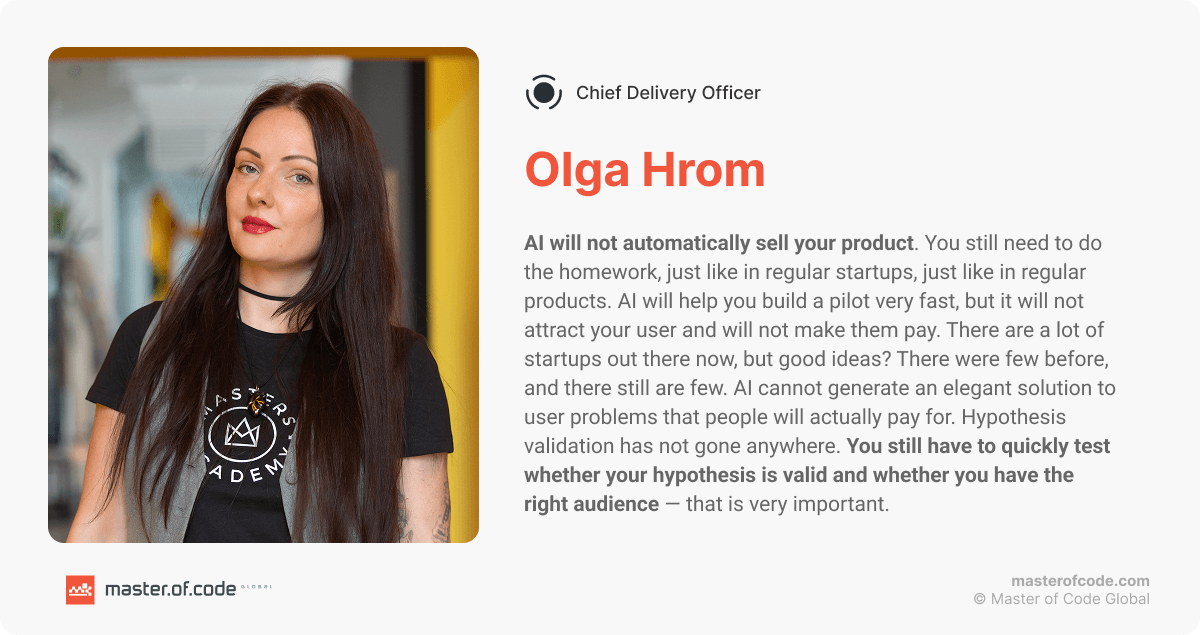
It is also worth separating an AI maturity assessment from a basic AI readiness check. Readiness asks whether you are prepared to start. Maturity maps where you are across all the dimensions that determine whether technology scales. If your initiatives are already running but not delivering enterprise-level results, readiness is the wrong question. Understanding how to implement AI in business at scale starts with an honest baseline, and that is what the AI maturity framework is designed to give you.

Why Most Organizations Need One Before Committing More Budget
On paper, adoption has never looked stronger. McKinsey’s State of AI report puts a clear number on it: 88% of organizations now use it in at least one business function, up from 78% the previous year. Investment is accelerating. Leadership confidence is high.
The production numbers tell a different story. According to the same research:
- Only about one-third of organizations have begun scaling AI across the enterprise, and just 7% report it is fully scaled.
- Only 39% report any EBIT impact at the enterprise level, meaning the majority of spend is producing activity, not results.
- Only 6% qualify as high performers with significant, measurable financial returns.
- Gartner found that organizations with high AI maturity sustain their initiatives for three or more years at a rate of 45%, compared to just 20% in low-maturity organizations.
The gap between “we use AI” and “AI is working for us at scale” is where most organizations are stuck right now. Closing it requires an honest picture of where you actually stand before committing more budget, and that picture is what most organizations do not have. The transition from experimentation to production deployment is where investment quietly stalls.

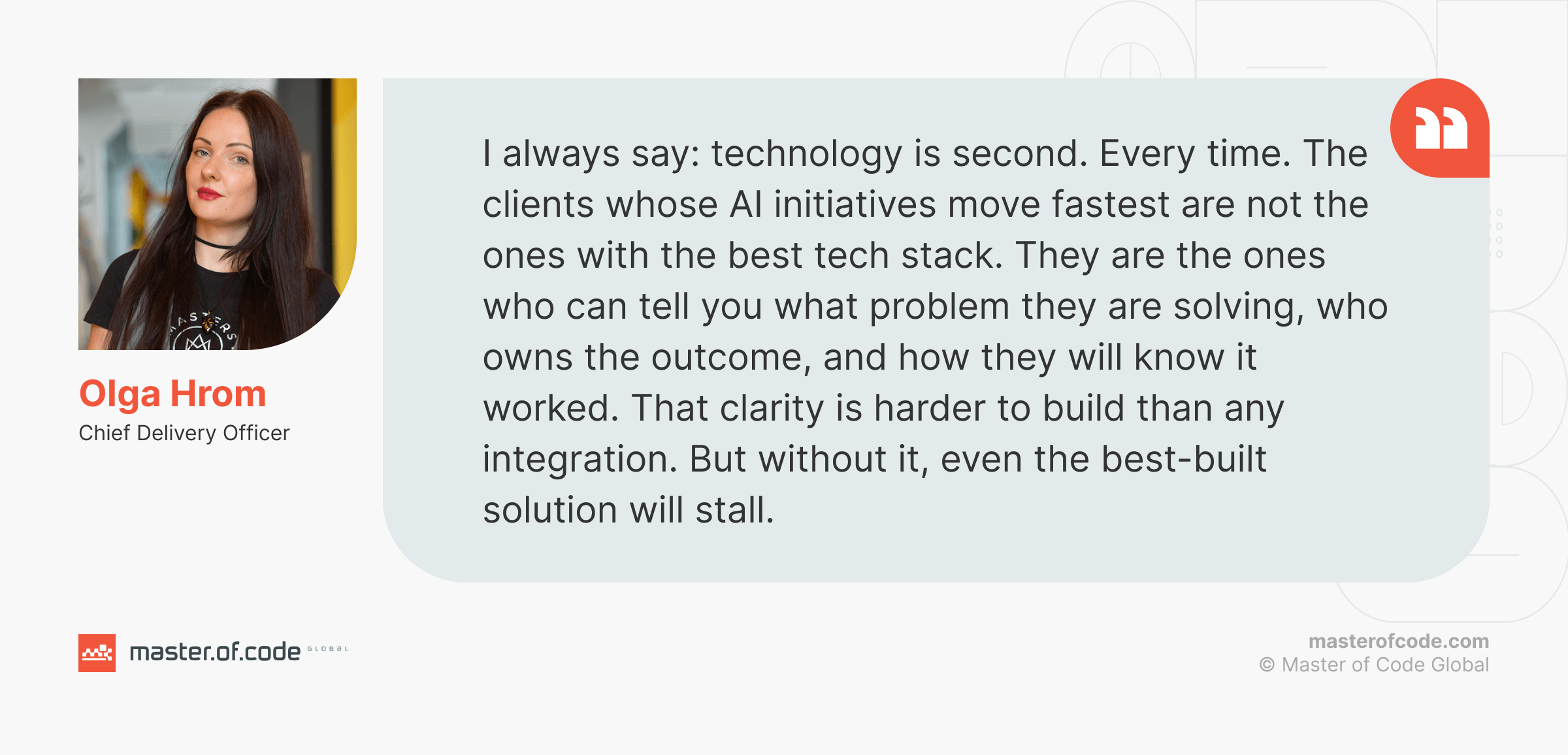
What I see consistently in pre-sales conversations is that the gap is almost never about technology.
The most common situation is significant board-level pressure with no structured internal picture to match it. Organizations know they need to move faster on intelligentization. They may have ideas, sometimes very detailed ones. But when you start asking about data availability, workflow ownership, and what measurable success looks like, the answers become uncertain quickly. The strategy exists at the level of intention, not execution.
A pattern that has become notably more common in the past year: clients arriving with AI-generated requirements documents that look thorough on paper but cannot survive contact with organizational reality. We have reviewed fully scoped pilot projects mapped out over 18 months and, after an hour of conversation with actual stakeholders, concluded the organization needed a one-month pilot on a single use case. That gap between what the document describes and what the organization is ready to execute is invisible until someone applies cross-functional judgment to it. Producing a requirements document and validating one are two different things.
The harder bottleneck to address is the measurement gap. Initiatives get approved, teams start building, and nobody defined what success looks like before the build started. There is no baseline, so when results arrive, there is nothing to measure them against. Without business alignment on what the initiative is supposed to deliver and how it will be tracked, stakeholder confidence erodes fast. Understanding what it actually takes to move from AI pilot to production reliably starts before the build, not after it.
The third pattern I find most revealing: organizations that have lost track of their own processes. When you ask how a specific workflow runs, who owns a particular decision, or what data is captured at each step, the answers are inconsistent between teams or absent entirely. You cannot automate a process you do not understand. AI does not fix that gap. It surfaces it.
How Master of Code Global Approaches AI Maturity Assessment
How We Assess Your Organization’s Maturity
Two paths, same goal: an honest picture of your AI readiness across the key dimensions.
- The free self-serve AI maturity tool is a 15-question assessment covering strategy, data readiness, team capability, and operational practice. It takes about 5-7 minutes. You receive a scored result with a plain-language explanation of your maturity level and a set of directional recommendations delivered to your email. It is the right starting point if you want an initial read before committing to a deeper conversation.
- The AI maturity audit with expert-facilitated workshop goes further. It covers 45 questions across all 7 dimensions, run by our consultants in structured sessions with your team. The output is a full maturity report: scored gap analysis per dimension, benchmark comparisons, and specific recommendations tied to your actual business context. This is the version that produces something you can take into a budget conversation or a leadership discussion and act on.
Which path makes sense depends on where you are. If you need a directional signal before any internal commitment is made, start with the self-serve assessment. If you are ready to commit resources and direction, the facilitated workshop gives you the foundation to do that without guesswork.

The 7 Dimensions We Evaluate
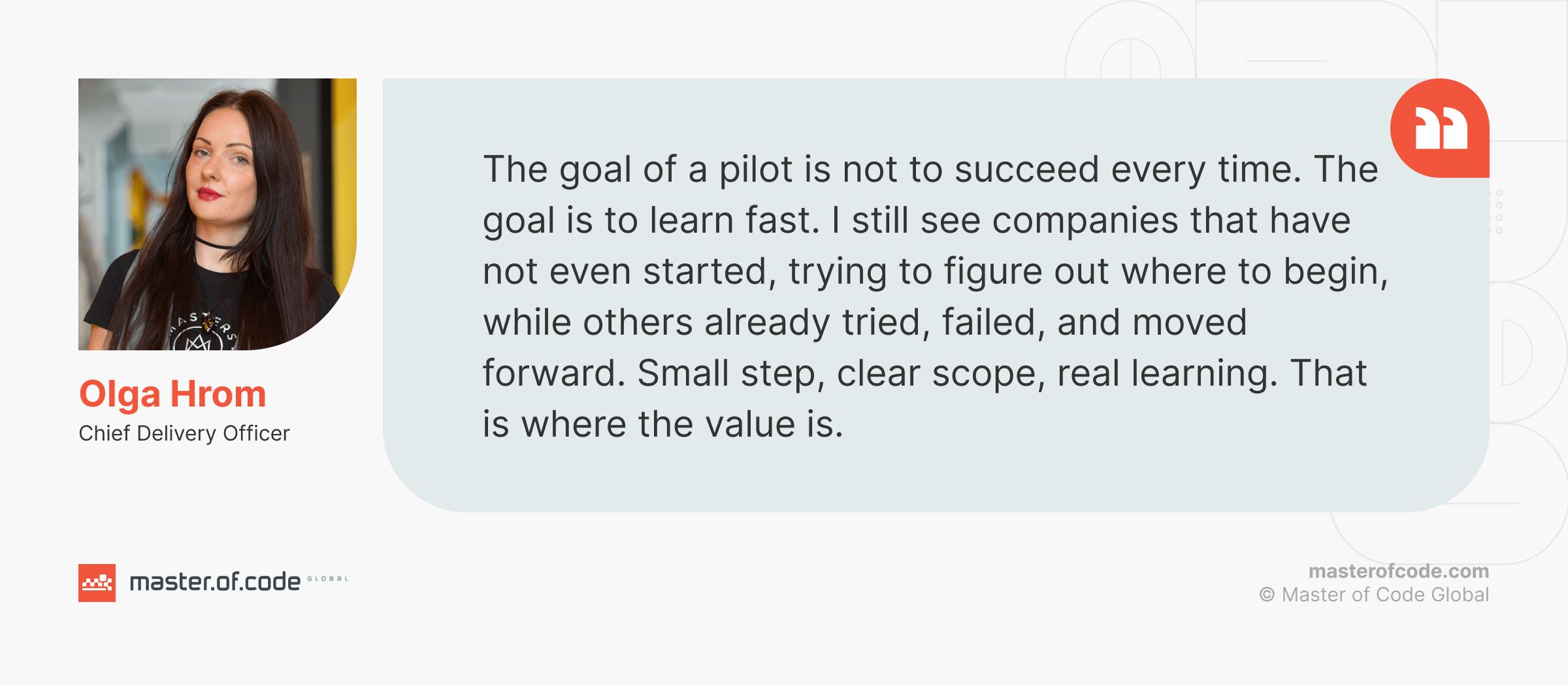
Our AI maturity model scores each dimension independently. A single composite score tells you nothing about where you are actually blocked. A dimension-by-dimension gap analysis reveals the specific combination of strengths and gaps that will determine what your organization can realistically build next.
The AI maturity framework we apply covers seven areas:
- AI Strategy & Vision: a documented roadmap with strategic alignment to business goals, leadership endorsement, named ownership, committed budget, and a defined methodology for evaluating ROI.
- Data Readiness: data centralization, quality processes, governance policies, and whether the data quality and accessibility of what your AI would rely on are production-ready.
- AI in Production: live solutions, end-to-end task completion, integration with existing systems, KPI tracking, and measurable impact on business outcomes.
- Team & Skills: dedicated roles, capability to evaluate and compare LLMs, and literacy at the leadership level, covering the human side of building AI that actually scales.
- Technology & Infrastructure: build and deploy platform, API integrations, cloud scalability, testing environments, and LLM orchestration. This is the data infrastructure foundation your workloads need to run reliably.
- Governance & Ethics: GDPR, CCPA, and HIPAA compliance where relevant, human review policies, bias assessment processes, and privacy standards built into the workflow.
- Operational Excellence: KPI review cadence, root cause analysis, flow documentation, user feedback loops, and whether your organization has a real mechanism for turning AI performance data into ongoing improvement.
What I have seen consistently is that these dimensions interact in ways that are easy to underestimate. Data infrastructure readiness determines what is buildable in production. Governance gaps become critical blockers the moment you try to scale past a single team. MLOps infrastructure, specifically the ability to deploy, monitor, and update AI reliably, determines whether an organization sustains its initiatives or rebuilds them at significant cost every 12 months. A gap analysis that treats these areas in isolation tells you what is broken. It does not tell you which gap is most likely to stop your next initiative.
The Four AI Maturity Levels
Knowing your maturity level is most useful when it tells you not just where you are but what is likely to break next if the right things are not in place.
AI Curious
The defining characteristic here is not the absence of intelligent tools but the absence of a committed question. Organizations at this stage are often responding to external pressure rather than internal conviction. The risk is moving to vendor conversations before the internal work is done, because any pilot project that follows will be built on assumptions rather than on an honest picture of what the organization actually has and needs.
AI Experimenting
At least one pilot is running, but production deployment is not yet a reality. The pattern I see most consistently is not failure but diffusion: capability spread across too many experiments simultaneously, with no genuine business alignment on which one is worth concentrating resources. Organizations stay at this stage longer than necessary, not because they lack ideas, but because they have not made a real prioritization decision.
AI Implementing
Production AI exists. The challenge shifts from building to sustaining. Governance gaps that were manageable at the pilot scale become active blockers when AI runs across multiple teams. MLOps discipline, specifically the ability to deploy updates, monitor performance, and roll back reliably, determines whether initiatives compound or require rebuilding from scratch. The organizations that scale cleanly from this stage treated the operational layer as a strategic investment.
AI-Led
Artificial intelligence is embedded and delivering measurable value. The risk at this stage is not failure but plateau: sustaining what works rather than examining where integration can go deeper. The competitive advantage here is not the number of use cases but the proprietary data loops that improve model performance over time on data no competitor has access to.
From Assessment to Action: What Comes Next
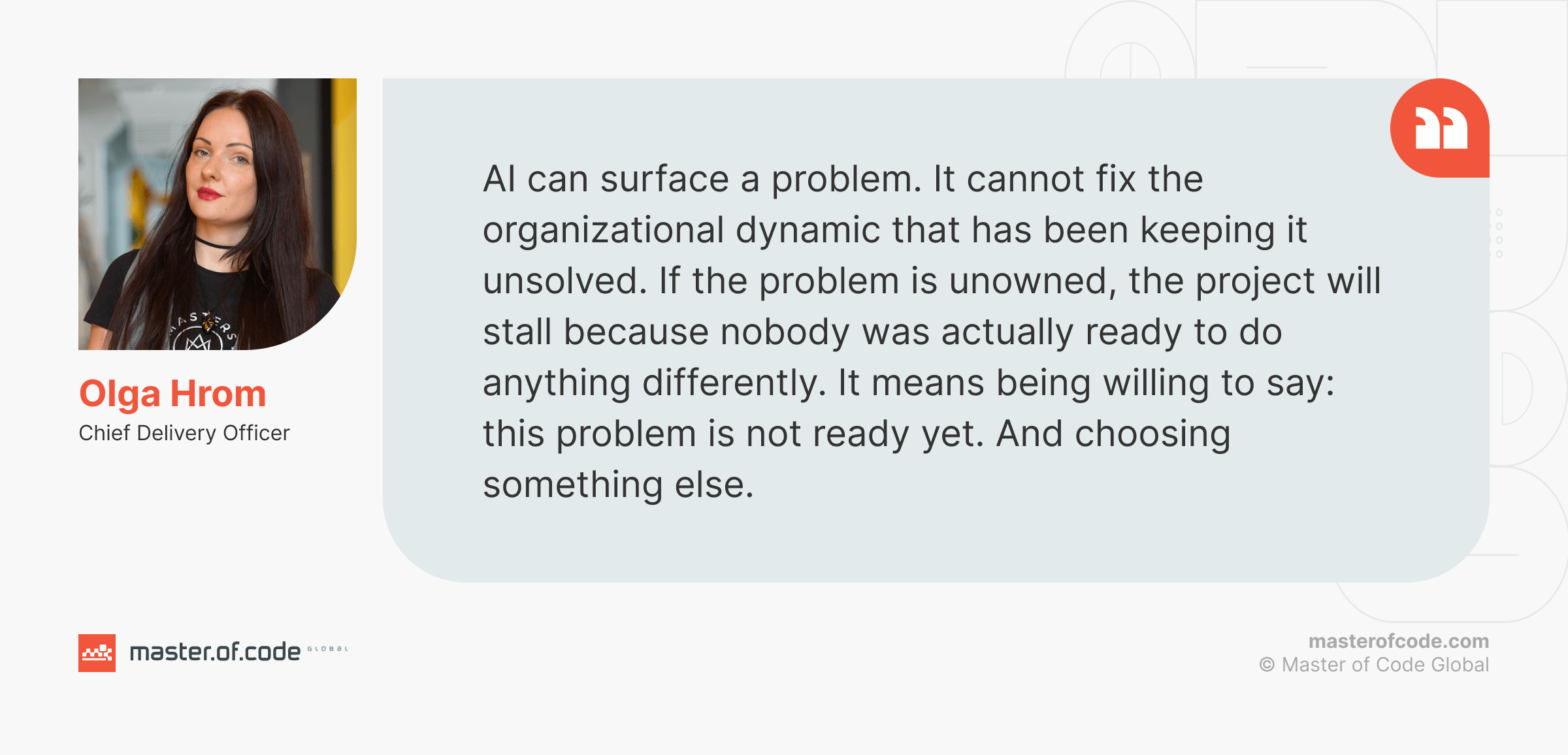
An AI maturity assessment output that ends with a score and a maturity label has not done its job. The score tells you where you are. What you actually need is a clear sequence of decisions: which gaps to close first, which use cases to prioritize, and what needs to be true organizationally before any build starts.
A well-structured path from assessment to action follows a consistent logic, regardless of who runs the assessment:
- Prioritize gaps by their impact on your next initiative, not by dimension score alone. A gap in operational excellence matters differently depending on what you are trying to build.
- Identify and score use cases by mapping processes against AI opportunity types and rating each on business impact and implementation effort, so the decision about what to build first becomes evidence-based.
- Sequence initiatives into waves based on what can start now, what needs groundwork first, and what becomes viable once earlier waves are in place.
- Define success metrics before the build starts. Two or three clear KPIs defined upfront will tell you more than ten defined after pressure to show results has already set in.
The principle that holds this together: sequence by organizational readiness, not ambition. The most impressive use case on paper is rarely the right one to start with.
This is how we work with assessment results at Master of Code Global.
We take the maturity baseline directly into our AI Compass Sprint, a four-week discovery engagement that moves from gap map through stakeholder interviews, process mapping, use case scoring, and roadmap delivery. I have seen it consistently: when we go unit by unit through an organization’s actual operations, the use case nobody had put at the top delivers the most value. It solves a real, daily problem for the people doing the work. That discovery only happens when you go deep into the processes, not when you start from a list of things leadership wants to automate.
What the Sprint delivers is decision-ready:
- A use case priority matrix with a business case per top opportunity, grounded in actual process and cost data.
- A 3-wave roadmap sequenced by impact, data readiness, and organizational capacity, with a 90-day activation plan specifying what starts in week one.
- Technology recommendations specific to your existing stack.
- KPIs and success metrics defined per initiative before any build begins.
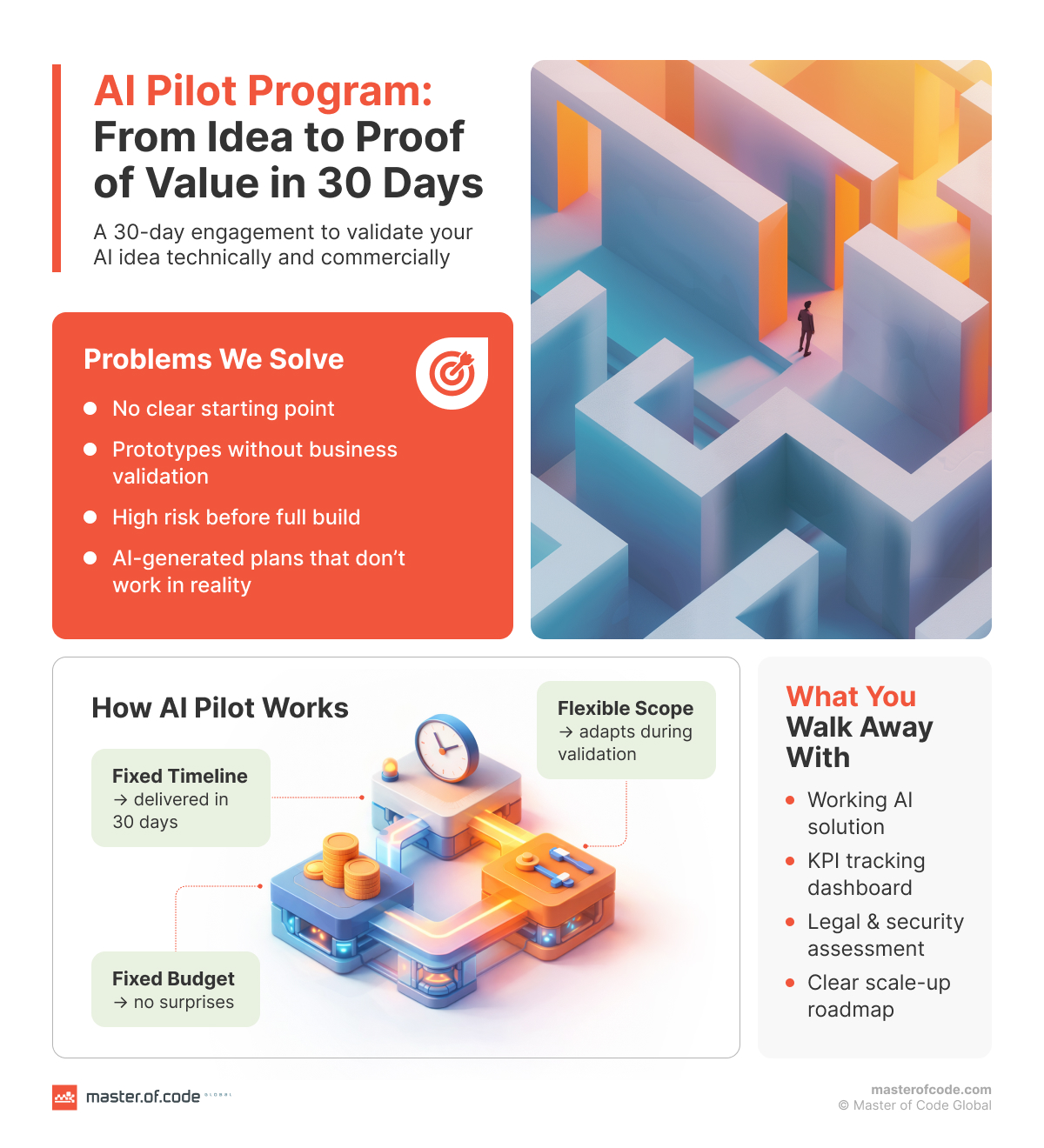
For organizations ready to move on their top-priority use case, the Sprint outcome connects directly into a 30-day AI pilot: a defined success baseline, a working solution to test with a real sample group, and a clear go/no-go decision.

Scaling AI across an organization is not primarily a technology problem. It is a sequencing and readiness problem. The assessment is where that sequence begins.
In the End…
The gap between using AI and scaling it is indeed a diagnostic problem. Most organizations have enough activity. What they are missing is a specific picture of which dimensions are holding them back and in what order to address them.
An AI maturity assessment does not tell you which vendor to choose or which tools to buy. It tells you what your organization can actually build right now, where gaps will surface if you try to scale, and which of those gaps need to be closed first. That is the foundation every other AI decision should be built on.
If your initiatives are running but not delivering the results leadership expects, or if you are about to commit budget and want to make sure you are building on solid ground, start with our free assessment for a directional read, or talk to our AI consultants about a full facilitated roadmap engagement. The problem is rarely what it looks like from the outside.