



Every utility executive knows the feeling. The interconnection queue keeps growing, storm seasons keep getting harsher, and the engineers who know every quirk of the network are edging toward retirement. Meanwhile, a new kind of customer, the hyperscale data center, wants hundreds of megawatts connected yesterday.
Boardroom priorities have shifted to match. In National Grid Partners’ 2026 Utility Innovation Survey, reliability jumped to a top-three priority for 73% of respondents, compared with 43% in 2025. Budgets are rising too. The same research, however, exposes the uncomfortable part: 84% of utilities need more than a year to scale their projects. Money is moving. Value isn’t moving at the same speed.
That gap is exactly where agentic AI in energy earns its keep. Conventional analytics tell operators what might happen. Agentic systems go further. They assess the situation, plan a response, and execute it through the tools your teams already use. Then they report back, all within the limits you set. The question for leadership is no longer whether autonomous software will touch your operations. It’s whose rules that software will follow when it does. Our energy AI consulting team helps utilities find where agents pay off first.
Table of Contents
Key Takeaways
- Reliability is the new AI mandate. The business case has moved from sustainability reporting to keeping the lights on under unprecedented load. Frame your AI investments accordingly.
- The bottleneck isn’t the model. It’s the road to production. Most energy AI value evaporates between a promising demo and the control room. Plan for scale on day one.
- Bounded autonomy beats full autonomy. In critical infrastructure, winners define precisely what an agent may do alone, what requires sign-off, and what it must never touch.
- Data sovereignty is a competitive moat. Operators who own their operational data, models, and decision logic will out-learn competitors renting generic intelligence.
- Governance readiness lags adoption. Being audit-ready will earn regulators’ trust before your rivals do.
From Dashboards to Decisions: What Agentic AI Means for the Energy Sector
What Is Agentic AI in the Energy Sector?
In practical terms, agentic AI in energy sector operations means software agents that pursue a defined goal. They don’t just answer a single question. An agent receives an objective, such as “restore service to the affected feeder” or “reduce imbalance costs this afternoon.” It then gathers context from live systems, reasons through options, takes action through connected tools, and checks whether the action worked.
The distinguishing trait is the loop. Perceive, plan, act, verify, repeat. A conventional model produces an output and stops. An agent keeps going until the job is done or it hits a boundary that requires a human.
Traditional AI vs. Generative AI vs. Agentic AI: Three Generations of Energy Intelligence
A simple analogy helps. Traditional machine learning is the thermometer: it measures, forecasts, and raises a flag. Generative AI is the analyst: it reads the manuals, summarizes the incident, and drafts the report. Agentic AI is the shift supervisor: it reads the situation, decides within its authority, dispatches the work, and briefs you afterward.
| Traditional AI | Generative AI | Agentic AI | |
|---|---|---|---|
| Core function | Predicts and classifies | Creates and summarizes content | Plans and executes multi-step tasks |
| Autonomy | None; outputs go to humans | Low; responds to prompts | Bounded; acts within guardrails |
| Typical energy task | Load forecasting, fault detection | Drafting outage reports, querying regulations | Isolating a fault, rerouting power, opening work orders |
| Integration depth | Reads data | Reads documents | Reads and writes to operational systems |
The generations don’t replace one another. They stack. Generative AI in energy and utilities has already proven its worth in document-heavy work. Those capabilities now become the “reasoning layer” inside agents. Agents also call traditional forecasting models as tools. The shift is architectural: intelligence moves from the sidelines into the workflow itself.

Where Agents Earn Their Keep: The Highest-Value Use Cases
The market is voting with capital. Fact.MR forecasts strong growth for the agentic AI market in energy and utilities. It expects the market to reach USD 36.2 billion by 2036, up from USD 4.8 billion in 2026. Grid operations will drive the largest share of demand, at 34%. Here are the agentic AI use cases in energy that are pulling that investment.
Keeping the Lights On: How Agentic AI Improves Grid Management and Reliability
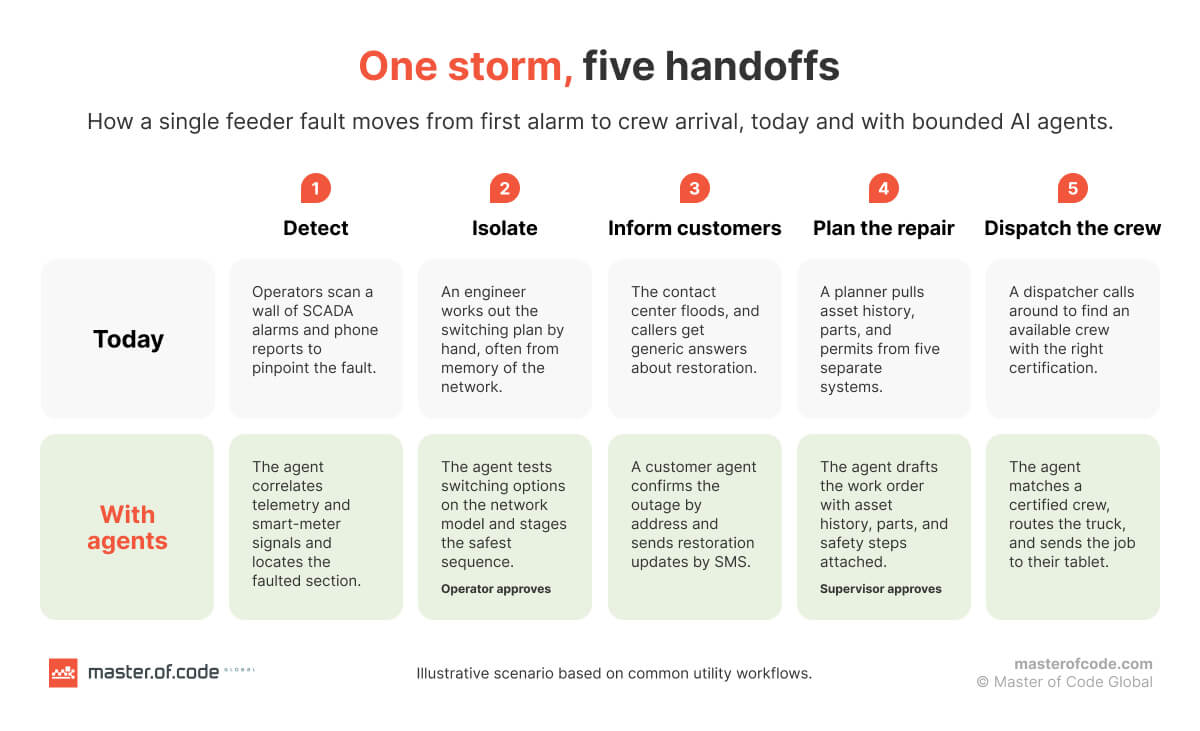
Grid operations are where autonomy pays off fastest, because every minute of an outage carries a financial and regulatory price. Agents monitor telemetry across substations and feeders and detect faults. They run switching scenarios against a network model, then propose the isolation and restoration sequence, or execute it where authorized. This self-healing pattern has long been a goal of FLISR programs. It becomes far more adaptive when an agent can reason about unusual conditions instead of following a static script.
Agents also tackle the slower, grinding work that keeps planners awake. Interconnection requests from data centers, batteries, and solar developers pile up. An agent can pre-screen applications, run preliminary hosting-capacity studies, flag missing documentation, and draft a first-pass assessment for an engineer to validate.
Fixing It Before It Breaks: Predictive Maintenance and Autonomous Asset Management
Most utilities already run models that predict when a transformer or turbine gearbox is degrading. The problem is what happens next: an alert lands in an inbox, and a human must translate it into action. Agentic systems close that loop. When a condition score crosses a threshold, the agent checks the asset’s history and weighs how critical its customers are. It then confirms parts inventory, finds a crew with the right certification, and drafts a prioritized work order.
The asset manager still approves the plan. But instead of assembling it from five systems, they review a complete recommendation with its reasoning attached. Predictive maintenance stops being a report and becomes a process.
Conducting the Orchestra: Coordinating Renewables, Demand, and Distributed Energy Resources
Rooftop solar, community batteries, EV chargers, heat pumps, and flexible industrial loads all behave differently, and each has its own owner and incentives. Coordinating them in real time is beyond manual control. Multi-agent systems assign specialized agents to each resource class. A forecasting agent anticipates renewable output, and a flexibility agent tracks what demand can shift. A dispatch agent then negotiates between them to keep the local network within limits.
The result is a distribution grid that absorbs variability instead of fighting it. Curtailment falls, peak costs flatten, and customers who enroll their devices see tangible rewards.
Milliseconds and Megawatts: Agentic AI in Energy Trading and Market Operations
Trading desks already run on algorithms, but most still depend on humans to stitch together weather updates, plant availability, and price signals. Agents can monitor all three continuously, adjust positions as forecasts change, prepare bids for day-ahead and intraday markets, and reconcile settlements afterward. The human trader defines the risk envelope, including position limits, loss thresholds, and prohibited strategies. The agent works inside it.
From Call Center to Crew Truck: Customer and Field Operations
When a storm knocks out power to 40,000 homes, the contact center floods within minutes. An outage-aware customer agent can recognize the caller’s address and confirm the outage. It then shares a restoration estimate from the live outage management system and offers proactive updates by SMS. Billing disputes, move-in and move-out requests, and payment arrangements follow the same pattern.
In the field, agents optimize crew routes and surface asset history and safety procedures on a technician’s tablet. They also capture notes by voice, so the record updates itself. The front line spends more time fixing and less time typing.

Proof in the Field: Real-World Examples of Agentic AI in Energy and Utilities
Several operators are already running agents in production workflows.
TECO (Tampa Electric). As TECO shared at DISTRIBUTECH 2026, one agentic program can serve very different teams inside a utility. The program was built with Microsoft, Neudesic, and IBM. It gives reliability staff a faster read on outage performance. It also pulls useful detail out of crew notes in outage tickets. New hires can ask plain-language questions of data that once took years of experience to navigate. Compliance teams get help collecting CIP-003 evidence and moving it through approvals. Asset managers receive maintenance recommendations based on equipment condition. Notably, TECO treated governance as a starting requirement, designing auditing and approval steps in from the beginning.
Hawaiian Electric. Speed to value can be startling when the scope is focused. According to Databricks, Hawaiian Electric cut regulatory document query times 60-fold, from five minutes to five seconds, in only two weeks.
envelio. Grid software vendors are embedding agents directly into planning tools. envelio’s new IGP Agents let users launch complex tasks in natural language. Specialized agents then draw on grid data and physics-based simulations across interconnection, planning, and operations.
A US energy leader, with Master of Code Global. Mismatches between water and oil readings were forcing operations staff into hours of manual reconciliation, with every hour adding cost and reporting risk. We built a Data Discrepancy Reconciliation Tool with an AI agent at its core. It pulls data from Snowflake on a schedule. Then it applies rules such as volume variance thresholds, geofence-based source verification, and BS&W checks. Finally, it explains each discrepancy in plain language, along with its likely root cause. Haulers get proactive alerts and clear next steps instead of spreadsheets.
The Business Case: Benefits That Show Up on the Balance Sheet
The benefits of agentic systems compound across several dimensions:
- Faster restoration and fewer outages. Minutes saved during an outage translate directly into lower customer costs, fewer penalties, and better reliability indices.
- Lower upkeep costs. Condition-based intervention replaces both “run to failure” and wasteful time-based maintenance schedules.
- Captured expertise. Agents encode the judgment of veteran engineers into repeatable workflows, softening the blow of a retiring workforce.
- Regulatory efficiency. Compliance evidence, filings, and audit responses assemble themselves from system records instead of manual hunts.
- Smarter capital allocation. With better visibility into asset health and grid constraints, investment committees fund the projects that matter most.
Just as important is what doesn’t happen. There’s no late-night escalation and no crew overtime, because the fault was isolated in seconds.
The Late-Night Worries: Challenges of Implementing Agentic AI in Energy
Enthusiasm without realism is how programs fail. These are the concerns we hear most often from energy executives, and they are legitimate.
Legacy systems and integration friction. SCADA, OMS, ADMS, GIS, and asset management platforms were built over decades, often by different vendors. None were designed to hand context to a language model. Integration is usually the largest line item in any serious program. It is also the least glamorous, and the most frequently underestimated.
Information quality. Agents are only as good as the information they reason over. Duplicated asset records, mislabeled sensor tags, and gaps in maintenance history can lead a capable agent to a confident, wrong conclusion.
Reliability in a zero-tolerance environment. A poor product recommendation costs a retailer one sale. A poor switching decision can cascade. Energy operators rightly demand deterministic safeguards around probabilistic reasoning.
Security and safety. From a cybersecurity standpoint, every agent that can write to an operational system is a new privileged identity. Without strict access scoping, credential management, and segmentation between IT and OT, an agent becomes an attack surface. Safety interlocks must remain physical and independent of any AI layer.
Shadow agents and technical debt. Enthusiastic teams will build their own agents with whatever tools are at hand. Shadow AI agent risk mitigation starts with visibility. Keep an inventory of every agent, its permissions, and its owner. Then require every new agent to register with a central orchestration layer. Without that discipline, today’s quick wins become tomorrow’s unmaintainable tangle.

Guardrails With Teeth: Governance, Compliance, and Human Oversight
Regulators are paying close attention, and energy leaders know it. Grant Thornton’s 2026 AI Impact Survey for the energy sector shows how real this is. For 54% of respondents, regulatory and compliance uncertainty is the top concern about deploying agentic AI.
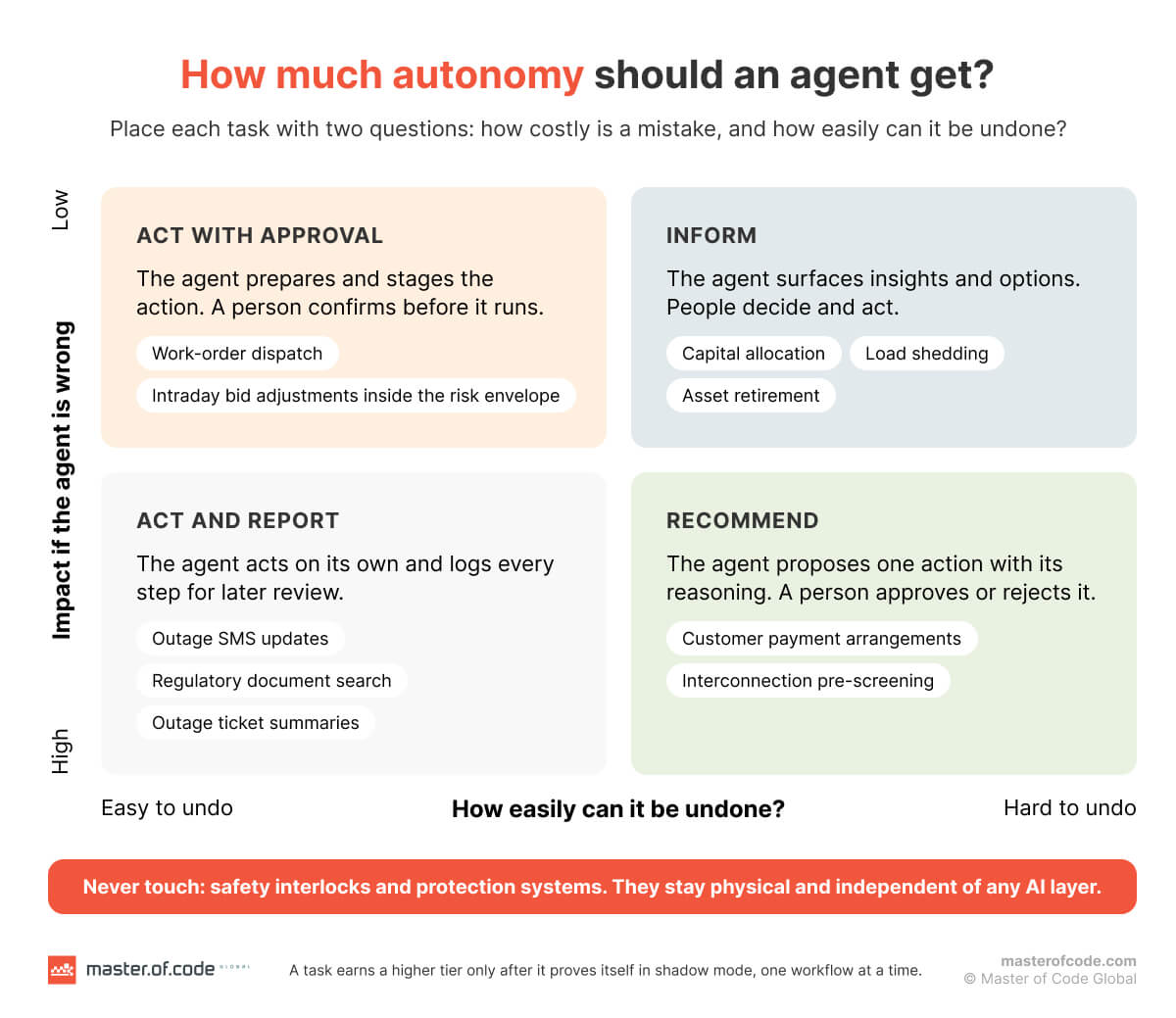
The answer is to engineer it in tiers. A practical model uses four levels:
- Inform. The agent monitors and surfaces insights. Humans decide and act.
- Recommend. The agent proposes a specific action with its reasoning. Humans approve or reject.
- Act with approval. The agent prepares and stages the action. A human confirms before execution.
- Act and report. For well-understood, low-risk tasks, the agent executes and logs its work for review.
Each workflow earns its way up the ladder through measured performance, not optimism. Every decision is logged with the data it used, the reasoning it followed, and the outcome it produced. That trail supports NERC CIP audits and EU AI Act record-keeping.
To understand how human-in-the-loop improves AI accuracy, picture an apprentice lineworker. Each time a senior colleague corrects their approach, the apprentice gets better. Operator overrides and corrections work the same way. Captured as structured feedback, they become training signal that sharpens the agent’s judgment with every shift. Oversight is the mechanism by which the system improves.
The Foundation Beneath the Agents: Data and Technology Requirements
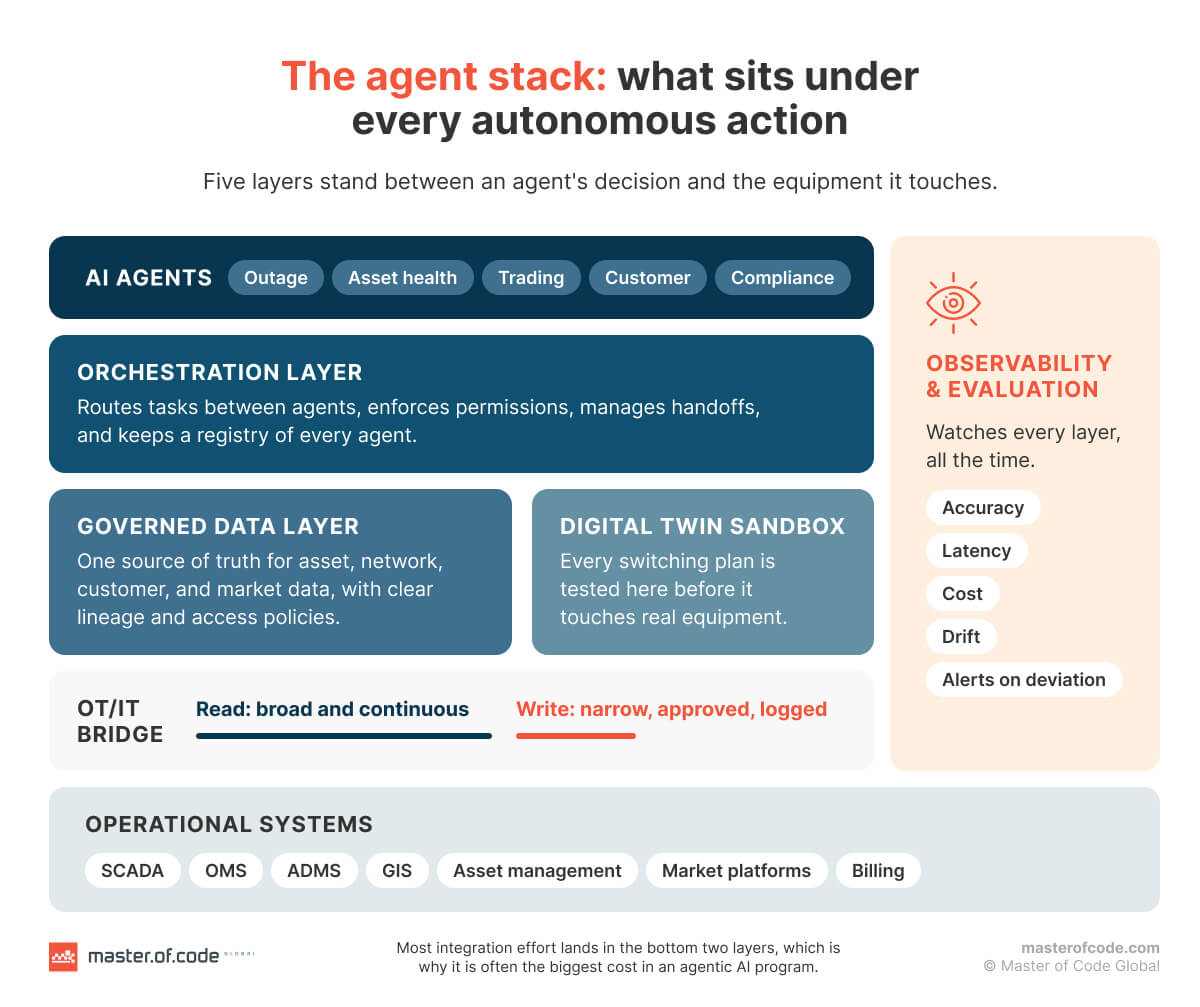
Agents sit on top of a foundation, and a weak foundation limits what they can safely do. Five layers matter most:
- A governed information layer. A unified, well-documented source of truth across asset, network, customer, and market data, with clear lineage and access policies.
- An OT/IT bridge. Secure, read-mostly interfaces to operational systems, with write access granted narrowly and deliberately.
- Digital twins and simulation. A network model where agents can test a switching plan before anyone touches real equipment.
- An orchestration layer. The “air traffic control” that routes tasks between agents, enforces permissions, and manages handoffs.
- Observability and evaluation. Continuous monitoring of agent accuracy, latency, cost, and drift, with alerts when behavior deviates from expectations.
Off-the-Shelf vs. Custom-Built: Why Generic Agents Stall at the Substation Door
Packaged AI agents make for impressive demos. Then they meet your network topology, your naming conventions, your regulator, and your twenty-year-old outage management system, and progress slows to a crawl.
| Off-the-shelf agents | Custom-built agents | |
|---|---|---|
| Domain grounding | Generic energy knowledge | Trained on your assets, procedures, and history |
| Integration depth | Standard connectors; brittle with legacy systems | Engineered for your specific stack |
| Data residency | Often vendor-hosted | Stays within your environment and control |
| Regulatory fit | One-size-fits-all compliance | Built around your jurisdiction’s rules |
| Cost at scale | Per-seat or per-call fees that rise with usage | Upfront investment, declining marginal cost |
| Strategic value | Same capability your competitors can buy | Proprietary advantage that compounds |
The deeper argument is about learning. A generic agent improves on the vendor’s roadmap. A custom agent improves on yours, absorbing your operators’ corrections and your incident history, and it gets harder to replicate every quarter. That is the essence of data sovereignty as a competitive edge.
From First Spark to Full Voltage: Where to Start and How to Scale
Where Should Energy Companies Start With Agentic AI?
Start with an honest baseline, not a technology shopping list. An AI maturity assessment reveals where your data, infrastructure, skills, and governance stand today, and which ambitions are realistic in the near term.
From there, our four-week AI Compass Sprint turns that baseline into direction. It moves through four phases. First, it establishes your readiness baseline and maps the operations where AI creates measurable value. Then it scores every opportunity by business impact and implementation effort, and builds the roadmap. You leave with a prioritized set of initiatives, a business case behind each one, and a 90-day plan to begin executing.
The best first candidates share three traits. The workflow is bounded, the data is accessible, and the value is measurable. Regulatory document search, work-order preparation, and outage communications usually qualify. Autonomous switching usually does not, at least not yet.
How Do Energy Companies Move From an Agentic AI PoC to Production?
A well-structured agentic AI PoC answers one question: will this work in our environment, against our KPIs? Our fixed-price PoC process defines success criteria before a line of code is written, which cuts potential average development cost savings by 50–70%. Our AI pilot program delivers a working proof of value in 30 days, with a fixed budget and timeline.
The journey from AI pilot to production then follows a disciplined path:
- Shadow mode. The agent runs alongside operators, making recommendations that are recorded but not acted on. Accuracy is measured against real decisions.
- Assisted operation. Operators begin accepting recommendations, and every override becomes feedback.
- Graduated autonomy. Proven, low-risk actions move up the autonomy ladder, one workflow at a time.
- Industrialization. Monitoring, retraining pipelines, security reviews, and support processes are formalized so the agent is maintained like any other critical system.
Programs stall when they skip steps, or when the team that built the prototype disappears before production. Continuity matters as much as code.
Why Master of Code Global Is the Partner for This Moment
Agentic systems in the energy sector demand a rare combination: deep AI engineering, enterprise integration discipline, and the patience to earn operator trust. That’s the combination we’ve built over 20+ years in software development and 10+ years in Conversational AI.
Our energy work speaks for itself. For a Fortune-level global energy leader, we operate as an extension of the client’s internal AI team. Together, we scale AI-powered customer support across business units on Voiceflow, Salesforce, and Vonage. One solution processes and saves incoming customer data with a 99.35% success rate. It earns a 93% customer satisfaction score and resolves 98.68% of conversations without human support or portal redirection. Our reconciliation agent for a US energy company shows the same rigor on the operations side.
What sets our agentic AI development services apart:
- Security by default. ISO 27001 certification underpins every build, which is non-negotiable when agents touch critical infrastructure.
- Zero turnover on active projects. The experts who scope your PoC are the ones who take it to production.
- Platform-agnostic judgment. As certified partners with AWS, Google Cloud, and Salesforce, we recommend what fits your environment, not what fits a reseller agreement.
- A founder’s mindset. Having built and scaled our own products, we care about adoption and ROI.
Some clients need agentic AI consulting to shape their strategy. Others need specialized energy AI consulting to identify their first high-impact workflow. Either way, you get the same team, accountability, and focus on measurable outcomes, from kickoff to steady state.
The Grid Won’t Wait
Load is climbing, assets are aging, and the tolerance for outages keeps shrinking. Agentic AI in energy gives operators a way to meet those pressures with speed and precision that manual processes can no longer match. That holds only if it rests on sound data, clear guardrails, and a partner who understands both the technology and the stakes. The leaders who start now, with bounded, well-governed agents, will be the ones setting the standard for agentic AI in energy sector operations over the next decade.
Ready to find your highest-value starting point? Book a free scoping call and let’s map where agentic AI can pay off in your operations.