



A construction manufacturer came to us with a problem many growing firms know well. Demand was rising, but skilled building information modeling (BIM) specialists were hard to hire. Producing coordinated models still took a lot of manual effort.
Their question was simple: could AI handle 70–80% of that workload?
But the answer was that simple. Technology could remove a large share of the work around data intake, validation, and preparation. But generating complete engineering models with little human input was a different challenge.
That gap between expectations and reality is shaping construction projects today.
As Olga Hrom, Chief Delivery Officer at Master of Code Global, explains:
AI today is less about automating individual tasks and more about rethinking how the business operates. Automation will still play a role, but the bigger opportunity is to redesign existing processes and ask where AI can create a meaningful change in how work gets done.
So, how is AI used in construction when the goal is real business value?
In this article, we combine market research with what we hear directly from construction and engineering companies. We also bring in lessons from our CEO and CDO on AI transformation, investment, and implementation. The focus is on real problems real businesses are trying to solve: limited specialist capacity, slow estimates, fragmented project data, rework, schedule risk, and difficult handoffs between systems.
If you are already exploring AI in your construction workflows, talk to our AI consulting team to identify the use cases with the strongest ROI potential. Now, let’s see where it delivers.
Table of Contents
Key Takeaways
- AI implementation in construction industry is progressing from isolated task automation toward broader workflow transformation, but data quality, integration, and skills still limit adoption.
- Across the project lifecycle, technology supports estimating, BIM, project controls, jobsite monitoring, procurement, equipment management, and postconstruction operations.
- Predictive analytics enables construction teams spot schedule, cost, resource, and procurement risks earlier, giving managers more time to act.
- The strongest business value comes from reducing costs, increasing specialist capacity, protecting margins, and speeding up delivery.
- Deciding whether to build, buy, or partner depends on workflow complexity, existing systems, internal expertise, and whether the capability can become strategic IP.
- For companies asking how to use AI in construction business, the best starting point is one measurable bottleneck, a clear baseline, and a focused pilot that proves value before scaling.

Why AI in Construction Is Moving From Point Automation to Workflow Transformation
Interest in intelligentization is growing faster than its adoption. RICS surveyed more than 2,200 construction professionals. 45% reported no implementation, while 34% were still running early pilots. Only a small share had moved AI into regular workflows.
Yet companies are preparing to spend more. In the AGC and Sage survey, 44% of contractors planned to increase AI investment. Document management, estimating, and project management software were among the priorities.
This tells us something important. Construction firms are interested in AI, but many still need to figure out where it fits operationally.
We saw this with an engineering company exploring pipe stress automation. Its workflow crossed SP3D, AutoPIPE, PCF files, Excel catalogs, PDFs, and structural models. Engineers had to move information between those systems and manually interpret vendor data.
At first, the goal sounded like an engineering task. In practice, the workflow was the challenge. Before AI could support stress analysis or structural design, they needed a reliable way to extract, validate, and transfer information between tools.
This is why AI transformation rarely means adding one model on top of an existing process. As Dmytro Hrytsenko, CEO of Master of Code Global, explains:
AI transformation is an iterative process of discovery and implementation. You cannot fully predict how quickly or effectively an organization will move through it. That is why we work through focused experiments, adapt as we learn, and avoid disrupting the parts of the business that already perform well.
For construction businesses, that means moving through three levels:
- Task automation: extract data from specifications, summarize RFIs, or classify documents.
- Workflow enhancement: connect those insights to estimating, BIM, scheduling, or project management systems.
- Process transformation: redesign how teams make decisions, hand work over, and use project data from bid through operations.
The last level offers the largest upside. It is also harder to reach.
RICS found that the main barriers are skills, integration, and data. 46% of respondents cited a lack of skilled personnel, 37% integration with existing systems, and 30% data quality or availability.
That is why the question is no longer simply where companies can add AI. A better question is: which construction workflow is limiting cost, capacity, or delivery today? And what would have to change to remove that constraint?
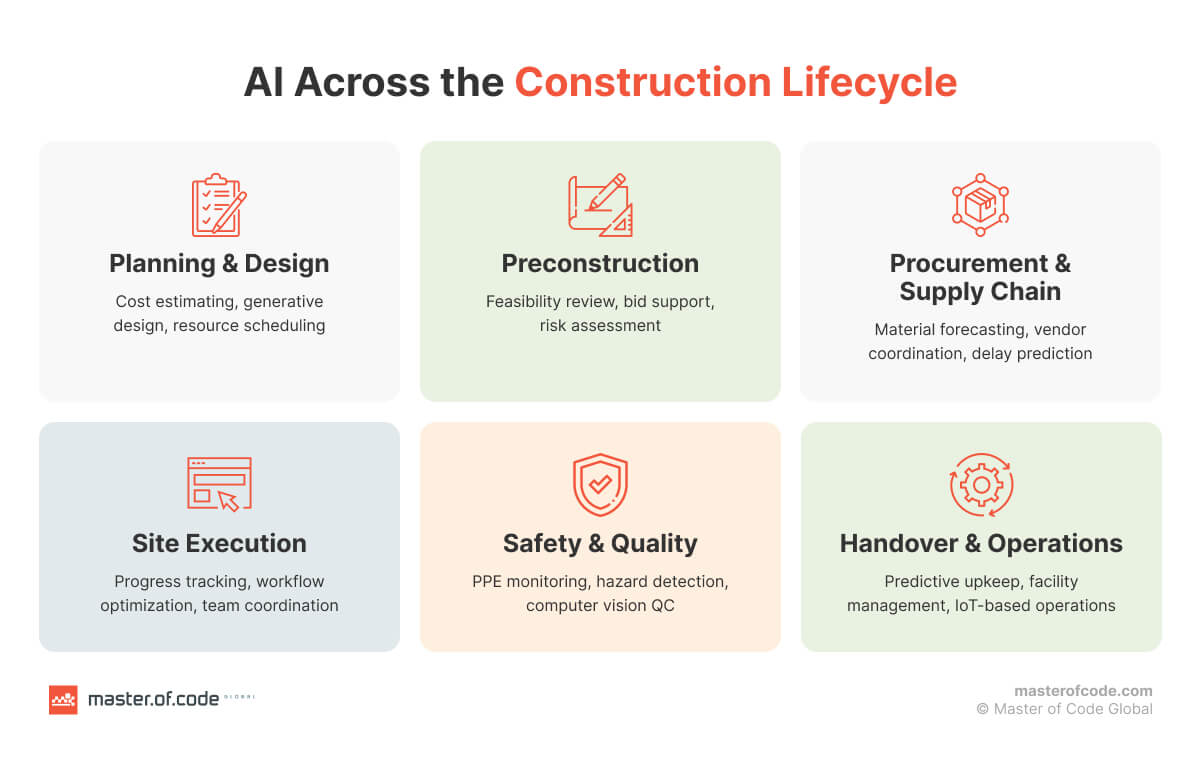
How Is AI Used in Construction Across the Project Lifecycle?
Construction projects move through estimating, design, planning, procurement, execution, and operations. Delays in one stage often create extra work in the next.
Artificial intelligence can help connect those stages. McKinsey estimates that it could automate around 39% of nonphysical work in construction. Its analysis identified more than 150 workflows across 25 AEC domains with different potential.
For business leaders, that does not mean automating 39% of the company. It means looking for work where people spend too much time finding, checking, moving, or interpreting information.
The most practical AI applications in construction currently fall across six parts of the lifecycle:
| Lifecycle stage | Where AI helps |
|---|---|
| Preconstruction | Improve takeoffs, estimates, bid analysis, and scope reviews. |
| Design and engineering | Support BIM workflows, design checks, and requirements validation. |
| Project controls | Forecast delays, cost analysis, resource allocation, and project risks. |
| Jobsite execution | Monitor progress, quality, and safety using computer vision and site data. |
| Procurement and equipment | Predict material needs, supply risks, and maintenance requirements. |
| Closeout and operations | Organize handover data and support asset performance after construction. |
Ready to turn these use cases into your AI transformation strategy for construction? Talk to our team to prioritize the right opportunities.
Preconstruction
A weak estimate can hurt the margin before work even starts. Yet estimators often work under tight deadlines. They search specifications, review drawings, compare bids, and pull costs from past projects. Much of this work is still manual.
This is where AI in construction estimating creates an early business case. It allows teams to:
- extract quantities and project requirements;
- review specifications and flag missing details;
- compare subcontractor scopes;
- connect current estimates with historical project data;
- identify unusual costs or budget risks;
- prepare data for an estimator’s final review.
The goal is to remove low-value manual work around the decision.
Machine learning can also support cost estimation when a contractor has reliable historical data. Springer systematic review found that ML methods are increasingly being tested to predict construction expenses from project characteristics and past records. The research also points to a familiar limitation: results depend heavily on the quality and relevance of the available data.
Generative AI is opening another route. Researchers from West Virginia University tested GPT-4 on cost analysis and bid pricing for a bridge rehabilitation project. The model worked with concrete, reinforcement, excavation, waterproofing, and other items.
The study found promising estimating potential, but also consistency and reliability issues. In other words, AI may accelerate analysis, but experienced estimators still need to check assumptions and outputs.
Design and Engineering
The design work is technical, coordination-heavy, and hard to scale. A single project may involve structural, mechanical, electrical, fire protection, and other disciplines. That makes building information modeling a natural place for intelligentization. Current applications include:
- checking requirements against model data;
- identifying coordination issues earlier;
- comparing design options against defined constraints;
- extracting information from technical documents;
- supporting generative design;
- preparing structured inputs for BIM workflows.
Research on AI-BIM integration shows growing use of machine learning, natural language processing (NLP), computer vision, and generative methods. These approaches can support design optimization, planning, documentation, and lifecycle analysis. But interoperability and data quality control remain major limitations.
Artificial intelligence can produce and compare design options based on constraints. It enables teams to explore alternatives faster. It does not remove the need to validate constructability, compliance, cost, or engineering assumptions.
For construction leaders, the stronger use case may therefore be less dramatic than “AI designs the building.” But it can be more useful: increase specialist throughput without lowering the bar for technical review. That is especially relevant when demand grows faster than a company can hire experienced engineers, BIM modelers, or draftspeople.
Project Controls
A late delivery affects a crew. That crew delay changes equipment needs. A design revision then pushes another activity off the critical path. Artificial intelligence connects these moving parts before the impact becomes obvious.
RICS found that construction professionals see some of the strongest near-term potential in project controls. In its survey, 36% pointed to project scheduling, 30% to optimized resource allocation, and 29% to risk management as areas where AI could have a high positive impact.
Predictive analytics combines current project data with historical patterns. Teams use it to:
- forecast activities at threat of delay;
- compare planned and actual progress;
- identify pressure on labor or equipment;
- predict how material shortages may affect the schedule;
- model cost and schedule scenarios before changing the plan;
- prioritize risks that need human attention first.
The business value is earlier intervention. A project manager who learns about a likely delay two weeks sooner has more options than one who sees it after milestones are already missed.
Springer study using data from 150 construction projects tested several machine learning models for schedule prediction. The strongest model achieved an R² of 0.93. Planned duration, workforce size, equipment utilization, and material availability were among the factors influencing the accuracy of predictive analytics.
That does not mean every contractor needs a complex forecasting model. The first question is simpler: do you have usable project data? If schedule updates live in one system, procurement status in another, and resource allocation information in spreadsheets, AI will inherit those gaps. Good predictions depend on timely inputs.
For larger portfolios, the opportunity goes further. Intelligent algorithms compare risks across projects and support decisions where people, equipment, or management attention will have the greatest impact. This turns project scheduling into a more proactive management tool.

Jobsite Execution
Site teams cannot watch every activity at once. Progress checks take time, inspections cover only part of the site, and problems stay hidden until they affect the schedule or require rework.
Computer vision gives teams another set of eyes. It analyzes images or video from fixed cameras, smartphones, and drones. The system then compares what it sees with plans, BIM data, or defined safety rules.
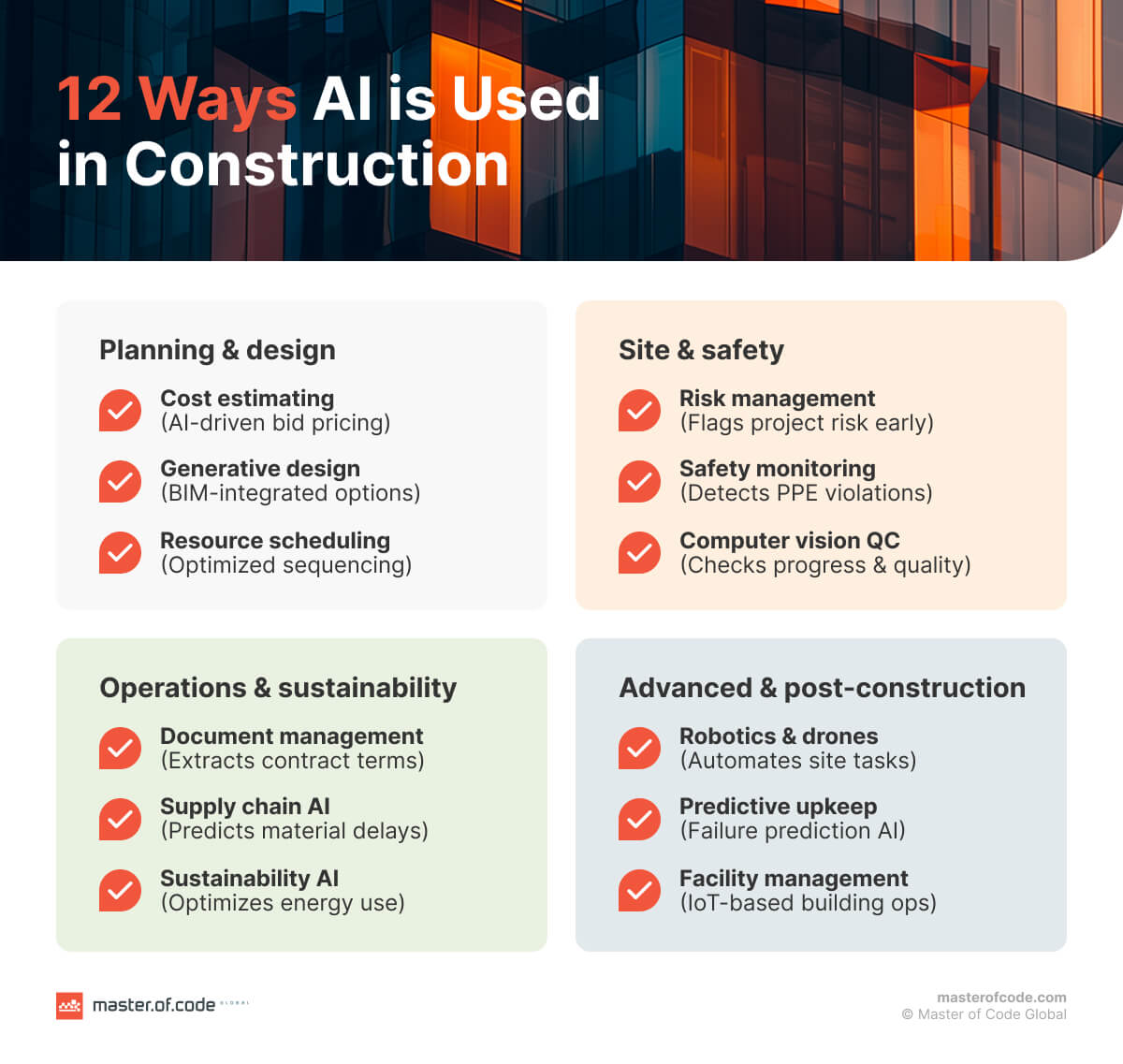
Common AI applications in construction jobsite include:
- tracking installed work against planned progress;
- spotting missing or incorrectly placed components;
- identifying visible defects and quality issues;
- checking PPE use and restricted areas;
- monitoring equipment and site activity;
- using drones to inspect large or hard-to-reach areas.
Safety adds a stronger business case. U.S. Bureau of Labor Statistics data shows that construction recorded 1,034 workplace fatalities in 2024, the highest number among private industry sectors. Falls, slips, and trips accounted for 389 of those deaths.
AI-based safety monitoring cannot prevent every incident. But it enable teams spot unsafe conditions earlier and extend oversight across larger sites.
The same technology is already supporting progress and quality control. Skanska uses drones to monitor project status, inspect hazardous or hard-to-reach areas, calculate material quantities, and check installation quality. On the Portland International Airport redevelopment, drone data helped the team monitor installation of a large prefabricated timber roof against tight tolerances.
Research is moving in the same direction. A field study combined drone imagery with machine learning to compare detected construction objects against design drawings. The system also identified locations that could require safety barriers.
For contractors, the value is less about collecting more photos. It is about turning site imagery into actionable project information. That can mean faster progress checks, earlier quality interventions, safer inspections, and less time spent building manual reports.
Our guide to machine learning in manufacturing explores how these systems work in more controlled production settings.
Procurement and Equipment
Materials arrive late. Too much stock sits unused. A critical component gets ordered only after the team realizes it is running short. These problems can turn procurement into a source of schedule risk.
With intelligent automation, teams move from reactive purchasing to demand forecasting. Models combine project schedules, past consumption, supplier lead times, inventory, and current progress to estimate what will be needed next.
Typical use cases include:
- forecasting material demand and delivery dates;
- identifying potential shortages earlier;
- comparing supplier performance and lead-time risk;
- optimizing inventory levels and order timing;
- tracking materials across sites and storage areas;
- detecting unusual equipment or maintenance patterns.
A 2026 study tested ML on procurement data from three real construction projects. The models predicted material demand, expense, and arrival time. Researchers then connected those forecasts to inventory planning. The result was lower holding costs while maintaining high material availability.
The bigger benefit is coordination. A material forecast means little if procurement sees it but the project manager does not. Recent research on 336 construction managers found that AI’s impact on supply chain performance was closely linked to better operational and information integration.
Equipment is moving in a similar direction. Artificial intelligence can analyze telematics, sensor readings, operating hours, and fault history to support predictive maintenance. Teams act before a machine failure stops planned work.
Robotics and autonomous machines go further. They can take over repetitive or high-risk activities such as hauling, grading, excavation, and material movement.
Still, autonomy is not universal. A controlled quarry and a crowded urban jobsite present very different operating conditions. Companies should judge robotics by the task, environment, safety case, and economics rather than by the technology alone.
Closeout and Operations
Facility teams inherit equipment, warranties, manuals, BIM data, inspection records, and maintenance schedules. When that information is incomplete or hard to search, valuable project knowledge gets lost just when the asset starts generating operating costs.
AI can make that handover data more useful. Combined with Internet of Things (IoT) sensors and a digital twin, it allows operators to:
- detect unusual equipment behavior;
- predict maintenance needs before failure;
- find asset information across manuals and records;
- optimize HVAC and other building systems;
- analyze occupancy and energy use;
- prioritize maintenance based on risk and condition.
Predictive maintenance is one of the clearest applications. A 2025 review found growing use of ML for fault diagnosis and optimization of building systems. The research also points to digital twins as an emerging part of this field.
The business case extends beyond maintenance. Energy becomes a long-term cost once a building enters operation. Buildings account for around 30% of global energy demand. In 2024 alone, electricity use in buildings increased by more than 600 TWh, or 5%.
Intelligentization can help building operators respond to that cost. Models analyze sensor data, weather, occupancy, and system performance. They then identify inefficient settings or predict how operational changes may affect consumption.
Digital twins connect many of these capabilities. Instead of leaving the BIM model as a record of what was built, teams can connect it with live operational data. Research on facility management shows that this approach supports real-time monitoring, intelligent analysis, and better asset decisions.
For owners and contractors, this changes the value of closeout. The handover package becomes more than documentation. It can become the starting point for lower operating costs, better supply chain management, and stronger asset performance.
Where AI Creates Business Value in Construction: Cost, Capacity, or Revenue
The benefits of AI in construction become clearer when you stop measuring them in “tasks automated.” Business leaders care about margin, capacity, and delivery.
Olga Hrom uses a simple test when evaluating opportunities:
When we look at AI transformation, we always come back to business value. In practice, that usually means one of two things: reducing the cost of an existing process or creating new revenue opportunities. Cost optimization is often easier to prove first, but the bigger question is how AI can reshape the process itself and create more value over time.
For construction companies, we would add a third lens: capacity. Skilled people are difficult to scale, yet project demand does not wait for hiring.
The problem is widespread. In the AGC and NCCER workforce survey, 92% of construction firms said they were having difficulty filling open positions. Another 45% reported that labor shortages were causing project delays.

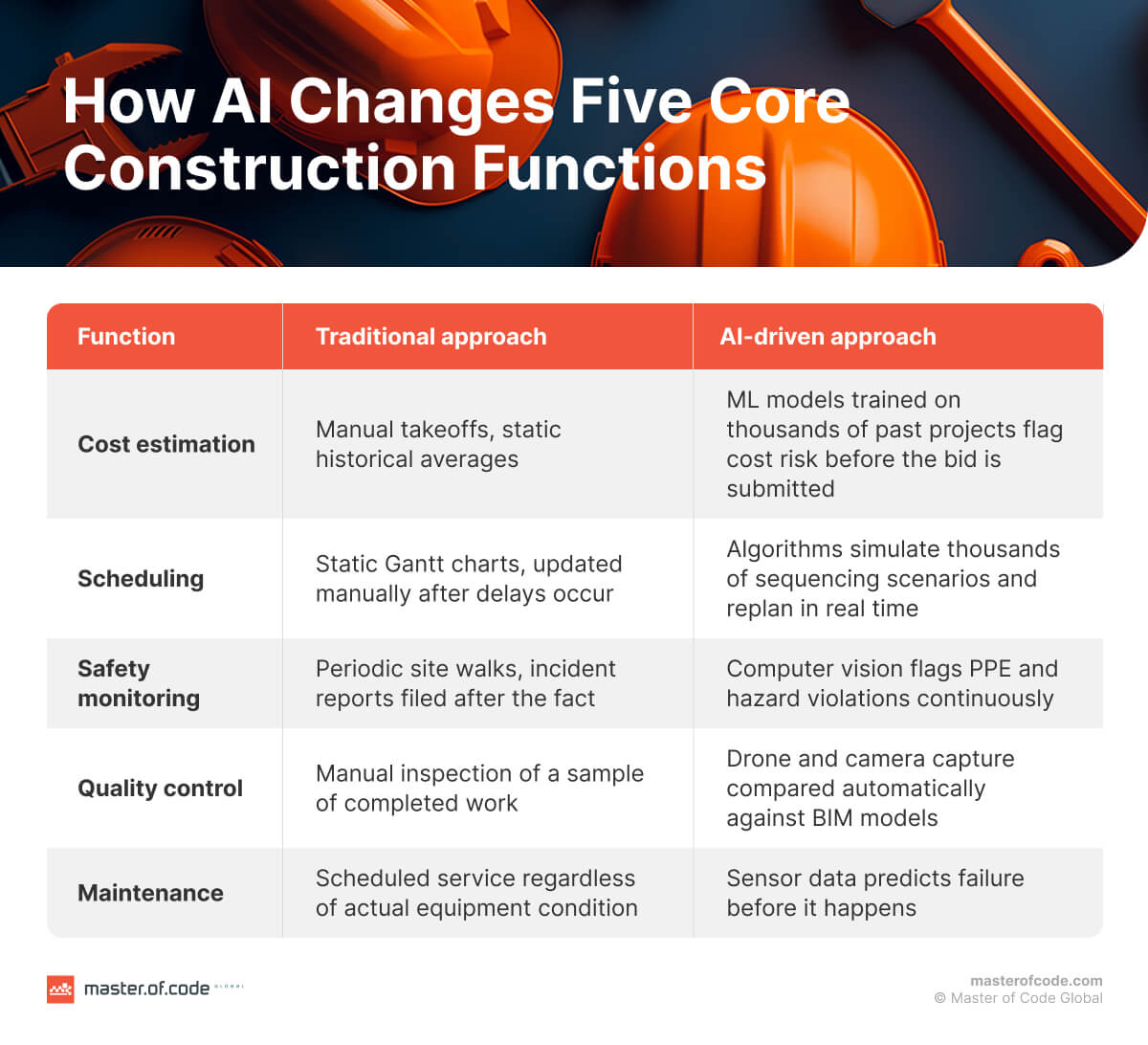
Artificial intelligence can create value in several ways:
- Reduce costs: automate document review, data entry, reporting, and repetitive analysis.
- Increase capacity: let estimators, engineers, and BIM specialists handle more work without adding the same amount of manual effort.
- Protect margins: identify schedule, cost, quality, and procurement risks before they become expensive problems.
- Accelerate revenue: shorten bidding, design, and project delivery cycles so companies can take on work sooner.
- Preserve expertise: make lessons from previous projects easier for less experienced teams to access.
Our modular construction lead is a good example of the capacity case.
The company was not looking to replace its BIM team. Demand was growing faster than it could find qualified specialists. Leadership wanted AI to handle much of the repetitive work so existing experts could review and finalize more projects.
A contractor that saves ten minutes on a report has automated a task. A contractor that removes a bottleneck preventing it from taking on another project has changed the economics of the business.
So before calculating AI ROI, define which constraint you are buying your way out of. It may be labor capacity, slow delivery, cost leakage, or project risk. The technology comes after that decision.
Have a costly bottleneck in mind? Get in touch with our expert to address it.
Build, Buy, or Partner? Choose the Delivery Model Before the AI Model
Once a use case looks viable, another question comes up fast: should you buy a tool, build the capability internally, or bring in an external partner?
There is no universal answer. The choice depends on how unique the workflow is, how much integration it needs, and whether the capability could become strategic IP.
For common problems, buying often makes sense. Document search, meeting summaries, standard reporting, and other repeatable tasks already have mature tools. Building them from scratch may add cost without creating much advantage.
Custom development becomes more relevant when the workflow is specific to your business. This often happens when an algorithm has to work across proprietary data, specialist engineering logic, or several legacy systems.
A simple decision rule helps:
- Buy when the workflow is standard and speed matters most.
- Build when the capability is unique enough to create long-term advantage.
- Partner when the use case is strategic, but internal teams lack AI expertise or delivery capacity.
- Combine approaches when an existing platform solves part of the problem but leaves important gaps.
At Master of Code Global, we do not start by pushing one of these paths. Our AI consulting approach is platform-agnostic and business-first.
We first look at the business case, data, systems, risks, and ownership. Then we decide what should be configured, integrated, built, or left alone. Our team has worked across 15+ Conversational AI platforms, which gives us a practical view of where packaged technology helps and where it starts creating limitations.
Dmytro Gritsenko describes the approach this way:
We need to understand how the AI strategy can work for the organization. Based on the outcome of that discovery, we can move into the first phase or the first use case. But it should not be treated as something isolated. It needs to fit into the broader strategy for the company.
That is also why we combine strategy and engineering in one team. The same people who help define the business case stay close to architecture, integrations, testing, and delivery. This reduces the risk of building something that looks good in discovery but becomes impractical in production.
We also treat “do not build yet” as a valid recommendation. If the data is not ready, the ROI is weak, or an existing product already solves the problem well, the better decision may be to narrow the scope or fix the foundation first.
If your construction use case sits between packaged software and a fully custom product, our enterprise AI development services can help define what is worth building and how it should fit into your existing stack.
How to Start Implementing AI in Construction: Redesign the Bottleneck, Not the Whole Business
Construction companies do not need an enterprise-wide AI program to get started. They need a problem worth solving. That may be an estimating team buried in specifications. Or engineers losing hours to manual data transfer. It could be project managers reacting to delays too late.

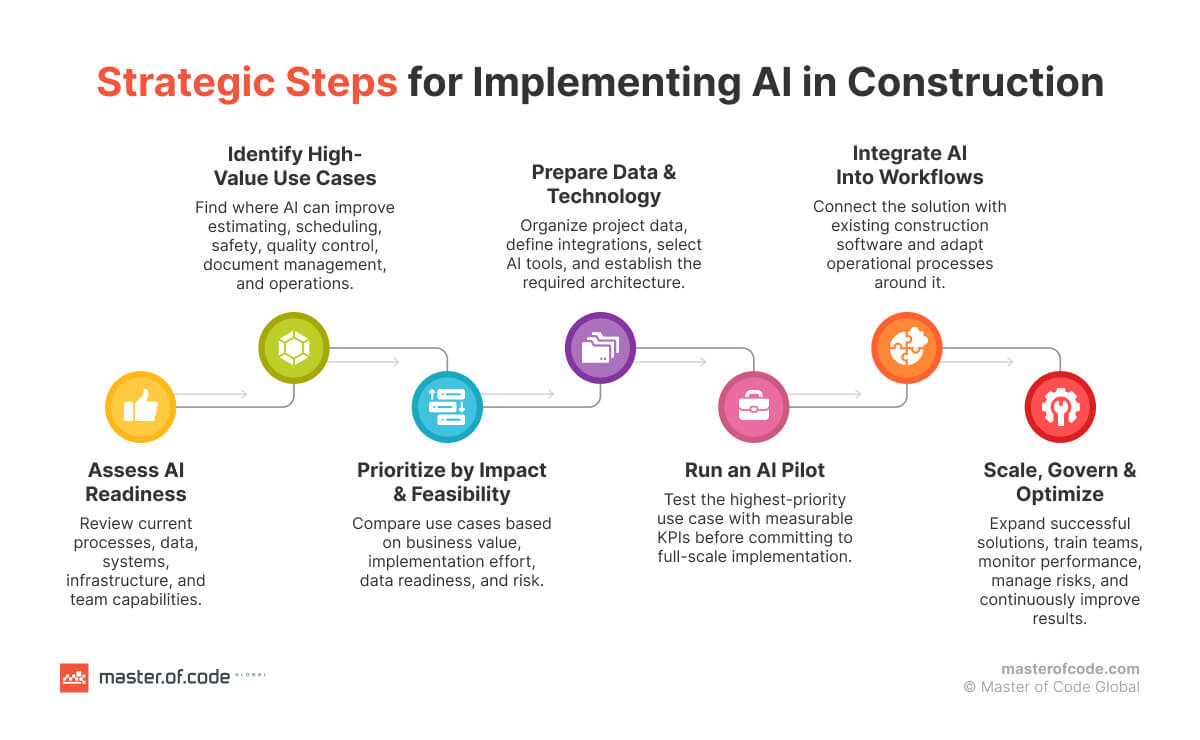
The strongest starting point is usually a measurable operational bottleneck. Here is how we approach that decision.
1. Find where the business is losing time or money
Ask where projects regularly slow down. Look at rework, missed requirements, repetitive document handling, idle equipment, long estimating cycles, or specialist teams that cannot keep up with demand.
Then establish a baseline you can measure. How many hours does the process take today? How often does rework happen? What does a delay cost? Without that baseline, proving ROI later becomes guesswork.
2. Map how the work really happens
Talk to the people doing the work. Find the spreadsheets they created themselves. Check which PDFs arrive from vendors. Understand where information gets copied between systems.
The valuable AI opportunity often appears in manual handoffs between tools, not in the most obvious part of the workflow.
3. Check the data before choosing the model
AI needs access to enough reliable context to do the job. That means checking:
- where the required information lives;
- whether it is structured or buried in documents;
- how consistent historical records are;
- which systems need to exchange data;
- what information can legally and securely reach the AI system.
If the foundation is weak, fix that before building a sophisticated solution.
4. Test the biggest uncertainty first
Do not try to prove everything at once.
A focused AI pilot can answer a narrower question. Can the system interpret your actual documents? Can it reach the required accuracy? Does it reduce enough manual work to justify further investment?
At Master of Code Global, our pilots start with agreed success criteria. We assess the business case, technical feasibility, security, legal exposure, and integration needs before deciding whether the solution is ready to move forward.
5. Keep specialists inside the workflow
Define which outputs technology can handle alone and which need review. An estimator may approve a pricing assumption. An engineer may validate technical data. A project manager may decide how to respond to a forecasted delay.
The aim is useful human oversight, not approval added as an afterthought.
6. Scale the outcome, not the demo
A successful pilot is evidence, not the finish line. Before expanding it, measure what changed. Did cycle time fall? Did specialists gain capacity? Were errors reduced? Did users actually adopt the workflow?
Only then decide whether to extend the solution across more teams, projects, or locations. For most companies, this is a safer route than trying to “implement AI” everywhere. Solve one expensive constraint, prove the economics, and use what you learn to choose the next one.
AI in Construction Works Best When It Solves a Constraint
Artificial intelligence is already useful across estimating, BIM, project scheduling, safety monitoring, procurement, and asset operations. But the strongest business case is rarely “we need AI.” It is usually more specific: we cannot scale this workflow with the people, systems, or time we have today.
The right path is to identify one costly constraint, test it against real project data, and measure the result. If the economics hold, expand from there.
And once a pilot becomes part of everyday delivery, the work changes again. Teams need clear testing, approval gates, monitoring, and ownership. Our AI SDLC approach helps companies build those controls into the way AI-enabled products are developed and maintained.
If you are deciding where AI could create measurable value in your construction operations, talk to our consultants. They will help you assess the workflow, validate the opportunity, and determine what is worth building before you commit to a larger investment.
FAQs
How is AI used across the construction lifecycle?
It supports estimating, design, scheduling, safety, progress tracking, procurement, and facility operations. Its main role is to reduce manual work and improve decisions with better project data. Technology is most useful where teams already have repeatable workflows and enough reliable information to support them.
What are the biggest benefits of AI in construction?
The main gains are lower costs, higher capacity, and enhanced risk management. Artificial intelligence speeds up routine work, improve forecasting, and shifts the focus to higher-value decisions. It also allows companies to take on more work without increasing manual effort at the same rate.
How is AI used for construction document and contract management?
Artificial intelligence can search, classify, summarize, and extract information from contracts, RFIs, specifications, submittals, and vendor documents. This reduces time spent reviewing large document sets. It’s also capable of surfacing missing requirements or conflicting information earlier.
Can AI in construction improve safety?
Yes. Computer vision and predictive analytics flags unsafe conditions, PPE issues, restricted-zone access, and higher-risk activities. Human safety teams still make the final call. The value is in spotting potential problems sooner and focusing attention where it is needed most.
How should a construction company start implementing AI?
Start with one expensive bottleneck. Measure the baseline, check the data, test the use case with a focused pilot, and scale only if it delivers clear business value. The first project should answer a specific business question, not try to prove technology works everywhere.
What are the biggest challenges of implementing AI in construction?
The main barriers are poor data quality, system integration, and unclear ownership. AI is harder to scale when project information is fragmented across tools and formats. Weak processes around review, accountability, and system access can slow adoption as much as the technology itself.